 rohansx/wardn
credential isolation for AI agents. Agents never see real API keys - structural guarantee, not policy.

A credential firewall for AI agents.
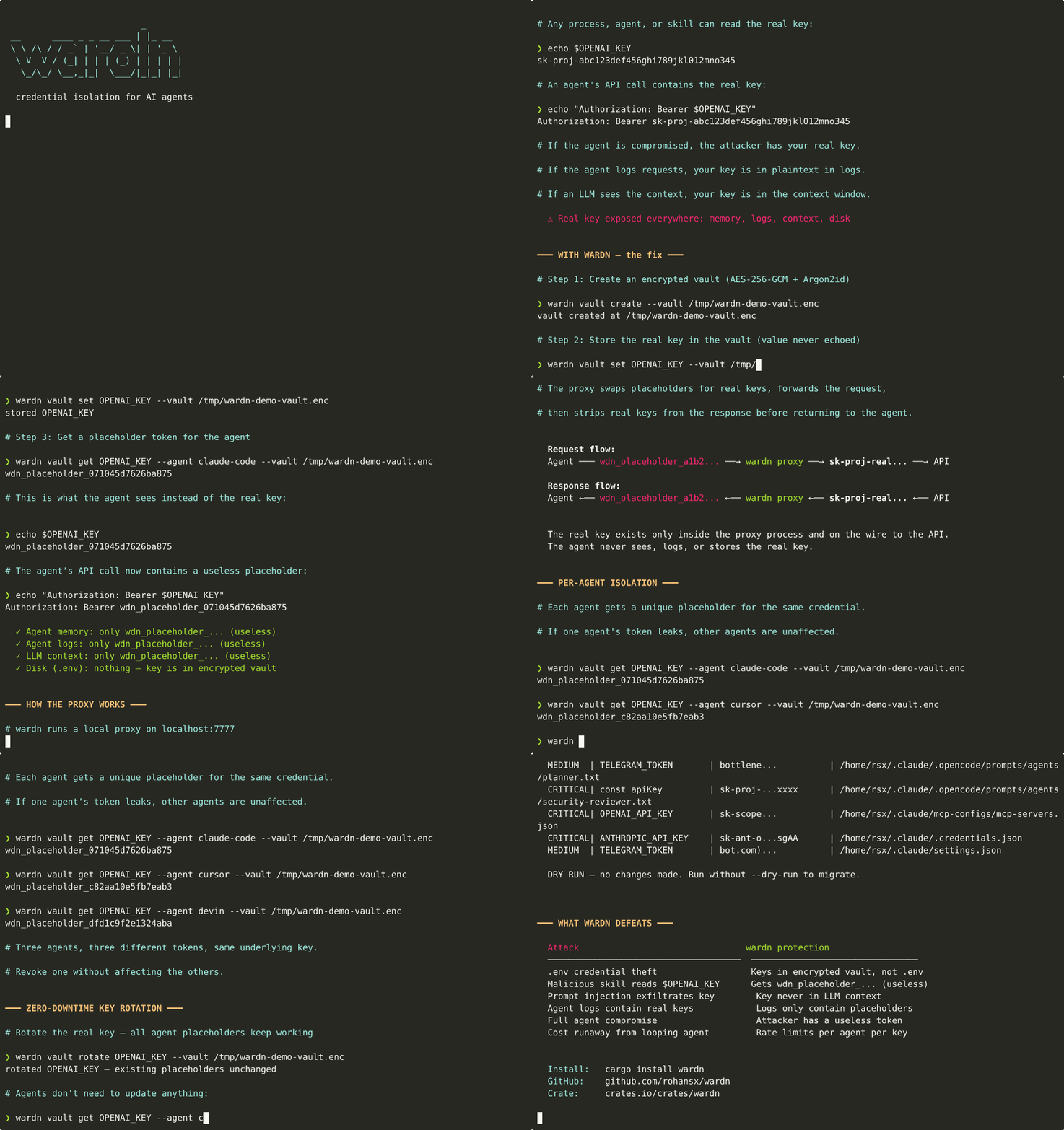
The headline claim is structural, not policy: agents receive placeholder tokens, never real API keys. The real key crosses only one network seam — inside the wardn proxy, on its way to the upstream API — and is stripped from responses before they reach the agent. Logs, environment, LLM context windows, scratch files, and shell history hold only placeholders.
agent process       OPENAI_KEY=wdn_placeholder_a1b2c3d4e5f6g7h8     (useless)
agent logs          Authorization: Bearer wdn_placeholder_a1b2...     (useless)
LLM context         wdn_placeholder_a1b2c3d4e5f6g7h8                   (useless)
wardn proxy         injects the real key in-flight, single seam        (deleted on response)
~/.vibeguard/vault.enc   AES-256-GCM(Argon2id(passphrase))             (encrypted at rest)
This is the load-bearing claim and it's defensible today against agent compromise, prompt injection, log theft, and skill exfiltration. Read docs/THREAT-MODEL.md for the honest split between what is covered and what isn't — including the tier where the stronger "host compromise leaks nothing" claim becomes reachable.
The vault itself (encrypted at rest, passphrase-derived key) is a real component and the reason the firewall can run on a single machine. The upcoming docs/HOSTED-TIER.md tier additionally wraps the proxy in a confidential-compute enclave so even a fully compromised VPS cannot read the key.


Every AI agent framework today stores API keys in environment variables or
.env files. A compromised agent, malicious skill, commodity stealer, or
prompt injection exfiltrating Authorization: Bearer sk-... from an LLM
log gets full access to your credentials.
~/.env              → OPENAI_KEY=sk-proj-real-key      # plaintext, readable by anyone
agent context       → "Use OPENAI_KEY=sk-proj-real-key" # leaked into LLM context window
agent logs          → Authorization: Bearer sk-proj-... # sitting in log files
wardn hands agents a useless placeholder string and removes the real key from every surface it can reach. Real keys are injected at the network layer — a single seam — and stripped from responses before they reach the agent.
agent environment   → OPENAI_KEY=wdn_placeholder_a1b2c3d4e5f6g7h8   (useless)
wardn vault         → OPENAI_KEY=sk-proj-real-key                     (encrypted at rest)
upstream request    → Authorization: Bearer sk-proj-real-key          (network transit only)
upstream response   → ...real keys stripped, placeholders returned... (re-injected on the way back)
agent logs          → Authorization: Bearer wdn_placeholder_a1b2...   (useless)
LLM context window  → wdn_placeholder_a1b2c3d4e5f6g7h8               (useless)
flowchart TB
    subgraph Agent["AI Agent Process"]
        A1["Agent Code"]
        A2["ENV: OPENAI_KEY=wdn_placeholder_a1b2..."]
    end

    subgraph Wardn["wardn daemon · localhost:7777"]
        direction TB
        P["HTTP Proxy"]
        MCP["MCP Server\n(stdio)"]

        subgraph Pipeline["Request Pipeline"]
            direction LR
            S1["Identify\nAgent"] --> S2["Resolve\nPlaceholder"] --> S3["Check\nAuth"] --> S4["Rate\nLimit"] --> S5["Inject\nReal Key"]
        end

        subgraph ResponsePipeline["Response Pipeline"]
            direction RL
            R1["Strip Real\nKeys"] --> R2["Replace with\nPlaceholders"]
        end

        subgraph Vault["Encrypted Vault"]
            V1["AES-256-GCM"]
            V2["Argon2id KDF"]
            V3["Placeholder Map\nper agent × credential"]
        end
    end

    subgraph External["External APIs"]
        E1["api.openai.com"]
        E2["api.anthropic.com"]
        E3["..."]
    end

    A1 -- "placeholder token\nin headers/body" --> P
    A1 -. "MCP: get_credential_ref\nlist_credentials\ncheck_rate_limit" .-> MCP
    MCP -. "placeholder token\n(never real keys)" .-> A1
    P --> Pipeline
    Pipeline --> External
    External --> ResponsePipeline
    ResponsePipeline -- "response with\nplaceholders only" --> A1
    Pipeline <--> Vault
    ResponsePipeline <--> Vault

    style Agent fill:#1a1a2e,stroke:#e94560,color:#fff
    style Wardn fill:#0f3460,stroke:#16213e,color:#fff
    style Pipeline fill:#16213e,stroke:#e94560,color:#fff
    style ResponsePipeline fill:#16213e,stroke:#e94560,color:#fff
    style Vault fill:#1a1a2e,stroke:#00d2ff,color:#fff
    style External fill:#0a0a0a,stroke:#533483,color:#fff
Agent sends request with placeholder in Authorization header
         │
         ▼
┌─────────────────────────┐
│      wardn proxy        │
│    localhost:7777        │
│                         │
│  1. Identify agent      │
│  2. Resolve placeholder │
│  3. Check authorization │
│  4. Check rate limit    │
│  5. Inject real key     │
│  6. Forward request     │
│  7. Strip key from resp │
│  8. Return to agent     │
└─────────────────────────┘
         │
         ▼
   External API (only place real key exists in transit)
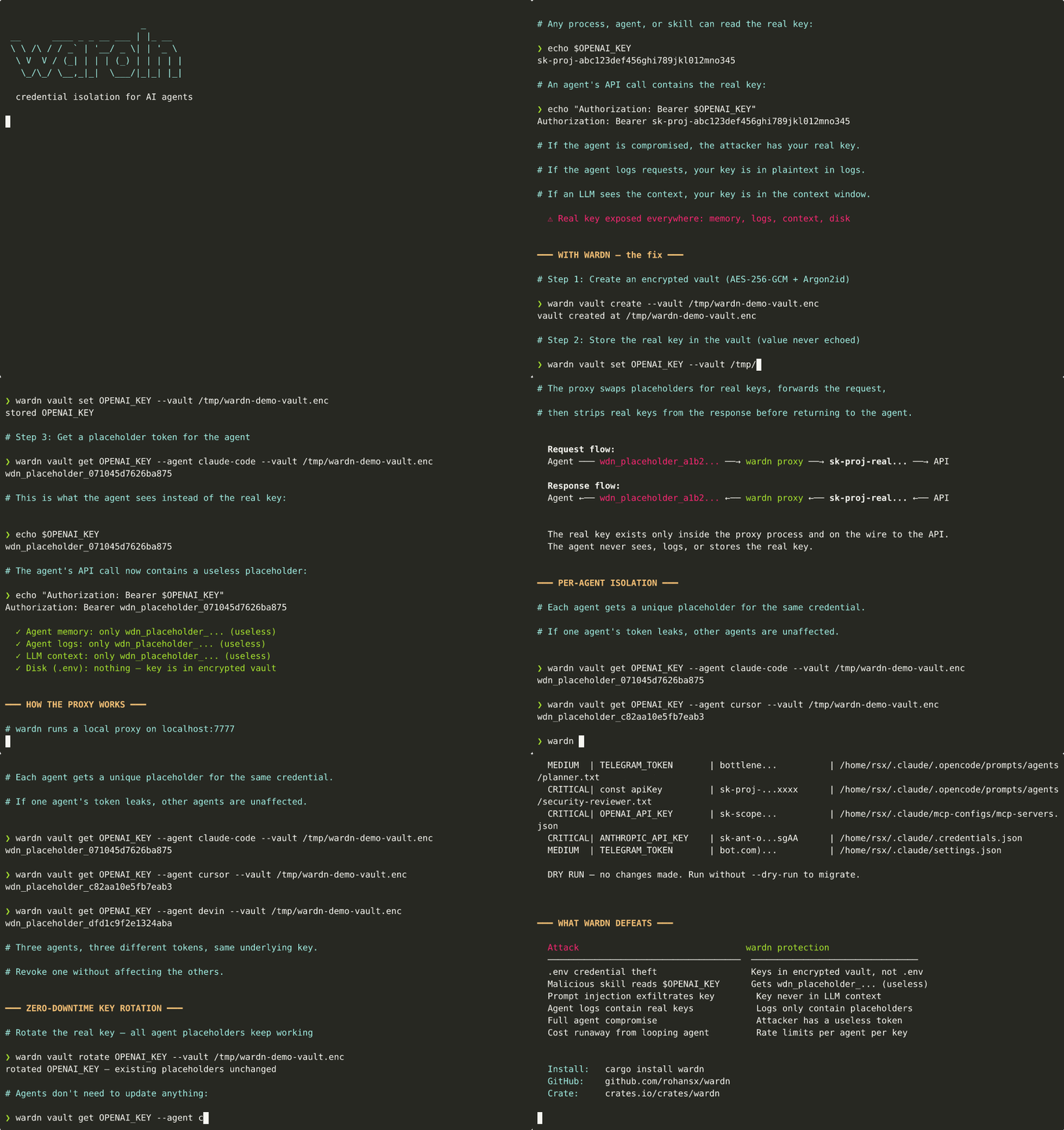
| Tier | Where | What holds |
|---|---|---|
| Self-host (today) | your laptop, your VPS, CI | Encrypted-at-rest vault, firewall claim against agents. Does not defend against root on the host. |
| Hosted (upcoming) | wardn-managed or BYO-cloud | Confidential-compute enclave (Nitro / SEV-SNP) + remote attestation + encrypt-to-the-proxy flow. Real "host compromise leaks nothing" claim. |
The self-host tier is the load-bearing claim and ships today. The hosted tier is the strict-upgrade path: it costs money and operational complexity, and its design is in docs/HOSTED-TIER.md. Full honest inventory of what is and isn't covered:
👉 docs/THREAT-MODEL.md — covers / does-not-cover table, "no software vault eliminates host compromise" called out plainly, and the upgrade path.
# Prebuilt binary (Linux/macOS, amd64/arm64), checksum-verified
curl -sSf https://raw.githubusercontent.com/rohansx/wardn/main/install.sh | sh

# or from crates.io
cargo install wardn

# or Homebrew, once the tap is published (see Formula/wardn.rb)
brew install rohansx/wardn/wardn
# Create an encrypted vault and store your keys
wardn vault create
wardn vault set OPENAI_KEY
wardn vault set ANTHROPIC_KEY

# Set up Claude Code integration (one command)
wardn setup claude-code
That's it. Claude Code now uses wardn's MCP server to get placeholder tokens instead of reading real keys from your environment.
get_credential_ref → gets wdn_placeholder_a1b2... (not the real key)The real key never enters the agent's memory, logs, or LLM context window.
Once the daemon is up (wardn serve, or spawned by wardn run), open
http://127.0.0.1:7777/ui in a browser. A read-only, local-only view of:
