
Skip to content
KitploitKITPLOIT
ToolsBlog
Submit
ToolsBlog
Submit

Hacking, PenTest, and Cybersecurity Tools for Your Security Arsenal!

Kitploit is a directory of hacking, cybersecurity, and pentesting tools. Discover the latest project updates to find vulnerabilities, analyze systems, automate testing, and strengthen your security.

··Feeds·Contact·Privacy·© 2026 Kitploit

Tool Directory

Categories

View all categories
Loading categories
pythia-sql-clairvoyance — Advanced SQL Injection Scanner with AI-powered analysis, ethical compliance framework, and professional reporting. | Kitploit
Tools/GitHubGitHub/rodhnin/pythia-sql-clairvoyance
Vulnerability ScannersWeb Application ExploitationWAF BypassPenetration TestingDevSecOpsLearning & EducationCrawlerAI Security
GitHubrodhnin/pythia-sql-clairvoyance

pythia-sql-clairvoyance

Advanced SQL Injection Scanner with AI-powered analysis, ethical compliance framework, and professional reporting.

View Repository
23 months agoNot yet reviewed

Most Popular

View all →

Discover the most used tools by our community.

Explore all tools

Browse our collection of tools

View all tools →
Share
Pythia — SQL Clairvoyance

Version Python License Docker OWASP Ethical


Production-ready SQL injection scanner with 6 detection methods, AI-powered remediation, SARIF output, and CI/CD integration.


Quick Start  ·  Documentation  ·  Docker  ·  AI Analysis  ·  Star on GitHub

Pythia — SQL Clairvoyance hero

In Action

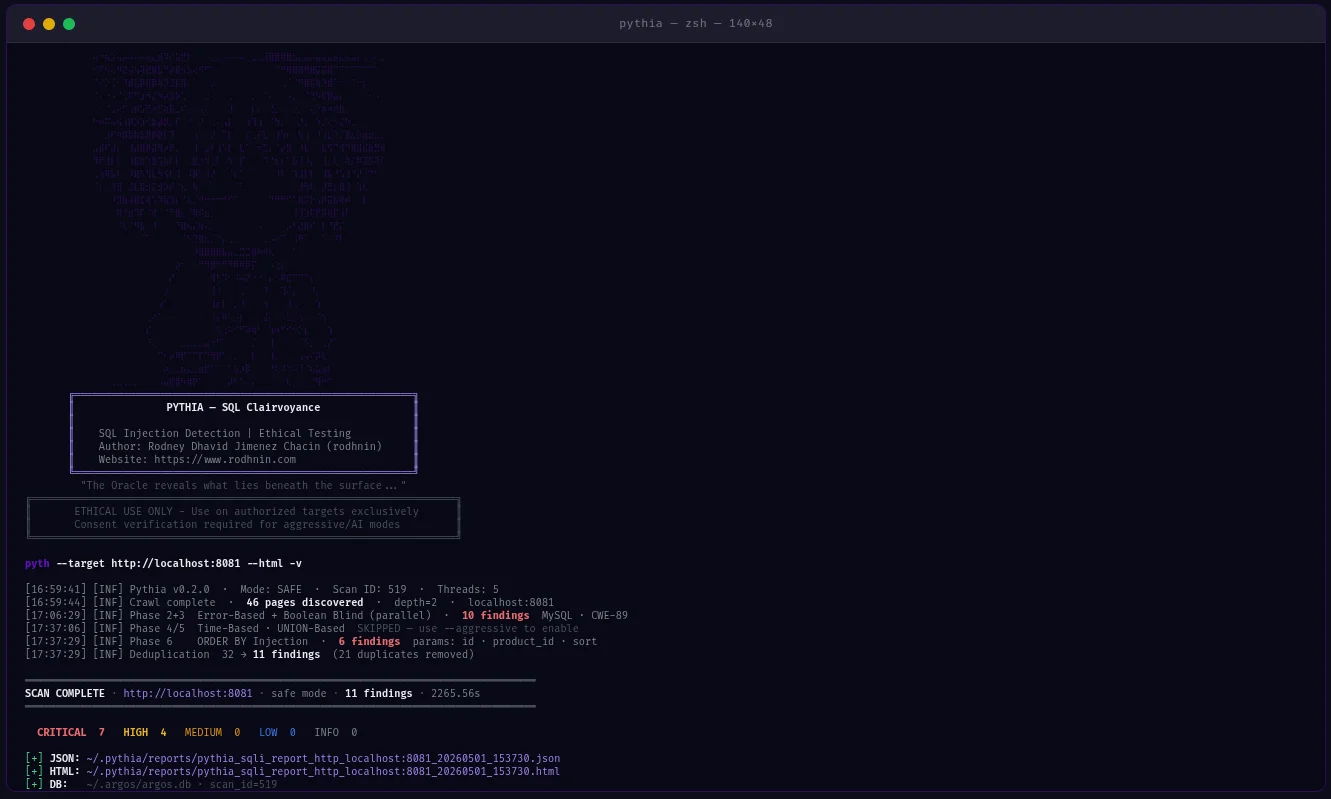
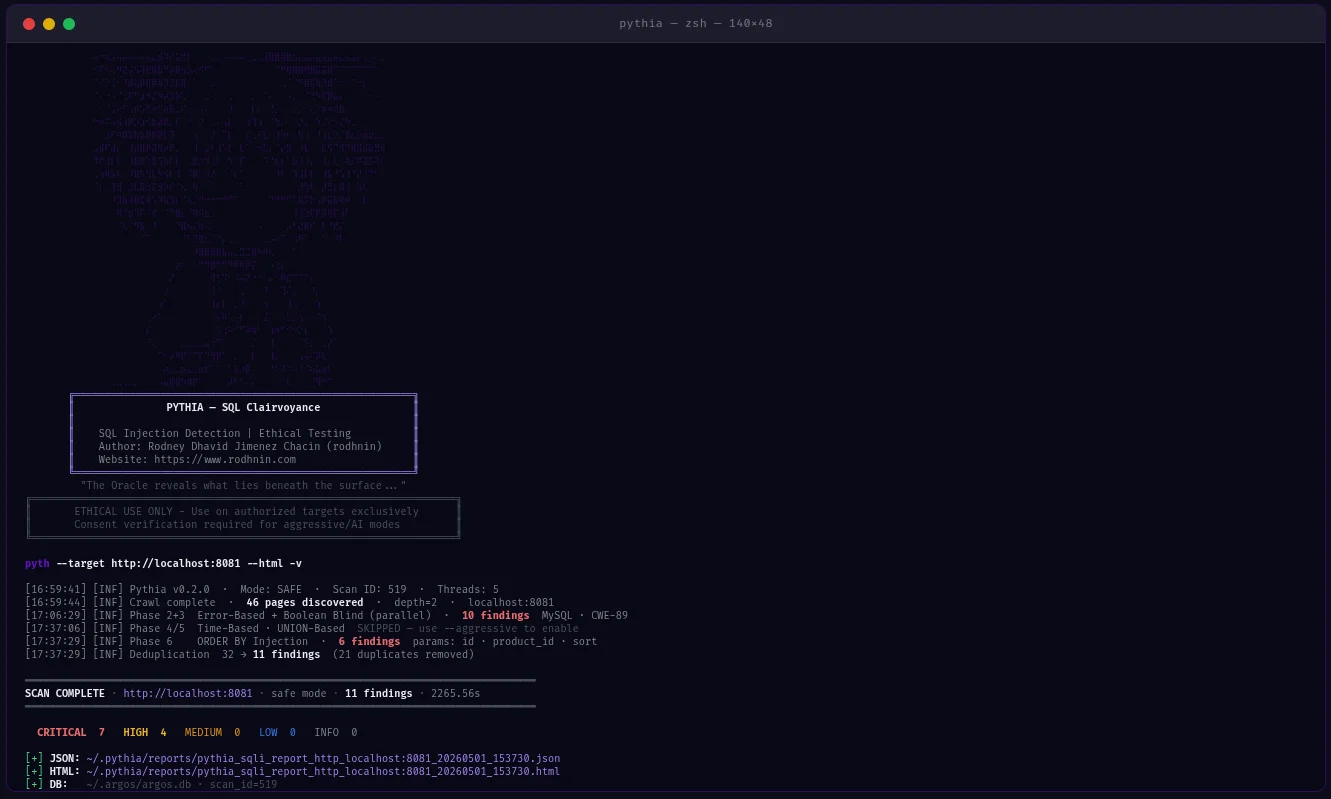
Pythia — real scan output
Live scan · PHP vulnerable shop · 11 findings detected · safe mode · 2265.56s

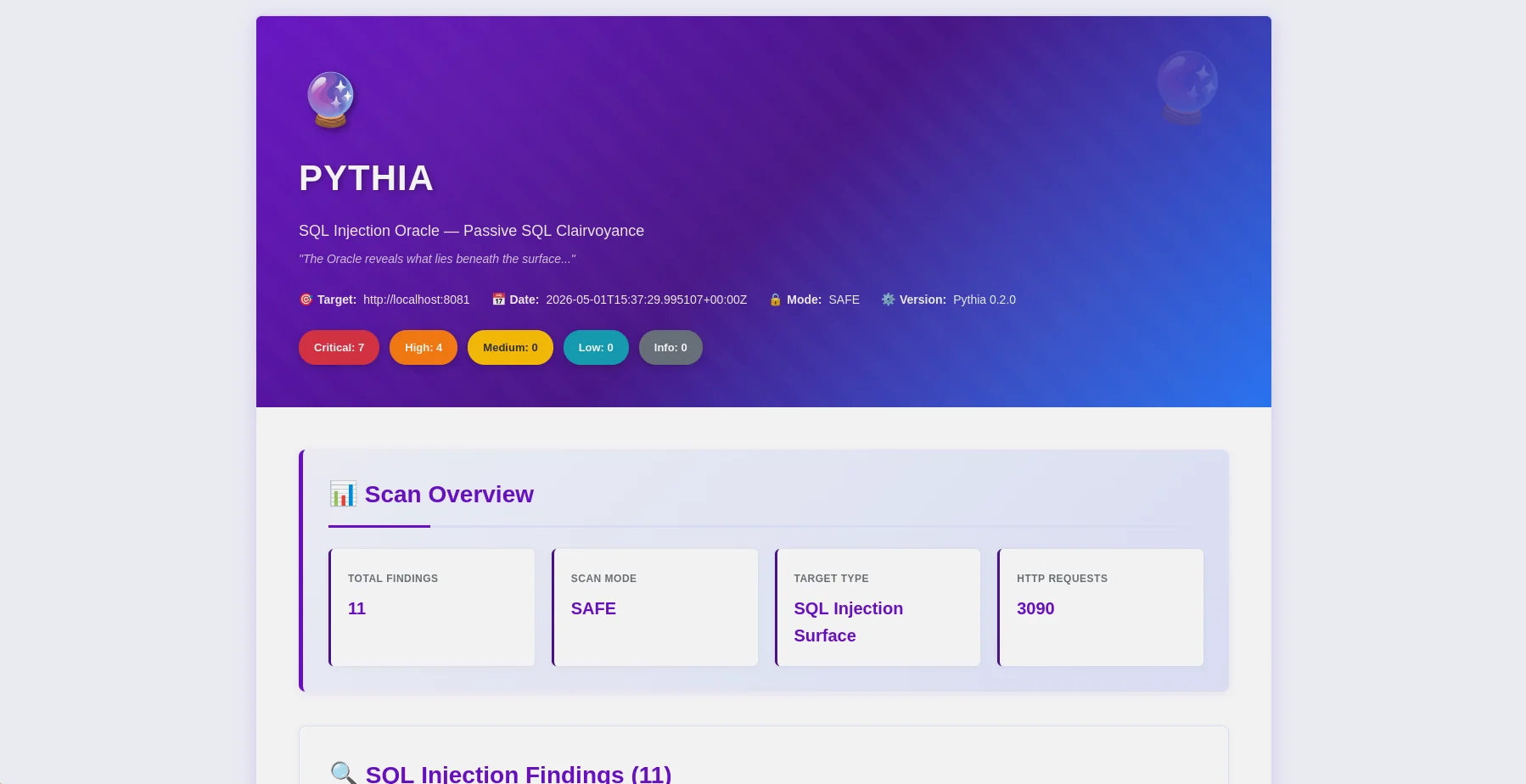
Pythia — HTML report overview
HTML report — findings overview with severity badges and OWASP mapping
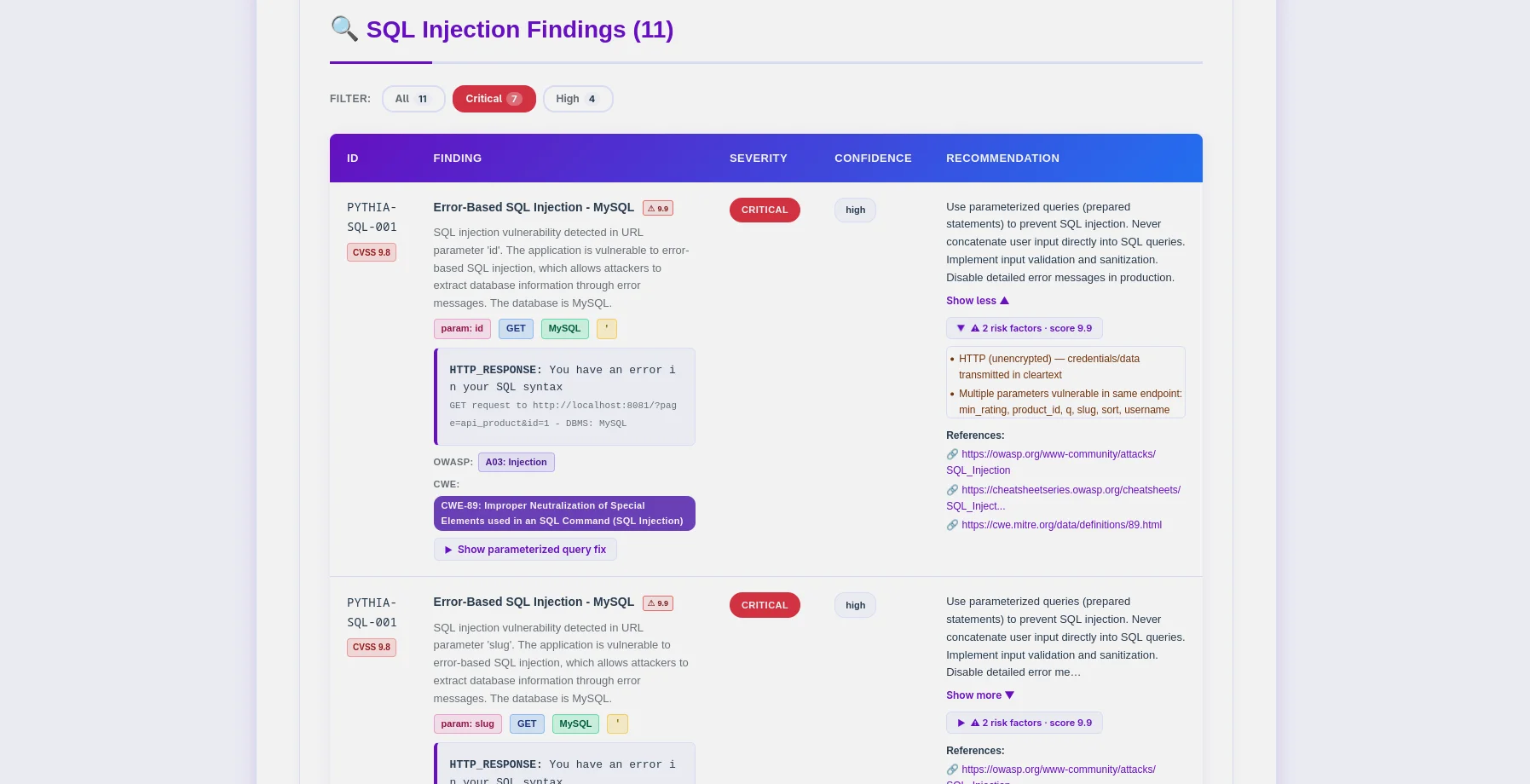
Pythia — findings table
Findings table — PYTHIA-SQL codes, DBMS detection, CWE-89 mapping

What is Pythia?

Pythia is a production-ready SQL injection detection scanner that puts ethics first. Built for penetration testers, security researchers, and DevSecOps engineers, it identifies SQL injection vulnerabilities across 6 detection methods and integrates directly into CI/CD pipelines.

Why Pythia?

  • Ethical by Design: Consent token system prevents unauthorized scanning
  • Multi-Method Detection: 6 detection techniques including second-order and ORDER BY injection
  • AI-Powered: GPT, Claude, or local Ollama for intelligent remediation guides with code examples
  • CI/CD Ready: --fail-on, --sarif, --diff flags for pipeline integration
  • Professional Reports: HTML with filter bar + OWASP/CWE/CVE badges + JSON with contextual CVSS scoring
  • Persistent Tracking: SQLite database shared with Argos Suite (~/.argos/argos.db)
  • High Accuracy: False positive hardening with similarity scoring and multi-payload confirmation

What It Detects


Features

Core SQL Injection Detection

root@kitploit:~
# One command, comprehensive SQLi analysis
python -m pyth --target http://example.com/products?id=1 --html
  • 14 Finding Codes: DBMS-specific (MySQL, PostgreSQL, MSSQL, Oracle, SQLite) + technique-specific
  • DBMS Fingerprinting: Automatic database type and version detection
  • WAF Bypass: 170+ bypass payloads in aggressive mode (hex, URL encoding, inline comments, case variants)
  • Session-Variable Detection: POST→GET chain for DVWA-high style authentication patterns
  • Smart Crawler: BFS with popup/onclick extraction (--js), sitemap, robots.txt
  • False Positive Hardening: SequenceMatcher similarity scoring + multi-payload confirmation

CI/CD Integration

root@kitploit:~
# Pipeline-friendly: exit 10 if high+ findings found
python -m pyth --target https://staging.app.com --aggressive --fail-on high
echo $?  # 0=clean, 10=findings found, 1=error

# SARIF for GitHub Security / GitLab SAST
python -m pyth --target https://app.com --aggressive --sarif > results.sarif

# Compare vs last scan — show what's new, what's fixed
python -m pyth --target https://app.com --aggressive --diff last --html

Auth Headers

root@kitploit:~
# Scan authenticated endpoints (JWT, API keys, custom cookies)
python -m pyth --target https://api.example.com/v1/users \
  --auth-header "Authorization: Bearer eyJhbGc..." \
  --auth-header "X-API-Key: sk-prod-xxx" \
  --aggressive --html

Pass --auth-header multiple times for multiple headers.

AI-Powered Analysis

Choose your AI provider from the command line:

root@kitploit:~
# Standard analysis
python -m pyth --target http://example.com --use-ai --ai-tone technical --html

# Agent mode: AI queries NVD for real CVEs (no API key for NVD)
python -m pyth --target http://example.com --use-ai --ai-agent --html

# Multi-provider comparison
python -m pyth --target http://example.com --use-ai \
  --ai-compare "openai:gpt-4o-mini,anthropic:claude-3-5-haiku-20241022" --html

# With budget cap
python -m pyth --target http://example.com --use-ai --ai-budget 0.05 --html

Professional Reporting

JSON Reports (Machine-Readable, v0.2.0 schema)

root@kitploit:~
{
    "tool": "pythia",
    "version": "0.2.0",
    "target": "http://localhost:8081",
    "mode": "aggressive",
    "summary": { "total": 26, "critical": 18, "high": 6, "medium": 2 },
    "findings": [
        {
            "id": "PYTHIA-SQL-001",
            "title": "Error-Based SQL Injection (MySQL/MariaDB)",
            "severity": "critical",
            "confidence": "high",
            "parameter": "id",
            "vector": "GET",
            "dbms": "MySQL 8.0.32",
            "cvss": 9.8,
            "contextual_score": 9.9,
            "risk_factors": ["no_ssl", "pii_detected"],
            "payload": "' OR '1'='1' --",
            "owasp": { "id": "A03", "name": "Injection" },
            "cwe": { "id": "CWE-89", "name": "SQL Injection" },
            "detection_method": "error-based"
        }
    ],
    "notes": {
        "scan_duration_seconds": 87.3,
        "requests_sent": 342,
        "rate_limit_applied": "5.0 req/s",
        "false_positive_disclaimer": "..."
    },
    "diff": null
}

HTML Reports (Human-Friendly)

  • Filter bar: severity, OWASP category, detection method, DBMS
  • OWASP/CWE/CVE badges per finding (clickable to external references)
  • CVSS base + contextual score with color coding
  • Expandable evidence sections with payload visualization
  • AI analysis tabs (standard / agent / compare)
  • Diff section (new/fixed/persisting findings)
  • Oracle theme (purple #6a11cb) — deliverable to clients without editing

Finding Codes

All codes → OWASP A03 Injection / CWE-89 SQL Injection


Validation & Testing

Pythia v0.2.0 has been empirically validated using controlled Docker-based vulnerable applications.

QA Results (May 2026)

Key Validations:

  • ✅ All 14 finding codes functional
  • ✅ DVWA high (session-variable pattern) — full 4/4 parity
  • ✅ Second-order detection (PYTHIA-SQL-040)
  • ✅ ORDER BY injection detection (PYTHIA-SQL-050)
  • ✅ Zero false positives on static URLs
  • ✅ --fail-on exit codes (0/10/1) correct
  • ✅ SARIF 2.1.0 output validates
  • ✅ --diff last comparison working
  • ✅ --auth-header passes headers through all requests

Quick Start

Prerequisites

  • Python 3.11+ (3.12 recommended)
  • pip (Python package manager)
  • Docker (optional, for vulnerable labs)

Installation

1. Clone the repository

root@kitploit:~
git clone https://github.com/rodhnin/pythia-sql-clairvoyance.git
cd pythia-sql-clairvoyance

2. Create and activate virtual environment

root@kitploit:~
python3 -m venv .venv
source .venv/bin/activate

3. Install dependencies

root@kitploit:~
python -m pip install --upgrade pip
python -m pip install -r requirements.txt

4. Configure API keys (if using cloud AI)

root@kitploit:~
export OPENAI_API_KEY="sk-..."
export ANTHROPIC_API_KEY="sk-ant-..."

5. Verify installation

root@kitploit:~
python -m pyth --version
# Output: Pythia v0.2.0

Your First Scan

root@kitploit:~
# Basic scan (safe mode, no consent required)
python -m pyth --target "http://testphp.vulnweb.com/artists.php?artist=1"

# With HTML report
python -m pyth --target "http://testphp.vulnweb.com/artists.php?artist=1" --html

# Aggressive mode (requires consent)
python -m pyth --gen-consent example.com
python -m pyth --verify-consent http --domain example.com --token verify-abc123
python -m pyth --target http://example.com --aggressive --html

Reports saved to ~/.pythia/reports/.


Usage Guide

CLI Flags Reference

root@kitploit:~
Scan Options:
  --target URL          Target URL to scan
  --safe                Safe mode (default): error-based + boolean-blind
  --aggressive          Aggressive mode: all 6 techniques + WAF bypass payloads

Auth:
  --cookie COOKIE       Session cookie string
  --auth-header HEADER  Custom HTTP header (pass multiple times for multiple headers)
  --auto-csrf           Automatically detect and include CSRF tokens

Crawler:
  --max-depth N         Max crawl depth (default: 2)
  --max-pages N         Max pages to crawl (default: 100)
  --no-robots           Ignore robots.txt
  --no-crawl            Skip BFS crawl, test target URL only
  --js                  JS-aware popup/onclick URL extraction

Output:
  --report-dir DIR      Output directory for reports (default: ~/.pythia/reports/)
  --html                Generate HTML report
  --db                  Save findings to database
  --diff SCAN_ID        Compare vs previous scan (use "last" for most recent)
  --sarif               Output SARIF 2.1.0 to stdout (logs redirect to stderr)
  --fail-on SEVERITY    Exit 10 if findings found at this severity or higher

CI/CD:
  --fail-on SEVERITY    Exit codes: 0=clean, 10=findings found, 1=error

Logging:
  -v / -vv / -vvv       Verbosity levels
  -q                    Quiet mode (errors only)
  --log-file FILE       Log to file
  --log-json            Structured JSON logging
  --no-color            Disable colored output

AI:
  --use-ai              Enable AI analysis
  --ai-tone TONE        Analysis tone: technical, non_technical, both
  --api-key-env VAR     Environment variable name for API key
  --ai-provider NAME    AI provider: openai, anthropic, ollama
  --ai-model MODEL      Model name (e.g. gpt-4o-mini, claude-3-5-haiku-20241022)
  --ai-stream           Stream AI output token by token
  --ai-compare LIST     Compare providers (e.g. "openai,anthropic" or "openai:gpt-4o-mini,anthropic:claude-3-5-haiku-20241022")
  --ai-agent            Agent mode: NVD CVE lookup + iterative analysis
  --ai-budget AMOUNT    Cost cap per scan in USD

Consent:
  --gen-consent DOMAIN  Generate consent token for domain
  --verify-consent METHOD  Verify consent: http or dns
  --domain DOMAIN       Domain for consent verification
  --token TOKEN         Consent token value

Advanced:
  --rate N              Request rate limit (default: 2.0 safe, 5.0 aggressive)
  --timeout N           HTTP timeout in seconds (default: 10)
  --user-agent STRING   Custom User-Agent
  --no-verify-ssl       Disable SSL verification
  --threads N           Worker threads (default: 5)
  --version             Show version and exit

Basic Scanning

root@kitploit:~
# Safe mode (default) - error-based + boolean-blind
python -m pyth --target "http://example.com/search?q=test"

# Generate HTML report
python -m pyth --target "http://example.com/products?id=1" --html

# Increase verbosity
python -m pyth --target "http://example.com/api/users?id=1" -vv

# Skip crawler, test target URL directly
python -m pyth --target "http://example.com/api/users?id=1" --no-crawl

CI/CD Integration

root@kitploit:~
# Exit 10 if high or critical findings exist (blocks pipeline)
python -m pyth \
  --target https://staging.myapp.com \
  --aggressive \
  --fail-on high

# SARIF output for GitHub Security tab
python -m pyth \
  --target https://staging.myapp.com \
  --aggressive \
  --sarif > results.sarif

# Compare vs last scan to see what changed
python -m pyth \
  --target https://staging.myapp.com \
  --aggressive \
  --diff last \
  --html

Authenticated Scanning

root@kitploit:~
# JWT Bearer token
python -m pyth \
  --target https://api.example.com/v1/products \
  --aggressive \
  --auth-header "Authorization: Bearer eyJhbGc..." \
  --html

# Multiple headers
python -m pyth \
  --target https://api.example.com/v1/users \
  --aggressive \
  --auth-header "Authorization: Bearer eyJhbGc..." \
  --auth-header "X-API-Key: sk-prod-xxx" \
  --html

# Session cookie (DVWA example)
python -m pyth \
  --target "http://localhost:8080/vulnerabilities/sqli/?id=1&Submit=Submit" \
  --no-crawl \
  --aggressive \
  --cookie "PHPSESSID=abc123; security=low"

JS-Aware Crawling

root@kitploit:~
# Extract popup/onclick URLs for complex navigation patterns
python -m pyth \
  --target http://localhost:8082 \
  --js \
  --aggressive \
  --html

# DVWA high: session-variable form (needs popup URL extraction)
python -m pyth \
  --target "http://localhost:8080/vulnerabilities/sqli/" \
  --js \
  --max-pages 2 \
  --aggressive \
  --cookie "PHPSESSID=abc123; security=high"

The --js flag uses regex extraction from onclick attributes — no Playwright dependency required.

Aggressive Mode

root@kitploit:~
# Step 1: Generate consent token
python -m pyth --gen-consent example.com
# Output: Token: verify-a3f9b2c1d8e4...

# Step 2: Place token at https://example.com/.well-known/verify-a3f9b2c1d8e4.txt

# Step 3: Verify consent
python -m pyth --verify-consent http \
  --domain example.com \
  --token verify-a3f9b2c1d8e4

# Step 4: Run aggressive scan (all 6 techniques + WAF bypass)
python -m pyth \
  --target http://example.com \
  --aggressive \
  --html -v

Docker Deployment

Pythia provides two Docker deployment options:

  1. Scanner Image: Build Pythia as a Docker image for one-shot scans
  2. Testing Lab: Vulnerable applications (DVWA, PHP, Flask) for safe testing

Quick Start

root@kitploit:~
cd docker
./deploy.sh

Testing Lab (Vulnerable Applications)

NEVER expose testing lab to public internet — LOCAL TESTING ONLY!

root@kitploit:~
# Start vulnerable applications
sudo docker compose -f docker/compose.testing.yml up -d

# Expected targets:
# DVWA:       http://localhost:8080
# PHP Shop:   http://localhost:8081
# Flask Blog: http://localhost:8082

# Scan from host
python -m pyth --target http://localhost:8081 --aggressive --html

# Stop lab
sudo docker compose -f docker/compose.testing.yml down

AI-Powered Analysis

Pythia uses LangChain v1.0.0 with support for multiple AI providers.

Two Analysis Modes

  • Technical: Prepared statements, parameterized queries, input validation code (PHP/PDO, Python/SQLAlchemy, Node.js/pg, Java/PreparedStatement)
  • Executive: Plain-language risk assessment for stakeholders and management

Switching Providers

root@kitploit:~
# CLI flags (v0.2.0) — no YAML editing required
python -m pyth --target http://example.com --use-ai --ai-provider anthropic --ai-model claude-3-5-haiku-20241022 --html
python -m pyth --target http://example.com --use-ai --ai-provider ollama --ai-model llama3.2 --html

YAML config (config/default.yaml) can still be used as fallback. CLI flags take priority.

For complete AI integration guide, see docs/AI_INTEGRATION.md


Understanding Reports

Report Files

root@kitploit:~
~/.pythia/
├── reports/
│   ├── pythia_sqli_report_localhost_20260318_143022.json
│   └── pythia_sqli_report_localhost_20260318_143022.html
~/.argos/
├── argos.db           # Shared Argos Suite database
├── costs.json         # AI cost tracking (shared)
└── logs/
    └── pythia.log     # Scan logs

Severity Mapping

  • CRITICAL (9.0-10.0): Error-based, time-based, UNION-based, second-order with confirmed exploitation
  • HIGH (7.0-8.9): Boolean-blind (high confidence), ORDER BY injection
  • MEDIUM (4.0-6.9): Boolean-blind (medium confidence)
  • LOW (0.1-3.9): Potential SQLi with inconclusive evidence

Exit Codes


Database Persistence

SQLite database shared with Argos ecosystem (~/.argos/argos.db):

  • Scan History: Date, duration, findings count, detection methods
  • Finding Repository: Searchable SQL injection vulnerability database
  • Verified Domains: Consent token tracking with expiration
  • AI Costs: Per-scan cost tracking (new in v0.2.0)
root@kitploit:~
# Query recent Pythia scans
sqlite3 ~/.argos/argos.db "SELECT * FROM scans WHERE tool='pythia' ORDER BY scan_id DESC LIMIT 10"

# Find critical SQL injections
sqlite3 ~/.argos/argos.db "SELECT * FROM findings WHERE severity='critical' AND scan_id IN (SELECT scan_id FROM scans WHERE tool='pythia')"

# View AI cost summary
sqlite3 ~/.argos/argos.db "SELECT provider, model, ROUND(SUM(cost_usd),4) FROM ai_costs WHERE tool='pythia' GROUP BY provider, model"

Project Structure

root@kitploit:~
pythia-sql-clairvoyance/
├── pyth/
│   ├── checks/
│   │   ├── crawler.py          # BFS web crawler (JS-aware with --js)
│   │   ├── error_based.py      # PYTHIA-SQL-001..005
│   │   ├── boolean_blind.py    # PYTHIA-SQL-010..011
│   │   ├── time_based.py       # PYTHIA-SQL-020..022
│   │   ├── union_based.py      # PYTHIA-SQL-030..031
│   │   ├── second_order.py     # PYTHIA-SQL-040
│   │   ├── order_injection.py  # PYTHIA-SQL-050
│   │   ├── waf_bypass.py       # WAF bypass payloads (aggressive only)
│   │   └── forms.py            # Form analysis
│   ├── core/
│   │   ├── ai.py               # AI integration + AICostTracker
│   │   ├── config.py           # Config loader
│   │   ├── consent.py          # Consent token system
│   │   ├── cve_lookup.py       # NVD CVE API client
│   │   ├── db.py               # ArgosDB (shared SQLite)
│   │   ├── diff.py             # Diff reports
│   │   ├── http_client.py      # Rate-limited HTTP session
│   │   ├── logging.py          # Structured logging + secret redaction
│   │   ├── owasp.py            # OWASP/CWE mapper
│   │   ├── report.py           # Report generation (JSON + HTML + SARIF)
│   │   └── risk_scoring.py     # Contextual CVSS scoring
│   ├── cli.py                  # CLI argument parser (35+ flags)
│   ├── scanner.py              # Main scan orchestrator
│   └── __init__.py             # version = "0.2.0"
├── config/
│   ├── default.yaml
│   └── prompts/                # AI prompt templates
├── db/migrate.sql              # Shared DB schema
├── schema/report.schema.json   # JSON Schema Draft 2020-12
├── templates/report.html.j2    # HTML template (oracle purple theme)
├── docker/                     # Docker deployment + vulnerable labs
└── docs/
    ├── AI_INTEGRATION.md
    ├── CONSENT.md
    ├── DATABASE_GUIDE.md
    ├── ETHICS.md
    ├── REPORT_FORMAT.md
    ├── ROADMAP.md
    └── TESTING_GUIDE.md

Roadmap

v0.1.0 — Initial Release (November 2025)

Status: Released

  • 4 detection methods, AI remediation, consent system, HTML+JSON reports, SQLite persistence

v0.2.0 — Full Parity & Enterprise Features (May 2026)

Status: Released

  • 6 detection methods (added second-order + ORDER BY)
  • 14 DBMS-specific finding codes
  • CI/CD integration (--fail-on, --sarif, --diff)
  • Auth headers, JS-aware crawling, WAF bypass payloads
  • AI: streaming, compare, agent (NVD CVE lookup), cost tracking, --ai-provider/--ai-model flags
  • OWASP/CWE/CVSS/contextual risk scoring in every finding
  • False positive hardening (similarity scoring, multi-payload confirmation)
  • DVWA high security parity (session-variable chain)

v0.3.0 — Pytest Suite & Developer Tooling (Q3 2026)

Planned:

  • 40+ pytest tests covering all 14 finding codes
  • Interactive config management (python -m pyth config set)
  • Database CLI (python -m pyth db scans list)
  • Session expiry detection during authenticated scans
  • Multi-site batch scanning (--targets targets.txt)

v0.4.0 — Intelligence & Automation (Q1 2027)

Planned:

  • ML-based anomaly detection
  • Automated read-only exploitation (proof of impact)
  • AI chat interface for scan result analysis

For detailed feature descriptions, see docs/ROADMAP.md


Ethics & Legal

The Golden Rule

Only scan systems you own or have explicit written permission to test.

Consent Enforcement

Legal Framework

  • USA: Computer Fraud and Abuse Act (CFAA)
  • UK: Computer Misuse Act 1990
  • EU: Directive 2013/40/EU
  • International: Various cybercrime laws

For complete ethical guidelines, see docs/ETHICS.md


Contributing

We welcome contributions — bug reports, feature requests, documentation improvements, and code contributions.

How to Contribute

  1. Fork the repository
  2. Create a feature branch (git checkout -b feature/amazing-feature)
  3. Make your changes and write tests
  4. Commit your changes
  5. Push to the branch and open a Pull Request

Development Setup

root@kitploit:~
git clone https://github.com/YOUR-USERNAME/pythia-sql-clairvoyance.git
cd pythia-sql-clairvoyance
python -m pip install -r requirements.txt
python -m pip install pytest black flake8 mypy
black pyth/
flake8 pyth/
pytest tests/

Documentation


License

This project is licensed under the MIT License — see the LICENSE file for details.


Disclaimer

IMPORTANT: This tool is for authorized security testing only.

By using Pythia, you acknowledge and agree that:

  1. You will only scan systems you own or have explicit written permission to test
  2. You will comply with all applicable laws and regulations
  3. You understand that unauthorized access is illegal (CFAA, Computer Misuse Act, etc.)
  4. The author and contributors assume no liability for misuse

Acknowledgments

  • OWASP — SQL Injection guidance, Testing Guide
  • SQLMap — Inspiration for detection methods and techniques
  • PortSwigger — Web Security Academy resources
  • LangChain — AI framework for intelligent analysis
  • Anthropic & OpenAI — AI models for vulnerability remediation
  • Ollama — Local AI inference for privacy-focused scanning
  • NVD/NIST — CVE data via free public API

Author

Rodney Dhavid Jimenez Chacin (rodhnin)

  • Website: rodhnin.com
  • GitHub: @rodhnin
  • Project: pythia-sql-clairvoyance

Built for ethical hackers, penetration testers, and DevSecOps engineers worldwide

Report Bug • Request Feature • Documentation


Pythia v0.2.0 — May 2026

Download Tool
Detection MethodDescriptionMode Required
Error-BasedSQL errors in responses (MySQL, PostgreSQL, MSSQL, Oracle, SQLite)Safe
Boolean-BlindResponse differences from TRUE/FALSE conditionsSafe
Time-Based BlindResponse delays from SLEEP/WAITFOR payloadsAggressive
UNION-BasedData extraction via UNION SELECTAggressive
Second-OrderStore→retrieve injection patterns (POST→GET chain)Aggressive
ORDER BY InjectionNumeric sort parameter injectionAggressive
ProviderBest ForSpeedCostPrivacy
OpenAI gpt-4o-mini (default)Production quality, low costFast~$0.02/scanStandard
Anthropic ClaudePrivacy-focused, code remediationFast~$0.06/scanEnhanced
Ollama (Local)Complete privacySlow (CPU)Free100% Offline
CodeTypeDBMS / VectorMode
PYTHIA-SQL-001Error-BasedMySQL / MariaDBSafe
PYTHIA-SQL-002Error-BasedPostgreSQLSafe
PYTHIA-SQL-003Error-BasedMSSQLSafe
PYTHIA-SQL-004Error-BasedOracleSafe
PYTHIA-SQL-005Error-BasedSQLiteSafe
PYTHIA-SQL-010Boolean BlindAny DBMSSafe
PYTHIA-SQL-011Boolean BlindVia header injectionSafe
PYTHIA-SQL-020Time-BasedMySQL SLEEP()Aggressive
PYTHIA-SQL-021Time-BasedMSSQL WAITFORAggressive
PYTHIA-SQL-022Time-BasedPostgreSQL pg_sleep()Aggressive
PYTHIA-SQL-030UNION-BasedGET/POST parameterAggressive
PYTHIA-SQL-031UNION-BasedVia cookieAggressive
PYTHIA-SQL-040Second-OrderStore → retrieve patternAggressive
PYTHIA-SQL-050ORDER BY InjectionNumeric sort parameterAggressive
TargetModeFindingsNotes
PHP Lab (8081)--aggressive26 findingsAll 4 techniques + second-order + ORDER BY
Flask Lab (8082)--js --aggressive18 findingsSession-var + second-order + ORDER BY
DVWA Low--no-crawl --aggressive4/4 techniquesPYTHIA-SQL-001/010/020/030
DVWA Medium--no-crawl --aggressive4/4 techniquesPOST form, all techniques
DVWA High--js --max-pages 2 --aggressive4/4 techniquesSession-variable POST→GET chain
False Positive Test--aggressive0 findingsStatic URL — confirmed no false positives
CodeMeaning
0Scan completed, no findings at --fail-on threshold (or no --fail-on used)
1Technical error (connection, timeout, database)
10Findings found at or above --fail-on severity threshold
130User cancelled (Ctrl+C)
ModeTestsConsent RequiredRate Limit
SafeError-Based, Boolean-BlindNo2.0 req/s
AggressiveAll 6 techniquesYes5.0 req/s
AI AnalysisRemediation guideYesN/A
DocumentDescription
AI_INTEGRATION.mdComplete AI setup guide (providers, streaming, agent, cost tracking)
CONSENT.mdConsent token system technical details
DATABASE_GUIDE.mdSQLite schema v1.1, queries, ai_costs table
ETHICS.mdLegal framework and ethical guidelines
REPORT_FORMAT.mdFull JSON schema, SARIF, diff format
ROADMAP.mdFeature history and development plans
TESTING_GUIDE.mdDocker lab setup and v0.2.0 test scenarios