
 quevatech/challenge_repo
Structured challenge repository offering bounties for breaking a neural-network-based random number generator validated against NIST SP 800-22 and SP 800-90B standards.





English · Türkçe
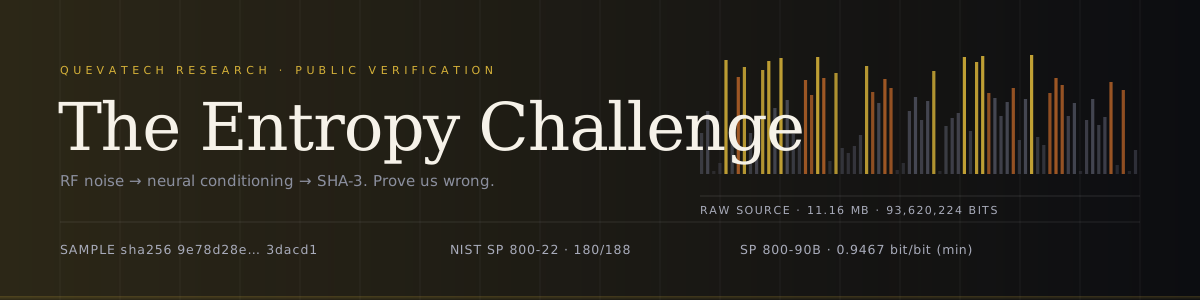
We built a random number generator that takes RF noise, runs it through a proprietary neural conditioning stage, and post-processes the result with SHA-3 / SHAKE-256. We claim the output is indistinguishable from an ideal random source — that no statistical or learned distinguisher can beat chance on it.
We publish the output and the verification reports. We do not publish the generator.
The ask is one line: prove us wrong.
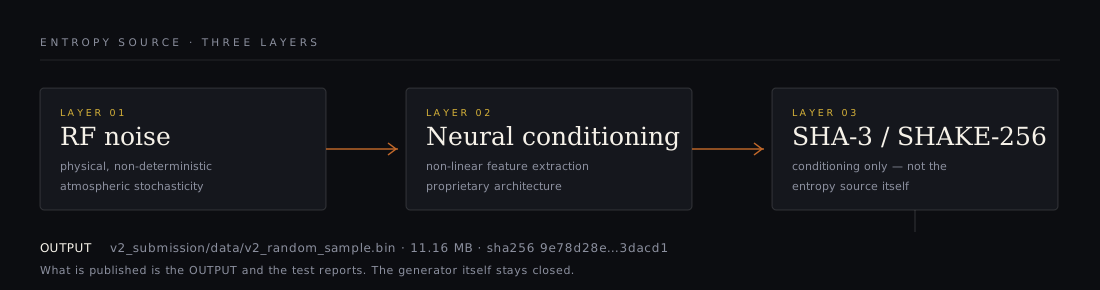
| Layer | Component | Role | Published |
|---|---|---|---|
| 01 | RF noise | Physical, non-deterministic source (atmospheric stochasticity) | ✗ |
| 02 | Neural conditioning | Non-linear feature extraction from the raw RF signal | ✗ |
| 03 | SHA-3 / SHAKE-256 | Cryptographic conditioning and whitening (SP 800-90B style) | ✗ |
| → | Sample file | 11.16 MB of output, bit-identical to the certified run | ✓ |
SHA-3 here is used strictly as a conditioning component, never as the entropy source. Conditioning can only reduce entropy; it cannot manufacture it.
| Item | Value |
|---|---|
| Sample | v2_submission/data/v2_random_sample.bin |
| Size | 11,702,528 bytes · 93,620,224 bits |
| SHA-256 | 9e78d28edfe7fe1e1a76a3da5eee805c2a472fe43d0abfe873b170a5453dacd1 |
| Certification | TEST_REPORT.md — SP 800-22, SP 800-90B, Dieharder, AIS 31 |
| Pipeline | .github/workflows/nist-tests.yml |
| Metric | Value | Reading |
|---|---|---|
| NIST SP 800-22 (official C STS) | 180 / 188 sub-tests pass | 95.7 %; failures within the expected ~1 % per-test rate |
| SP 800-90B, IID assessment | H = 7.9675 bits/byte | IID assumption confirmed |
| SP 800-90B, non-IID (conservative) | min-entropy 7.5739 bits/byte → 0.9467 bits/bit | the number we will defend |
| Markov prediction attack | best 50.06 % | indistinguishable from a coin |
| ML distinguisher (GBM, RF) | best 51.25 %, p = 0.36 | no significant advantage |
| Autocorrelation, lags 1–1000 | 2 significant lags (expected ~2.7) | no periodicity |
Read the conservative number. 0.9996 bits/bit is the IID MCV estimate; 0.9467 bits/bit is the non-IID bound driven by the t-tuple estimator. A conditioned stream should look perfect to IID tests — that proves very little. The bound we will stand behind is 0.9467 bits/bit.
Not a claim, a command:
python tools/verify_sample.py
| Check | Observed | Gate |
|---|---|---|
| SHA-256 / size | matches the certified report | exact |
| Bit balance | 49.999 % ones, monobit p = 0.847 | p > 0.01 |
| Byte uniformity | χ² = 248.39 (df 255), p = 0.605 | p > 0.01 |
| Byte mean / std | 127.49 / 73.906 | 127.5 / 73.90 |
| Serial correlation, lags 1–8 | max |ρ| = 0.00031 | < 0.000877 (3σ) |
| Longest identical run | 28 bits | ≈ log₂(93.6 M) ≈ 26.5 |
| Duplicate 16-byte blocks | 0 of 731,408 | 0 |
| Compression bound | 8.0024 bits/byte | > 7.99 |
All eight gates pass, and the script exits non-zero if any stops passing. This is deliberately the cheapest possible test set: it is meant to be trivial to run, not to replace the certification.
Three levels, in increasing order of what a success would prove.
| Level | Question | Acceptance criterion | Recognition |
|---|---|---|---|
| 🥇 L1 · Predictor | Can you predict bit N+1? | Over N = 100,000 held-out bits: accuracy ≥ 50.52 % (two-sided p < 0.001). Higher N is allowed; the threshold follows from the binomial test. | Hall of Fame + certificate |
| 🥈 L2 · Distinguisher | Can you tell us apart from os.urandom? | ≥ 100,000 samples per class, advantage > 0.01 at p < 0.001, evaluated on a stream you have never seen. | Hall of Fame, named mention |
| 🥉 L3 · Pattern finder | Did every standard test miss something? | A bias or period that survives multiple-comparison correction at p < 1e-6 and reproduces on a second sample. | Hall of Fame, public acknowledgment |
os.urandom.tools/referee.py runs your frozen method
against the held-out stream and writes results.json. A finding without that
file is not a finding.| Date | Researcher | Level | Result | Evidence |
|---|---|---|---|---|
| — | your name | — | — | — |
pip install -r requirements.txt

# 1. cheapest gate, ~10 s
python tools/verify_sample.py

# 2. NIST SP 800-22 official C implementation (89 streams × 1 Mbit)
git clone --depth=1 https://github.com/arcetri/sts && (cd sts && make legacy)
bash tests/run_sts.sh v2_submission/data/v2_random_sample.bin sts/sts_legacy_fft 89 results/

# 3. NIST SP 800-90B official tools (ea_iid + ea_non_iid)
bash tests/run_ea90b.sh v2_submission/data/v2_random_sample.bin 8 results/

# 4. attack suite: Markov prediction, ML distinguisher, autocorrelation, leakage
python tests/security_tests.py --file v2_submission/data/v2_random_sample.bin
A short list of what this repository does not prove. Hiding it would be the first thing a serious reviewer notices, so it is here instead.
