
 protectai/vulnhuntr
Zero shot vulnerability discovery using LLMs


A tool to identify remotely exploitable vulnerabilities using LLMs and static code analysis.
World's first autonomous AI-discovered 0day vulnerabilities
Vulnhuntr leverages the power of LLMs to automatically create and analyze entire code call chains starting from remote user input and ending at server output for detection of complex, multi-step, security-bypassing vulnerabilities that go far beyond what traditional static code analysis tools are capable of performing. See all the details including the Vulnhuntr output for all the 0-days here: Protect AI Vulnhuntr Blog
[!TIP] Found a vulnerability using Vulnhuntr? Submit a report to huntr.com to get $$ and submit a PR to add it to the list below!
[!NOTE] This table is just a sample of the vulnerabilities found so far. We will unredact as responsible disclosure periods end.
| Repository | Stars | Vulnerabilities |
|---|---|---|
| gpt_academic | 67k | LFI, XSS |
| ComfyUI | 66k | XSS |
| Langflow | 46k | RCE, IDOR |
| FastChat | 37k | SSRF |
| Ragflow | 31k | RCE |
| LLaVA | 21k | SSRF |
| gpt-researcher | 17k | AFO |
| Letta | 14k | AFO |
[!IMPORTANT] Vulnhuntr strictly requires Python 3.10 because of a number of bugs in Jedi which it uses to parse Python code. It will not work reliably if installed with any other versions of Python.
We recommend using pipx or Docker to easily install and run Vulnhuntr.
Using Docker:
docker build -t vulnhuntr https://github.com/protectai/vulnhuntr.git#main
Using pipx:
pipx install git+https://github.com/protectai/vulnhuntr.git --python python3.10
Alternatively you can install directly from source using poetry:
git clone https://github.com/protectai/vulnhuntr
cd vulnhuntr && poetry install
This tool is designed to analyze a GitHub repository for potential remotely exploitable vulnerabilities. The tool requires an API key and the local path to a GitHub repository. You may also optionally specify a custom endpoint for the LLM service.
[!CAUTION] Always set spending limits or closely monitor costs with the LLM provider you use. This tool has the potential to rack up hefty bills as it tries to fit as much code in the LLMs context window as possible.
[!TIP] We recommend using Claude for the LLM. Through testing we have had better results with it over GPT.
usage: vulnhuntr [-h] -r ROOT [-a ANALYZE] [-l {claude,gpt,ollama}] [-v]

Analyze a GitHub project for vulnerabilities. Export your ANTHROPIC_API_KEY/OPENAI_API_KEY before running.

options:
  -h, --help            show this help message and exit
  -r ROOT, --root ROOT  Path to the root directory of the project
  -a ANALYZE, --analyze ANALYZE
                        Specific path or file within the project to analyze
  -l {claude,gpt,ollama}, --llm {claude,gpt,ollama}
                        LLM client to use (default: claude)
  -v, --verbosity       Increase output verbosity (-v for INFO, -vv for DEBUG)
From a pipx install, analyze the entire repository using Claude:
export ANTHROPIC_API_KEY="sk-1234"
vulnhuntr -r /path/to/target/repo/
[!TIP] We recommend giving Vulnhuntr specific files that handle remote user input and scan them individually.
From a pipx install, analyze the /path/to/target/repo/server.py file using GPT-4o. Can also specify a subdirectory instead of a file:
export OPENAI_API_KEY="sk-1234"
vulnhuntr -r /path/to/target/repo/ -a server.py -l gpt
From a docker installation, run using Claude and a custom endpoint to analyze /local/path/to/target/repo/repo-subfolder/target-file.py:
docker run --rm -e ANTHROPIC_API_KEY=sk-1234 -e ANTHROPIC_BASE_URL=https://localhost:1234/api -v /local/path/to/target/repo:/repo vulnhuntr:latest -r /repo -a repo-subfolder/target-file.py
Experimental
Ollama is included as an option, however we haven't had success with the open source models structuring their output correctly.
export OLLAMA_BASE_URL=http://localhost:11434/api/generate
export OLLAMA_MODEL=llama3.2
vulnhuntr -r /path/to/target/repo/ -a server.py -l ollama
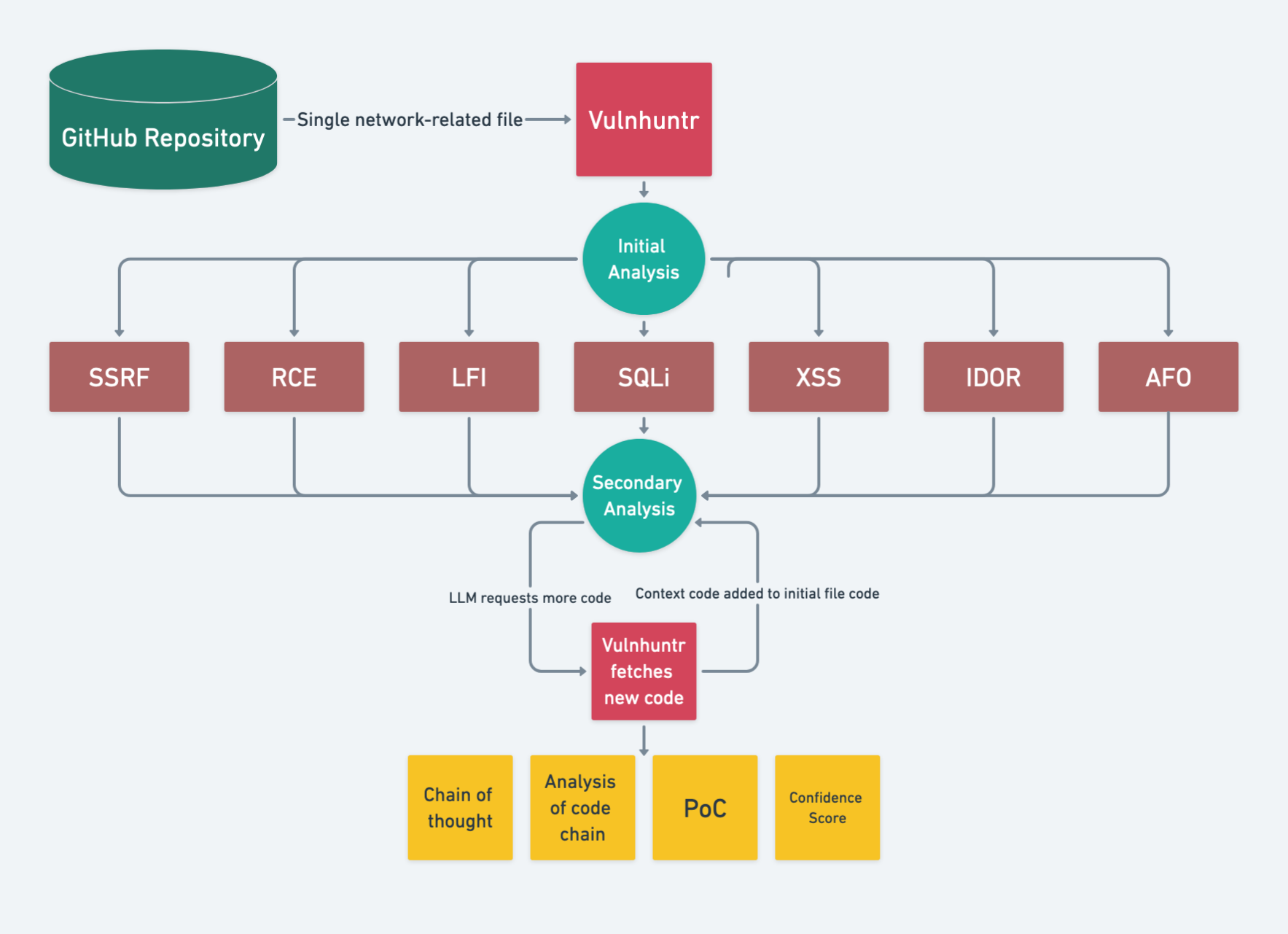
[!TIP] Generally confidence scores < 7 mean there's unlikely a vulnerability. Confidence scores of 7 mean it should be investigated, and confidence scores of 8+ mean it is very likely to be a valid vulnerability.
The tool generates a detailed report of the vulnerabilities found in the analyzed files. The report includes:
Below is an example of a Vulnhuntr report describing a 0-day remote code execution vulnerability in Ragflow (now fixed):
