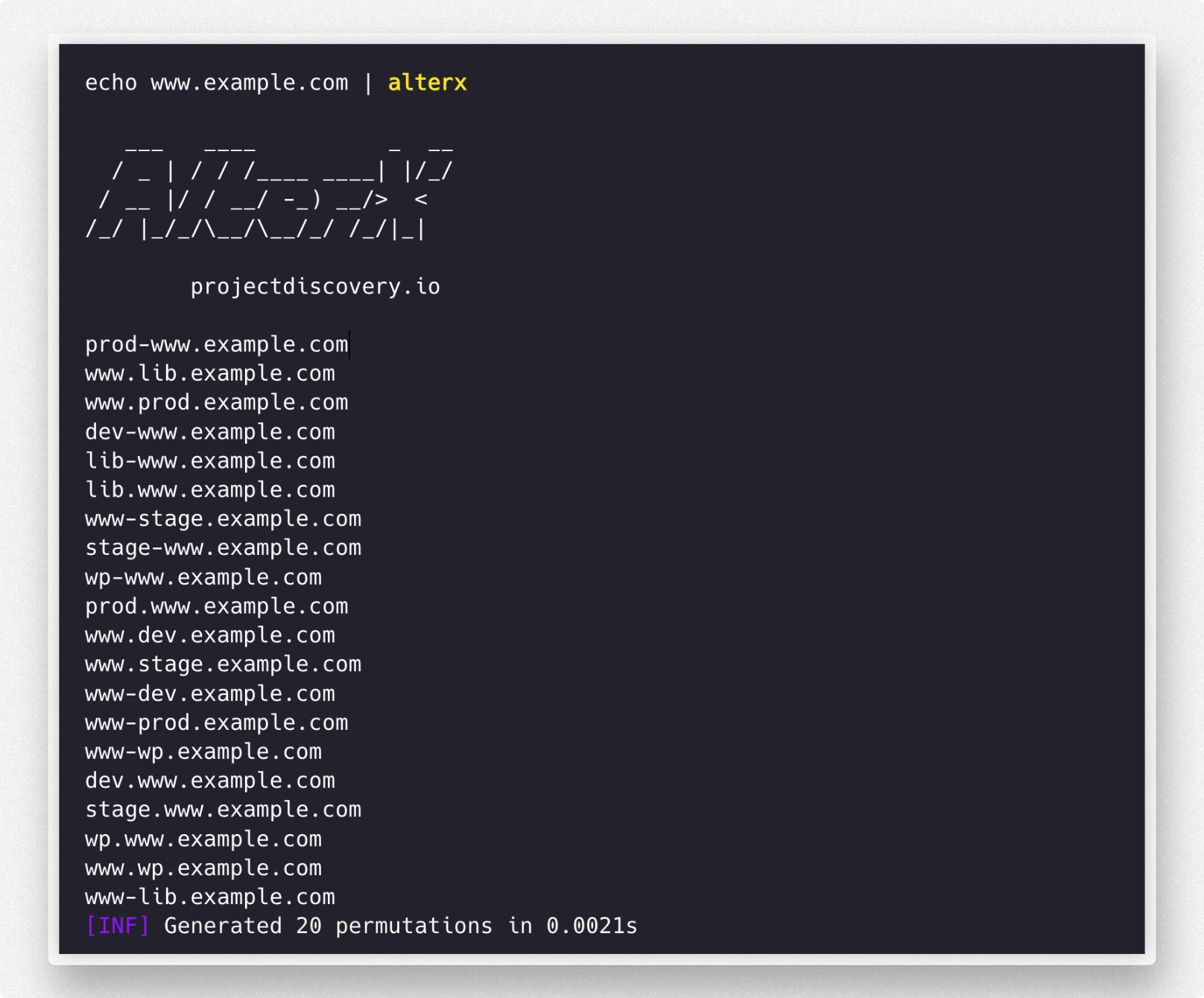
 projectdiscovery/alterx
Fast and customizable subdomain wordlist generator using DSL




Features • Installation • Usage • Running AlterX • Join Discord
Fast and customizable subdomain wordlist generator using DSL.
To install alterx, you need to have Golang 1.19 installed on your system. You can download Golang from here. After installing Golang, you can use the following command to install alterx:
go install github.com/projectdiscovery/alterx/cmd/alterx@latest
# Clone the repository
git clone https://github.com/projectdiscovery/alterx.git
cd alterx

# Build using Makefile
make build

# Or build manually
go build ./cmd/alterx
Available Makefile targets:
make help          # Show all available targets
make build         # Build the binary
make test          # Run tests
make test-coverage # Run tests with coverage
make lint          # Run linter
make fmt           # Format code
make clean         # Clean build artifacts
make install       # Install to $GOPATH/bin
You can use the following command to see the available flags and options:
Fast and customizable subdomain wordlist generator using DSL.

Usage:
  ./alterx [flags]

Flags:
INPUT:
   -l, -list string[]     subdomains to use when creating permutations (stdin, comma-separated, file)
   -p, -pattern string[]  custom permutation patterns input to generate (comma-seperated, file)
   -pp, -payload value    custom payload pattern input to replace/use in key=value format (-pp 'word=words.txt')

OUTPUT:
   -es, -estimate      estimate permutation count without generating payloads
   -o, -output string  output file to write altered subdomain list
   -ms, -max-size int  Max export data size (kb, mb, gb, tb) (default mb)
   -v, -verbose        display verbose output
   -silent             display results only
   -version            display alterx version

CONFIG:
   -config string  alterx cli config file (default '$HOME/.config/alterx/config.yaml')
   -en, -enrich    enrich wordlist by extracting words from input
   -ac string      alterx permutation config file (default '$HOME/.config/alterx/permutation_v0.0.1.yaml')
   -limit int      limit the number of results to return (default 0)

UPDATE:
   -up, -update                 update alterx to latest version
   -duc, -disable-update-check  disable automatic alterx update check
alterx ??what makes alterx different from any other subdomain permutation tools like goaltdns is its scripting feature . alterx takes patterns as input and generates subdomain permutation wordlist based on that pattern similar to what nuclei does with fuzzing-templates .
What makes Active Subdomain Enumeration difficult is the probability of finding a domain that actually exists. If finding possible subdomains is represented on a scale it should look something like
Using Wordlist < generate permutations with subdomains (goaltdns) < alterx
Almost all popular subdomain permutation tools have hardcoded patterns and when such tools are run they create wordlist which contain subdomains in Millions and this decreases the feasibility of bruteforcing them with tools like dnsx . There is no actual convention to name subdomains and usually depends on person registering the subdomain. with alterx it is possible to create patterns based on results from passive subdomain enumeration results which increases probability of finding a subdomain and feasibility to bruteforce them.
alterx uses variable-like syntax similar to nuclei-templates. One can write their own patterns using these variables . when domains are passed as input alterx evaluates input and extracts variables from it .
{{sub}}     :  subdomain prefix or left most part of a subdomain
{{suffix}}  :  everything except {{sub}} in subdomain name is suffix
{{tld}}     :  top level domain name (ex com,uk,in etc)
{{etld}}    :  also know as public suffix (ex co.uk , gov.in etc)
| Variable | api.scanme.sh | admin.dev.scanme.sh | cloud.scanme.co.uk |
|---|---|---|---|
{{sub}} | api | admin | cloud |
{{suffix}} | scanme.sh | dev.scanme.sh | scanme.co.uk |
{{tld}} | sh | sh | uk |
{{etld}} | - | - | co.uk |
{{sld}}  :   second-level domain  (ex for api.scanme.sh => {{sld}} is scanme)
{{root}}  :  also known as eTLD+1 i.e only root domain (ex for api.scanme.sh => {{root}} is scanme.sh)
{{subN}}  :  here N is an integer (ex {{sub1}} , {{sub2}} etc) .

// {{subN}} is advanced variable which exists depending on input
// lets say there is a multi level domain cloud.nuclei.scanme.sh
// in this case {{sub}} = cloud and {{sub1}} = nuclei`
| Variable | api.scanme.sh | admin.dev.scanme.sh | cloud.scanme.co.uk |
|---|---|---|---|
{{sld}} | scanme | scanme | scanme |
{{root}} | scanme.sh | scanme.sh | scanme.co.uk |
{{sub1}} | - | dev | - |
{{sub2}} | - | - | - |
pattern in simple terms can be considered as template that describes what type of patterns should alterx generate.
// Below are some of example patterns which can be used to generate permutations
// assuming api.scanme.sh was given as input and variable {{word}} was given as input with only one value prod
// alterx generates subdomains for below patterns

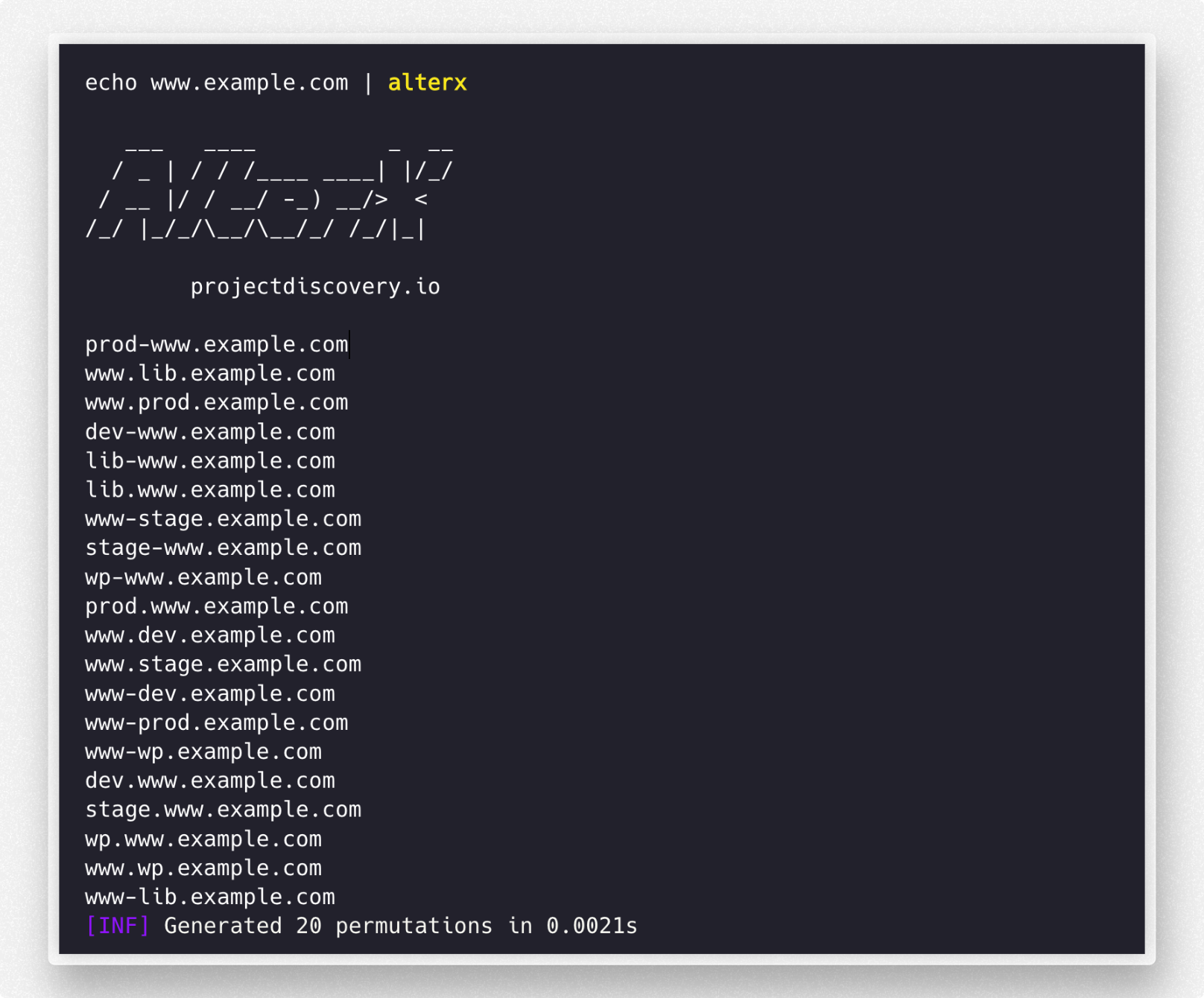
"{{sub}}-{{word}}.{{suffix}}" // ex: api-prod.scanme.sh
"{{word}}-{{sub}}.{{suffix}}" // ex: prod-api.scanme.sh
"{{word}}.{{sub}}.{{suffix}}" // ex: prod.api.scanme.sh
"{{sub}}.{{word}}.{{suffix}}" // ex: api.prod.scanme.sh
Here is an example pattern config file - https://github.com/projectdiscovery/alterx/blob/main/permutations.yaml that can be easily customizable as per need.
