 primait/nuvola
Graph-based AWS security analysis tool that dumps cloud configurations, detects misconfigurations, and maps attack paths using a Neo4j digital twin with extensible YAML rules.


nuvola (with the lowercase n) is a tool to dump and perform automatic and manual security analysis on AWS environments configurations and services using predefined, extensible and custom rules created using a simple Yaml syntax.
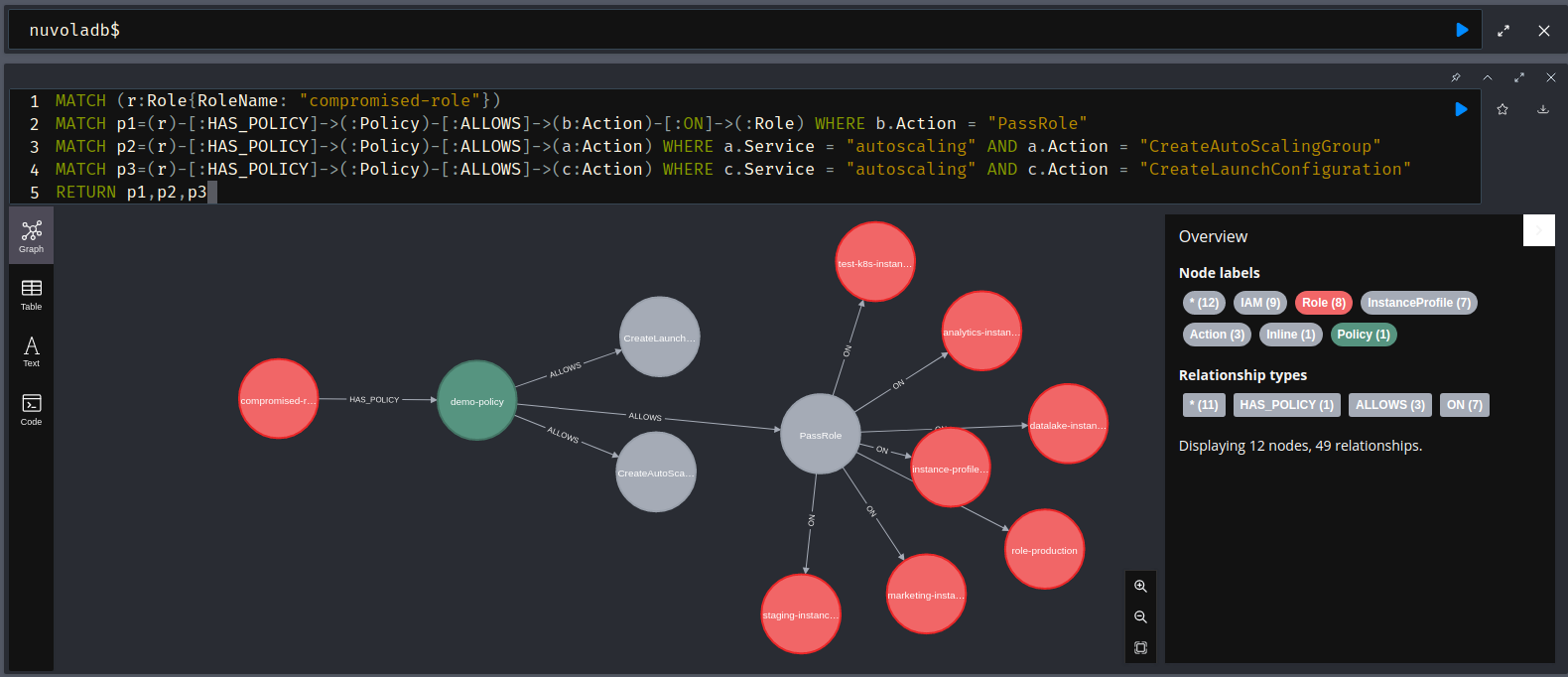
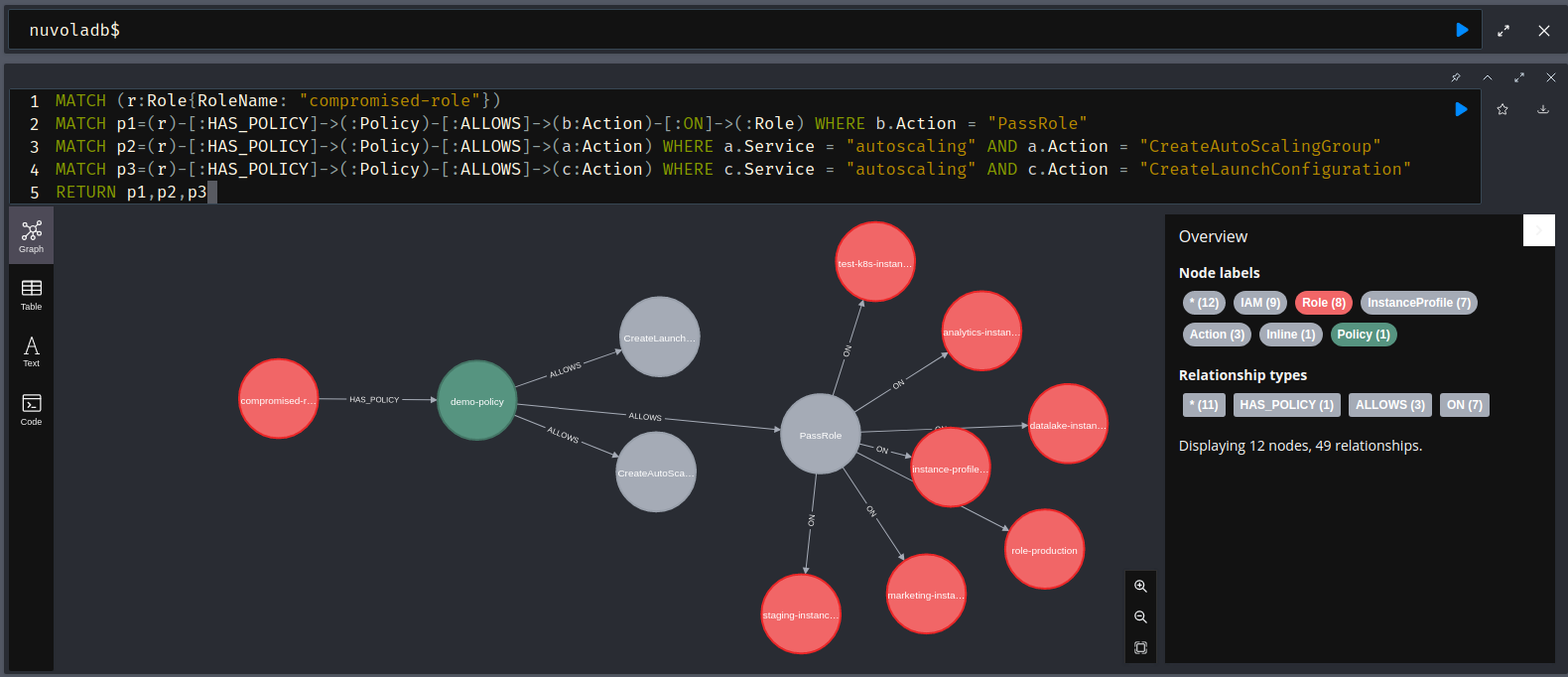
The general idea behind this project is to create an abstracted digital twin of a cloud platform. For a more concrete example: nuvola reflects the BloodHound traits used for Active Directory analysis but on cloud environments (at the moment only AWS).
The usage of a graph database also increases the possibility of finding different and innovative attack paths and can be used as an offline, centralised and lightweight digital twin.
docker-compose installedawscli with full access to the cloud resources, better if in ReadOnly mode (the policy arn:aws:iam::aws:policy/ReadOnlyAccess is fine)git clone --depth=1 https://github.com/primait/nuvola.git; cd nuvola
.env file to set your DB username/password/URLcp .env_example .env;
You may need to edit the size of the memory allocated to Neo4j in you run the tool in a low-RAM device.
make start-containers
make build
./nuvola dump --aws-profile default_RO --output-dir ~/DumpDumpFolder --output-format zip
./nuvola assess --import ~/DumpDumpFolder/nuvola-default_RO_20220901.zip
./nuvola assess
If you leverage on .env_example, NEO4J_server_memory_* neo4j memory settings may be too large, causing the docker container to crash due to a lack of memory on the host system. Removing the NEO4J_server_memory_* lines will force neo4j to calculate those values based on the available system resources (ref).
To get started with nuvola and its database schema, check out the nuvola Wiki.
No data is sent or shared with Prima Assicurazioni.
nuvola uses graph theory to reveal possible attack paths and security misconfigurations on cloud environments.
This program is free software: you can redistribute it and/or modify it under the terms of the GNU General Public License as published by the Free Software Foundation, either version 3 of the License, or (at your option) any later version.
This program is distributed in the hope that it will be useful, but WITHOUT ANY WARRANTY; without even the implied warranty of MERCHANTABILITY or FITNESS FOR A PARTICULAR PURPOSE. See the GNU General Public License for more details.
You should have received a copy of the GNU General Public License along with this repository and program. If not, see http://www.gnu.org/licenses/.
