 pptx704/domainim
A fast and comprehensive tool for organizational network scanning

Features • Usage • Installation • Usage • Contributing • Additional Notes
Domainim is a fast domain reconnaissance tool for organizational network scanning. The tool aims to provide a brief overview of an organization's structure using techniques like OSINT, bruteforcing, DNS resolving etc.
Current features (v1.0.1)-
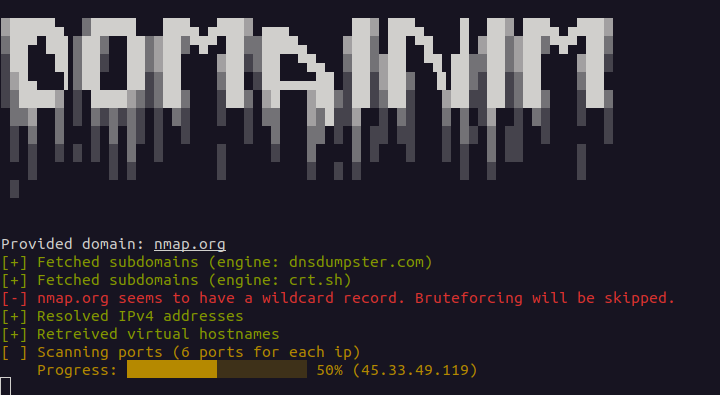
Virtual hostname enumeration
Reverse DNS lookup
Detects wildcard subdomains (for bruteforcing)
Basic TCP port scanning
Subdomains are accepted as input
Export results to JSON file
A few features are work in progress. See Planned features for more details.
The project is inspired by Sublist3r. The port scanner module is heavily based on NimScan.
You can build this repo from source-
git clone [email protected]:pptx704/domainim
nimble build
./domainim <domain> [--ports=<ports>]
Or, you can just download the binary from the release page. Keep in mind that the binary is tested on Debian based systems only.
./domainim <domain> [--ports=<ports> | -p:<ports>] [--wordlist=<filename> | l:<filename> [--rps=<int> | -r:<int>]] [--dns=<dns> | -d:<dns>] [--out=<filename> | -o:<filename>]
<domain> is the domain to be enumerated. It can be a subdomain as well.-- ports | -p is a string speicification of the ports to be scanned. It can be one of the following-
all - Scan all ports (1-65535)none - Skip port scanning (default)t<n> - Scan top n ports (same as nmap). i.e. t100 scans top 100 ports. Max value is 5000. If n is greater than 5000, it will be set to 5000.80 scans port 8080-100 scans ports 80 to 10080,443,8080 scans ports 80, 443 and 808080,443,8080-8090,t500 scans ports 80, 443, 8080 to 8090 and top 500 ports--dns | -d is the address of the dns server. This should be a valid IPv4 address and can optionally contain the port number-
a.b.c.d - Use DNS server at a.b.c.d on port 53a.b.c.d#n - Use DNS server at a.b.c.d on port e--wordlist | -l - Path to the wordlist file. This is used for bruteforcing subdomains. If the file is invalid, bruteforcing will be skipped. You can get a wordlist from SecLists. A wordlist is also provided in the release page.--rps | -r - Number of requests to be made per second during bruteforce. The default value is 1024 req/s. It is to be noted that, DNS queries are made in batches and next batch is made only after the previous one is completed. Since quries can be rate limited, increasing the value does not always guarantee faster results.--out | -o - Path to the output file. The output will be saved in JSON format. The filename must end with .json.Examples
./domainim nmap.org --ports=all./domainim google.com --ports=none --dns=8.8.8.8#53./domainim pptx704.com --ports=t100 --wordlist=wordlist.txt --rps=1500./domainim pptx704.com --ports=t100 --wordlist=wordlist.txt --outfile=results.json./domainim mysite.com --ports=t50,5432,7000-9000 --dns=1.1.1.1The help menu can be accessed using ./domainim --help or ./domainim -h.
Usage:
    domainim <domain> [--ports=<ports> | -p:<ports>] [--wordlist=<filename> | l:<filename> [--rps=<int> | -r:<int>]] [--dns=<dns> | -d:<dns>] [--out=<filename> | -o:<filename>]
    domainim (-h | --help)

Options:
    -h, --help              Show this screen.
    -p, --ports             Ports to scan. [default: `none`]
                            Can be `all`, `none`, `t<n>`, single value, range value, combination
    -l, --wordlist          Wordlist for subdomain bruteforcing. Bruteforcing is skipped for invalid file.
    -d, --dns               IP and Port for DNS Resolver. Should be a valid IPv4 with an optional port [default: system default]
    -r, --rps               DNS queries to be made per second [default: 1024 req/s]
    -o, --out               JSON file where the output will be saved. Filename must end with `.json`

Examples:
    domainim domainim.com -p:t500 -l:wordlist.txt --dns:1.1.1.1#53 --out=results.json
    domainim sub.domainim.com --ports=all --dns:8.8.8.8 -t:1500 -o:results.json
The JSON schema for the results is as follows-
[
  {
    "subdomain": string,
    "data": [
      "ipv4": string,
      "vhosts": [string],
      "reverse_dns": string,
      "ports": [int]
    ]
  }
]
Example json for nmap.org can be found here.
Contributions are welcome. Feel free to open a pull request or an issue.
This project is still in its early stages. There are several limitations I am aware of.
The two engines I am using (I'm calling them engine because Sublist3r does so) currently have some sort of response limit. dnsdumpster can fetch upto 100 subdomains. crt.sh also randomizes the results in case of too many results. Another issue with crt.sh is the fact that it returns some SQL error sometimes. So for some domain, results can be different for different runs. I am planning to add more engines in the future (at least a brute force engine).
The port scanner has only ping response time + 750ms timeout. This might lead to false negatives. Since, domainim is not meant for port scanning but to provide a quick overview, such cases are acceptable. However, I am planning to add a flag to increase the timeout. For the same reason, filtered ports are not shown. For more comprehensive port scanning, I recommend using Nmap. Domainim also doesn't bypass rate limiting (if there is any).
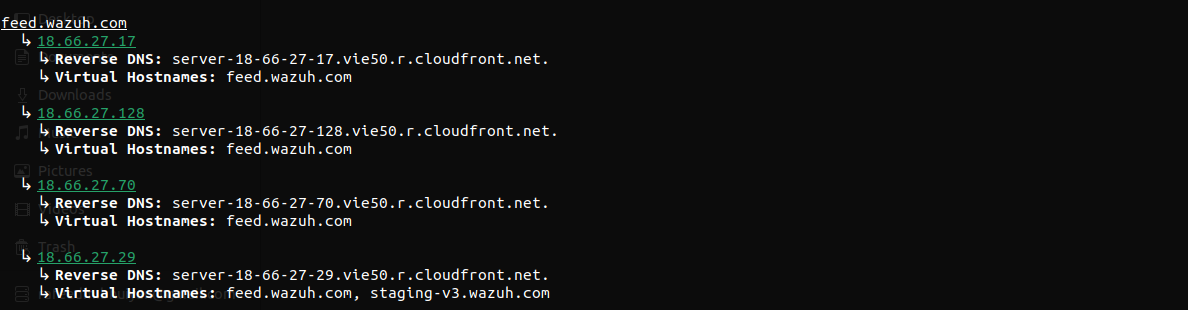
It might seem that the way vhostnames are printed, it just brings repeition on the table.
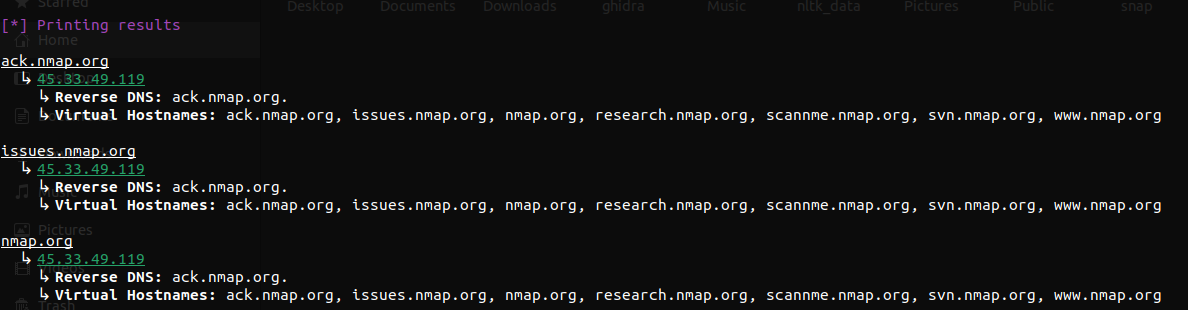
Printing as the following might've been better-
ack.nmap.org, issues.nmap.org, nmap.org, research.nmap.org, scannme.nmap.org, svn.nmap.org, www.nmap.org
  ↳ 45.33.49.119
    ↳ Reverse DNS: ack.nmap.org.
But previously while testing, I found cases where not all IPs are shared by same set of vhostnames. That is why I decided to keep it this way.
