
Fault-injection library for Go that adds runtime-controllable failpoints to trigger panics, sleeps, returns, and conditional error paths via environment variables.
An implementation of failpoints for Golang. Fail points are used to add code points where errors may be injected in a user controlled fashion. Fail point is a code snippet that is only executed when the corresponding failpoint is active.
failpoint-ctl)Build failpoint-ctl from source
git clone https://github.com/pingcap/failpoint.git
cd failpoint
make
ls bin/failpoint-ctl
Inject failpoints to your program, eg:
package main
import "github.com/pingcap/failpoint"
func main() {
failpoint.Inject("testPanic", func() {
panic("failpoint triggerd")
})
}
Transfrom your code with failpoint-ctl enable
Build with go build
Enable failpoints with GO_FAILPOINTS environment variable
GO_FAILPOINTS="main/testPanic=return(true)" ./your-program
Note: GO_FAILPOINTS does not work with InjectCall type of marker.
If you use go run to run the test, don't forget to add the generated in your command, like:
failpoint-toolexec)Build failpoint-toolexec from source
git clone https://github.com/pingcap/failpoint.git
cd failpoint
make
ls bin/failpoint-toolexec
Inject failpoints to your program, eg:
package main
import "github.com/pingcap/failpoint"
func main() {
failpoint.Inject("testPanic", func() {
panic("failpoint triggerd")
})
}
Use a separate build cache to avoid mixing caches without failpoint-toolexec, and build
GOCACHE=/tmp/failpoint-cache go build -toolexec path/to/failpoint-toolexec
Enable failpoints with GO_FAILPOINTS environment variable
GO_FAILPOINTS="main/testPanic=return(true)" ./your-program
You can also use go run or go test, like:
GOCACHE=/tmp/failpoint-cache GO_FAILPOINTS="main/testPanic=return(true)" go run -toolexec path/to/failpoint-toolexec your-program.go
Define failpoint in valid Golang code, not comments or anything else
Failpoint does not have any extra cost
Failpoint routine is writable/readable and should be checked by a compiler
Generated code by failpoint definition is easy to read
Keep the line numbers same with the injecting codes(easier to debug)
Support parallel tests with context.Context
Failpoint
Faillpoint is a code snippet that is only executed when the corresponding failpoint is active.
The closure will never be executed if failpoint.Disable("failpoint-name-for-demo") is executed.
var outerVar = "declare in outer scope"
failpoint.Inject("failpoint-name-for-demo", func(val failpoint.Value) {
fmt.Println("unit-test", val, outerVar)
})
Marker functions
It is just an empty function
It is easy to write/read
Introduce a compiler check for failpoints which cannot compile in the regular mode if failpoint code is invalid
Marker funtion list
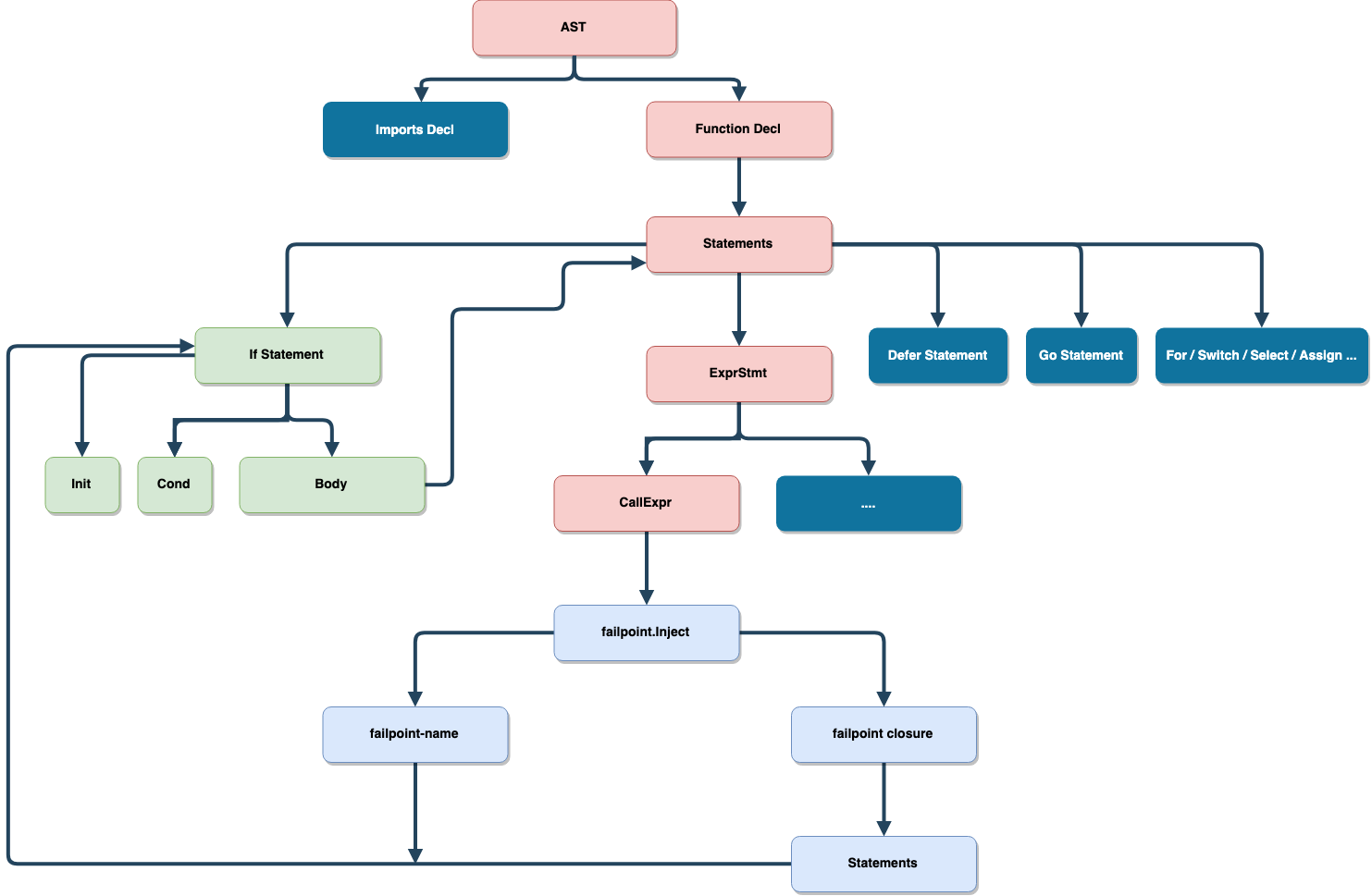
func Inject(fpname string, fpblock func(val Value)) {}func InjectContext(fpname string, ctx context.Context, fpblock func(val Value)) {}func InjectCall(fpname string, args ...any) {}func Break(label ...string) {}You can call failpoint.Inject to inject a failpoint to the call site, where failpoint-name is
used to trigger the failpoint and failpoint-closure will be expanded as the body of the IF statement.
failpoint.Inject("failpoint-name", func(val failpoint.Value) {
failpoint.Return("unit-test", val)
})
The converted code looks like:
if val, _err_ := failpoint.Eval(_curpkg_("failpoint-name")); _err_ == nil {
return "unit-test", val
}
failpoint.Value is the value that passes by failpoint.Enable("failpoint-name", "return(5)")
which can be ignored.
failpoint.Inject("failpoint-name", func(_ failpoint.Value) {
fmt.Println("unit-test")
})
OR
failpoint.Inject("failpoint-name", func() {
fmt.Println("unit-test")
})
And the converted code looks like:
Inject a failpoint to the IF INITIAL statement or CONDITIONAL expression
if a, b := func() {
failpoint.Inject("failpoint-name", func(val failpoint.Value) {
fmt.Println("unit-test", val)
})
}, func() int { return rand.Intn(200) }(); b > func() int {
failpoint.Inject("failpoint-name", func(val failpoint.Value) int {
return val.(int)
})
return rand.Intn(3000)
}() && b < func() int {
failpoint.Inject("failpoint-name-2", func(val failpoint.Value) {
return rand.Intn(val.(int))
})
return rand.Intn(6000)
}() {
a()
failpoint.Inject("failpoint-name-3", func(val failpoint.Value) {
fmt.Println("unit-test", val)
})
}
The above code block will generate something like this:
if a, b := func() {
if val, _err_ := failpoint.Eval(_curpkg_("failpoint-name")); _err_ == nil {
fmt.Println("unit-test", val)
}
}, func() int { return rand.Intn(200) }(); b > func() int {
if val, _err_ := failpoint.Eval(_curpkg_("failpoint-name")); _err_ == nil {
return val.(int)
}
return rand.Intn(3000)
}() && b < func() int {
if val, ok := failpoint.Eval(_curpkg_("failpoint-name-2")); ok {
return rand.Intn(val.(int))
}
return rand.Intn(6000)
}() {
a()
if val, ok := failpoint.Eval(_curpkg_("failpoint-name-3")); ok {
fmt.Println("unit-test", val)
}
}
Inject a failpoint to the SELECT statement to make it block one CASE if the failpoint is active
As you see above, _curpkg_ will automatically wrap the original failpoint name in failpoint.Eval call.
You can think of _curpkg_ as a macro that automatically prepends the current package path to the failpoint name. For example,
package ddl // which parent package is `github.com/pingcap/tidb`
func demo() {
// _curpkg_("the-original-failpoint-name") will be expanded as `github.com/pingcap/tidb/ddl/the-original-failpoint-name`
if val, ok := failpoint.Eval(_curpkg_("the-original-failpoint-name")); ok {...}
}
You do not need to care about _curpkg_ in your application. It is automatically generated after running failpoint-ctl enable
and is deleted with failpoint-ctl disable.
Because all failpoints in a package share the same namespace, we need to be careful to avoid name conflict. There are some recommended naming rules to improve this situation.
Keep name unique in current subpackage
Use a self-explanatory name for the failpoint
You can enable failpoints by environment variables
GO_FAILPOINTS="github.com/pingcap/tidb/ddl/renameTableErr=return(100);github.com/pingcap/tidb/planner/core/illegalPushDown=return(true);github.com/pingcap/pd/server/schedulers/balanceLeaderFailed=return(true)"
failpoint.Eval to determine whether a
failpoint is active and executes failpoint code if the failpoint is enabled
binding__failpoint_binding__.goGO_FAILPOINTS="main/testPanic=return(true)" go run your-program.go binding__failpoint_binding__.go
func Goto(label string) {}func Continue(label ...string) {}func Fallthrough() {}func Return(results ...interface{}) {}func Label(label string) {}Supported failpoint environment variable
failpoint can be enabled by export environment variables with the following patten, which is quite similar to freebsd failpoint SYSCTL VARIABLES
Note: InjectCall cannot be enabled by environment variables.
[<percent>%][<count>*]<type>[(args...)][-><more terms>]
The argument specifies which action to take; it can be one of:
if _, _err_ := failpoint.Eval(_curpkg_("failpoint-name")); _err_ == nil {
fmt.Println("unit-test")
}
Also, the failpoint closure can be a function which takes context.Context. You can
do some customized things with context.Context like controlling whether a failpoint is
active in parallel tests or other cases. For example,
failpoint.InjectContext(ctx, "failpoint-name", func(val failpoint.Value) {
fmt.Println("unit-test", val)
})
The converted code looks like:
if val, _err_ := failpoint.EvalContext(ctx, _curpkg_("failpoint-name")); _err_ == nil {
fmt.Println("unit-test", val)
}
You can ignore context.Context, and this will generate the same code as above non-context version. For example,
failpoint.InjectContext(nil, "failpoint-name", func(val failpoint.Value) {
fmt.Println("unit-test", val)
})
Becomes
if val, _err_ := failpoint.EvalContext(nil, _curpkg_("failpoint-name")); _err_ == nil {
fmt.Println("unit-test", val)
}
You can use failpoint.InjectCall to inject a function call, this type of marker can only be enabled using failpoint.EnableCall and it must be called in the same process as the InjectCall call site. Using this marker, you can avoid failpoint code pollute you source code. See examples.
You can control a failpoint by failpoint.WithHook
func (s *dmlSuite) TestCRUDParallel() {
sctx := failpoint.WithHook(context.Backgroud(), func(ctx context.Context, fpname string) bool {
return ctx.Value(fpname) != nil // Determine by ctx key
})
insertFailpoints = map[string]struct{} {
"insert-record-fp": {},
"insert-index-fp": {},
"on-duplicate-fp": {},
}
ictx := failpoint.WithHook(context.Backgroud(), func(ctx context.Context, fpname string) bool {
_, found := insertFailpoints[fpname] // Only enables some failpoints.
return found
})
deleteFailpoints = map[string]struct{} {
"tikv-is-busy-fp": {},
"fetch-tso-timeout": {},
}
dctx := failpoint.WithHook(context.Backgroud(), func(ctx context.Context, fpname string) bool {
_, found := deleteFailpoints[fpname] // Only disables failpoints.
return !found
})
// other DML parallel test cases.
s.RunParallel(buildSelectTests(sctx))
s.RunParallel(buildInsertTests(ictx))
s.RunParallel(buildDeleteTests(dctx))
}
If you use a failpoint in the loop context, maybe you will use other marker functions.
failpoint.Label("outer")
for i := 0; i < 100; i++ {
inner:
for j := 0; j < 1000; j++ {
switch rand.Intn(j) + i {
case j / 5:
failpoint.Break()
case j / 7:
failpoint.Continue("outer")
case j / 9:
failpoint.Fallthrough()
case j / 10:
failpoint.Goto("outer")
default:
failpoint.Inject("failpoint-name", func(val failpoint.Value) {
fmt.Println("unit-test", val.(int))
if val == j/11 {
failpoint.Break("inner")
} else {
failpoint.Goto("outer")
}
})
}
}
}
The above code block will generate the following code:
outer:
for i := 0; i < 100; i++ {
inner:
for j := 0; j < 1000; j++ {
switch rand.Intn(j) + i {
case j / 5:
break
case j / 7:
continue outer
case j / 9:
fallthrough
case j / 10:
goto outer
default:
if val, _err_ := failpoint.Eval(_curpkg_("failpoint-name")); _err_ == nil {
fmt.Println("unit-test", val.(int))
if val == j/11 {
break inner
} else {
goto outer
}
}
}
}
}
You may doubt why we do not use label, break, continue, and fallthrough directly
instead of using failpoint marker functions.
Any unused symbol like an ident or a label is not permitted in Golang. It will be invalid if some label is only used in the failpoint closure. For example,
label1: // compiler error: unused label1
failpoint.Inject("failpoint-name", func(val failpoint.Value) {
if val.(int) == 1000 {
goto label1 // illegal to use goto here
}
fmt.Println("unit-test", val)
})
break and continue can only be used in the loop context, which is not legal in the Golang code
if we use them in closure directly.
func (s *StoreService) ExecuteStoreTask() {
select {
case <-func() chan *StoreTask {
failpoint.Inject("priority-fp", func(_ failpoint.Value) {
return make(chan *StoreTask)
})
return s.priorityHighCh
}():
fmt.Println("execute high priority task")
case <- s.priorityNormalCh:
fmt.Println("execute normal priority task")
case <- s.priorityLowCh:
fmt.Println("execute normal low task")
}
}
The above code block will generate something like this:
func (s *StoreService) ExecuteStoreTask() {
select {
case <-func() chan *StoreTask {
if _, ok := failpoint.Eval(_curpkg_("priority-fp")); ok {
return make(chan *StoreTask)
})
return s.priorityHighCh
}():
fmt.Println("execute high priority task")
case <- s.priorityNormalCh:
fmt.Println("execute normal priority task")
case <- s.priorityLowCh:
fmt.Println("execute normal low task")
}
}
Inject a failpoint to dynamically extend SWITCH CASE arms
switch opType := operator.Type(); {
case opType == "balance-leader":
fmt.Println("create balance leader steps")
case opType == "balance-region":
fmt.Println("create balance region steps")
case opType == "scatter-region":
fmt.Println("create scatter region steps")
case func() bool {
failpoint.Inject("dynamic-op-type", func(val failpoint.Value) bool {
return strings.Contains(val.(string), opType)
})
return false
}():
fmt.Println("do something")
default:
panic("unsupported operator type")
}
The above code block will generate something like this:
switch opType := operator.Type(); {
case opType == "balance-leader":
fmt.Println("create balance leader steps")
case opType == "balance-region":
fmt.Println("create balance region steps")
case opType == "scatter-region":
fmt.Println("create scatter region steps")
case func() bool {
if val, ok := failpoint.Eval(_curpkg_("dynamic-op-type")); ok {
return strings.Contains(val.(string), opType)
}
return false
}():
fmt.Println("do something")
default:
panic("unsupported operator type")
}
More complicated failpoints



