 percivalll/copy-fail-cve-2026-31431-kubernetes-poc
PoC: fully unprivileged container escape to node-level code execution on Kubernetes via CVE-2026-31431 page-cache corruption + shared image layers. Validated on Alibaba Cloud ACK, Amazon EKS and Google GKE.

A proof-of-concept demonstrating how a fully unprivileged container can achieve node-level code execution on Kubernetes by exploiting the CVE-2026-31431 Linux kernel page-cache corruption bug through shared container image layers.
The core attack primitive is: any privileged DaemonSet sharing image layers with an attacker-controlled container can be weaponized for container escape. This PoC uses kube-proxy as one concrete example, but the technique generalizes to any privileged workload on the cluster.
Validated on Alibaba Cloud ACK, Amazon EKS, and Google GKE — an unprivileged pod writes [*] success to the host filesystem via the privileged kube-proxy DaemonSet:
| Alibaba Cloud ACK (kernel 6.6.88) | Amazon EKS (kernel 6.12.79) | Google GKE (kernel 6.12.68) |
|---|---|---|
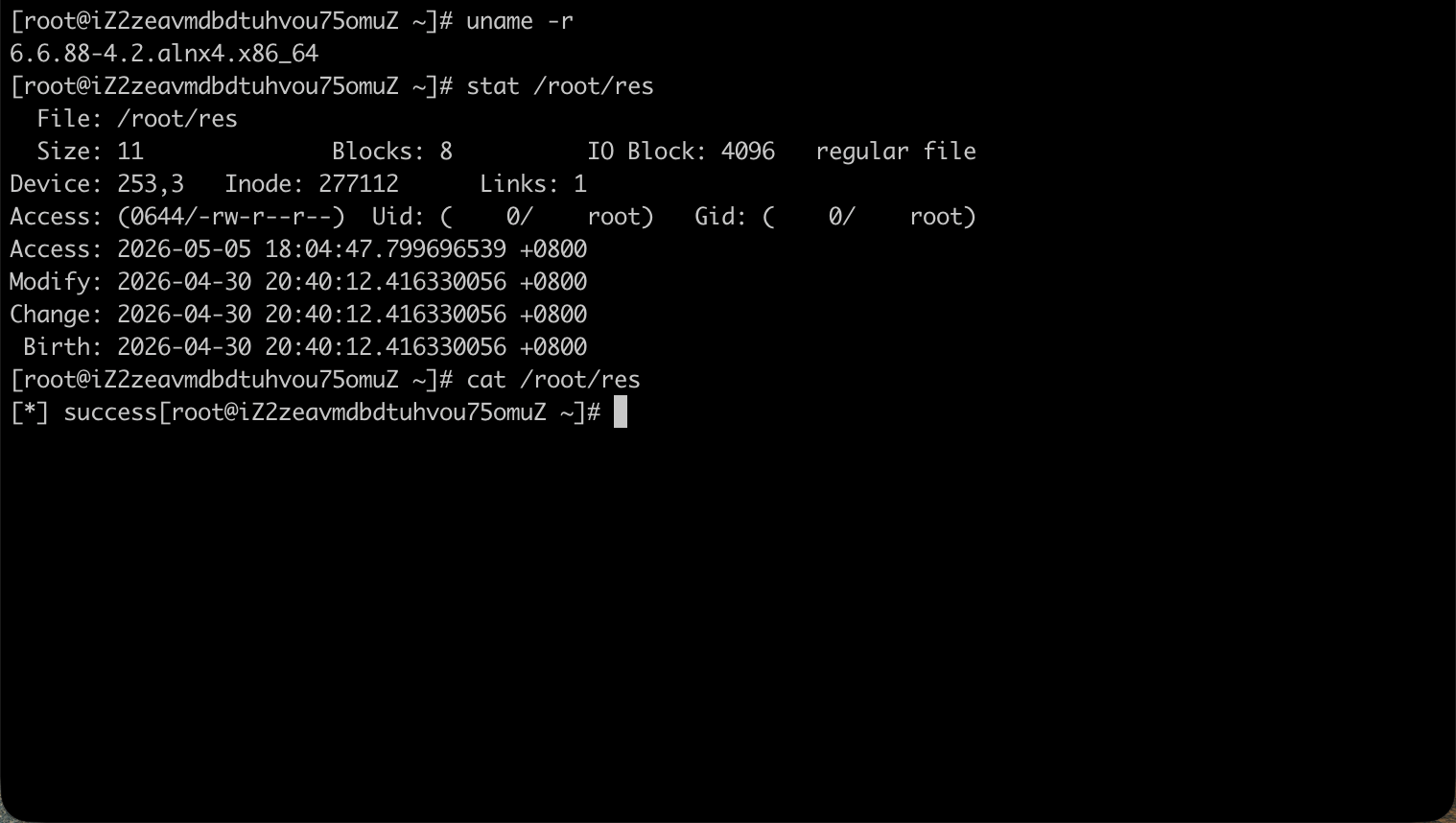 | 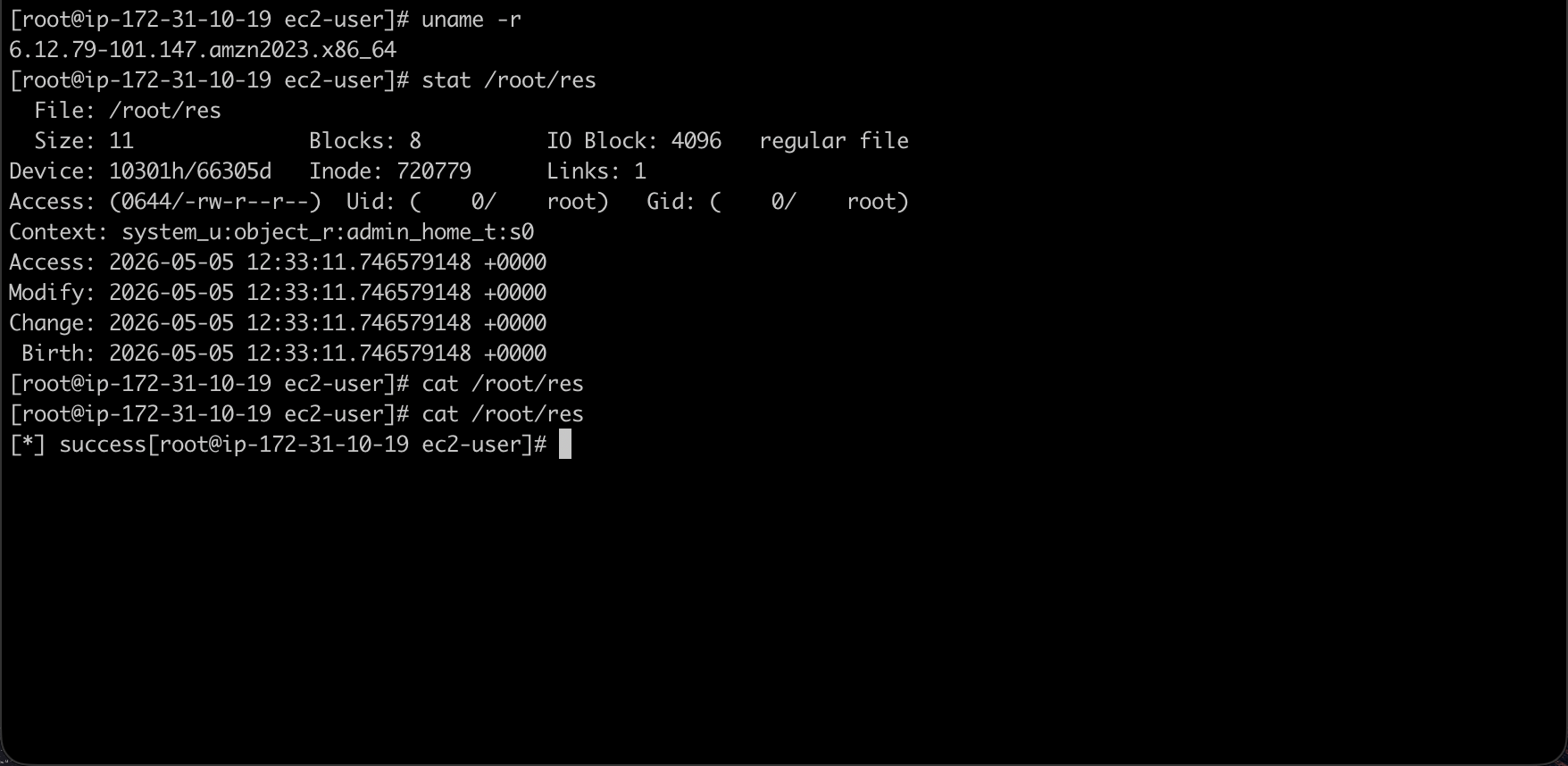 | 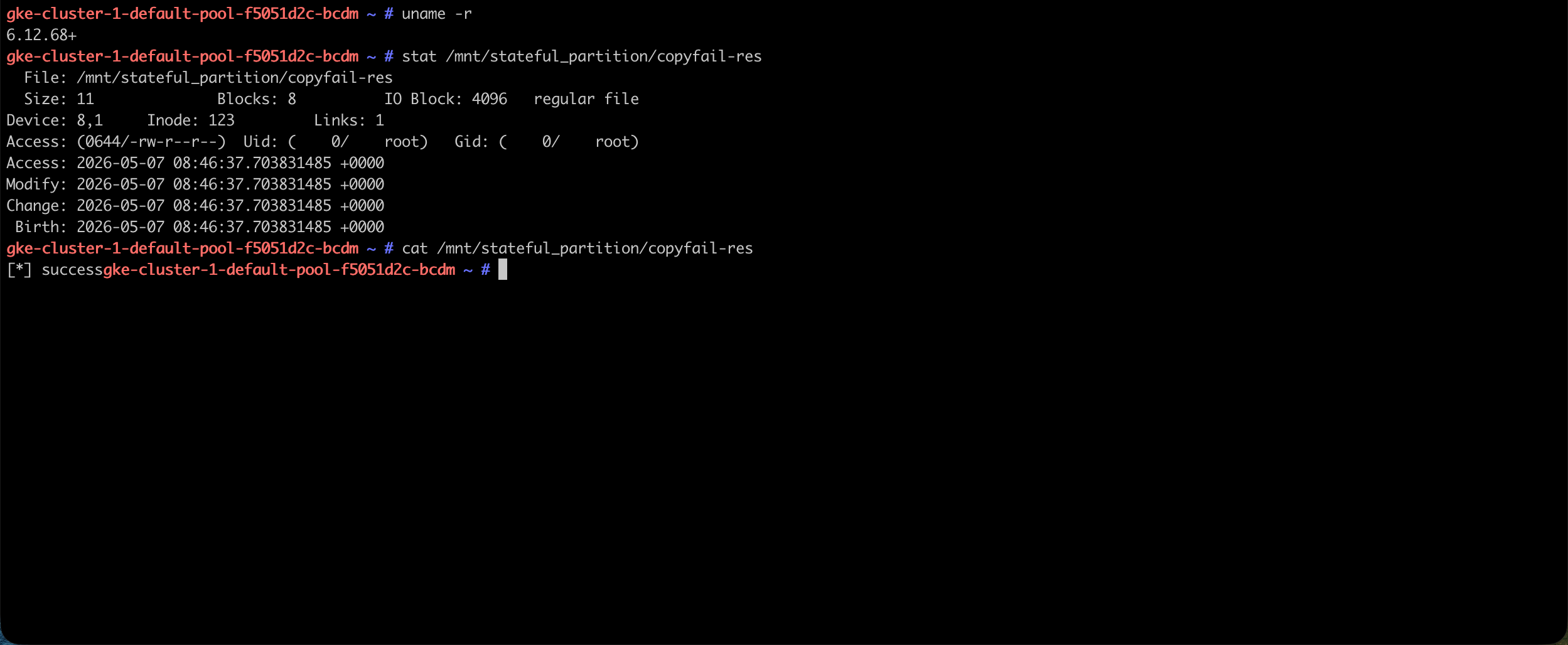 |
Disclaimer: This repository is published for educational and defensive purposes only. Use it exclusively on systems you own or have explicit authorization to test.
CVE-2026-31431 ("Copy Fail") is a Linux kernel vulnerability in the page-cache Copy-on-Write (CoW) path. An AF_ALG splice race allows an unprivileged process to corrupt the page-cache pages of a read-only file. The corruption persists in the kernel page cache and is visible to every process that subsequently reads or executes the file — including processes in other containers or on the host.
For full details on the original vulnerability, see copy.fail.
The attack exploits three properties that commonly coexist in Kubernetes clusters:
privileged: true, hostNetwork: true, broad capabilities, etc.) that periodically execute binaries from their image.When these conditions align, an unprivileged pod can corrupt a binary in a shared image layer, and a privileged DaemonSet on the same node will unknowingly execute the corrupted binary with its elevated privileges — achieving full node-level code execution.
The vulnerability target is NOT limited to kube-proxy. Any privileged DaemonSet (monitoring agents, CNI plugins, log collectors, security agents, etc.) whose container image shares layers with an attacker-controlled image is a viable target.
The attack chain has three stages: page-cache corruption, cross-container propagation, and privileged execution.
The kernel's AF_ALG (crypto) subsystem exposes a socket-based interface for userspace cryptographic operations. The exploit abuses a race condition in how the kernel handles splice() from a file into an AF_ALG socket:
authencesn(hmac(sha256),cbc(aes)).MSG_MORE, telling the kernel to expect more data.splice() the target file's contents from an fd → pipe → AF_ALG socket.The exploit repeats this for each 4-byte window until the entire target binary's cached pages are overwritten with a custom payload.
No write permission to the file is needed. The file on disk is unchanged — only the in-memory page cache is corrupted.
Container runtimes use overlay filesystems. When two containers share the same image layer, the kernel serves their file reads from the same page-cache pages.
The attacker builds their PoC image FROM the same base image as the target privileged DaemonSet. Because both containers share the same overlay lower-dir, binaries in the shared layer map to identical page-cache pages.
When the unprivileged PoC container corrupts a binary's page cache, the corruption is immediately visible to the privileged container on the same node — with zero cross-container communication.
When the privileged DaemonSet next executes any corrupted binary (through its normal operation cycle), the kernel loads the corrupted page-cache pages. The attacker's payload runs with the DaemonSet's full privileges — potentially including:
The payload in this PoC (payload/payload.c) simply mounts the host root filesystem and writes a marker file to /root/res as proof of node-level code execution.
┌──────────────────────────┐     ┌──────────────────────────┐
│   PoC Container          │     │   Privileged DaemonSet   │
│   (unprivileged)         │     │   (e.g. kube-proxy,      │
│                          │     │    monitoring agent, etc.)│
│  1. Open target binary   │     │                          │
│     (read-only)          │     │                          │
│                          │     │                          │
│  2. AF_ALG splice race   │     │                          │
│     corrupts page cache  │     │                          │
│          │               │     │                          │
└──────────┼───────────────┘     └──────────────────────────┘
           │                                  │
           ▼                                  │
  ┌─────────────────────┐                     │
  │  Kernel Page Cache   │                     │
  │                      │◄────────────────────┘
  │  Shared-layer binary │     3. DaemonSet executes the
  │  (CORRUPTED)         │        corrupted binary
  │  contains attacker's │        → loads corrupted pages
  │  payload bytes       │        → payload runs with
  └─────────────────────┘           DaemonSet's privileges
The PoC has been successfully validated on the following managed Kubernetes platforms:
| Property | Value |
|---|---|
| Platform | Alibaba Cloud Container Service for Kubernetes (ACK) |
| Kubernetes | v1.35.2 |
| Node Kernel | 6.6.88-4.2.alnx4.x86_64 |
| kube-proxy | registry-cn-*.ack.aliyuncs.com/acs/kube-proxy:v1.35.2-aliyun.1 |
| Base Image | registry.k8s.io/kube-proxy:v1.35.2 (upstream) |
| Root Device | /dev/vda3 (ext4) |
| Property | Value |
|---|---|
| Platform | Amazon Elastic Kubernetes Service (EKS) |
| Kubernetes | v1.35.4 |
| Node Kernel | 6.12.79-101.147.amzn2023.x86_64 |
| kube-proxy | ***.dkr.ecr.***.amazonaws.com.cn/eks/kube-proxy:v1.35.3-eksbuild.2 |
| Base Image | public.ecr.aws/eks-distro-build-tooling/eks-distro-minimal-base-iptables:2026-03-11-1773190710.2023 |
| Root Device | /dev/nvme0n1p1 (xfs) |
