 pa55w0rd/cve-2019-0708
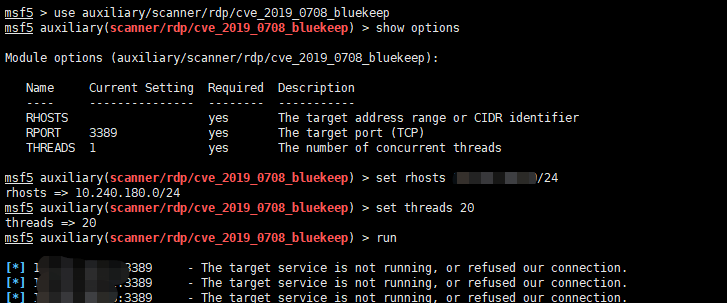
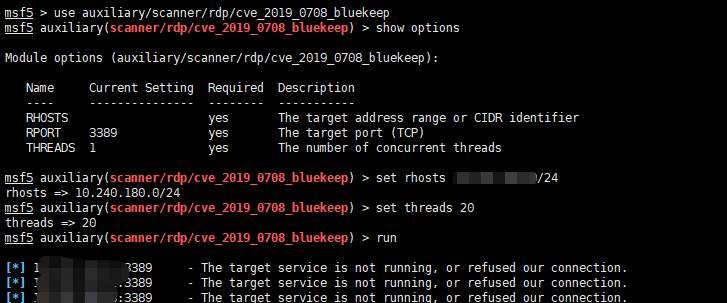
CVE-2019-0708批量检测

CVE-2019-0708 Windows RDP Remote Code Execution Vulnerability
On May 15, 2019, a high-risk vulnerability was disclosed for Windows series servers. This vulnerability affects a wide range of systems, including Windows 2003, Windows 2008, Windows 2008 R2, Windows XP*, all of which are susceptible to attack. The exploitation method for this server vulnerability involves the remote desktop port 3389 and the RDP protocol. The CVE-2019-0708 vulnerability bypasses user authentication checks, allowing an attacker to connect directly via the RDP protocol without any interaction, sending malicious code and executing commands on the server. This is the most severe vulnerability of the year in terms of damage potential. In other words, this vulnerability is "wormable," meaning any malware exploiting it could propagate from an affected computer to other affected computers, similar to how the WannaCry malware spread globally in 2017. It is comparable to previous ransomware and EternalBlue viruses.
Since there are many servers running Windows systems, mass detection is needed. Although blocking TCP port 3389 at the border firewall can protect servers from external attacks, for internal lateral attacks, measures such as applying patches and other methods are still necessary to ensure server security.
0708detector.exe is a detection tool for the Windows Remote Desktop Protocol vulnerability CVE-2019-0708, released by 360Vulcan Team of 360 Company. In principle, this scanner will not cause a blue screen on the target system. Please test before use.
Program checksum MD5 (to prevent bundled backdoors/Trojans): febc027cee2782dba25b628ce3a893d6 *0708detector.exe
For usage and result interpretation, please refer to readme.txt.
Environment
python3.6
win10
Usage
> python cve-2019-0708_v1.py -h
usage: cve-2019-0708_v1.py [-h] [-p PORT] [-t TARGET | -f FILE]

Example: python cve-2019-0708_v1.py -t 192.168.1.0/24 -p 3389

optional arguments:
  -h, --help            show this help message and exit
  -p PORT, --port PORT  Default port 3389
  -t TARGET, --target TARGET
                        Can be a single IP address or CIDR format, e.g. 192.168.1.0/24. Note: In CIDR format,
                        the first part must be the network address of the IP range.
  -f FILE, --file FILE  Input IP address file
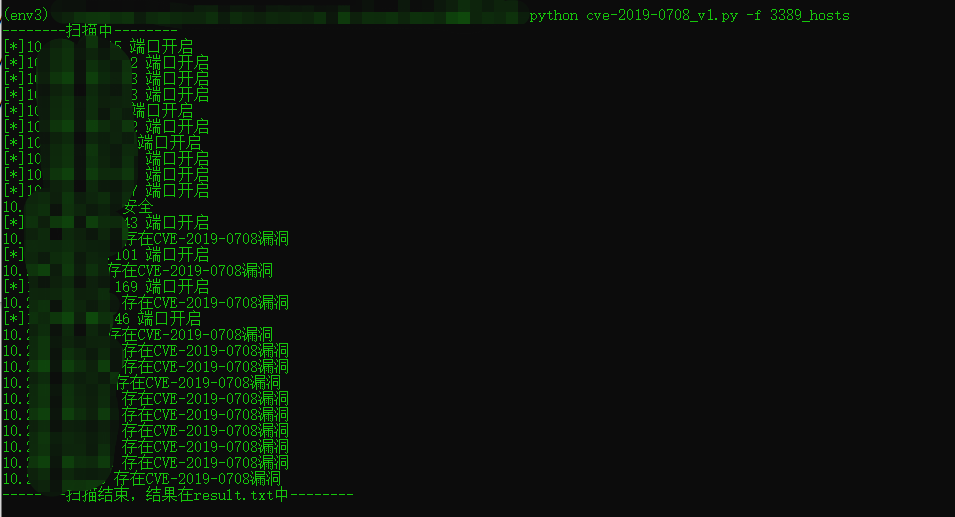
The process first checks if port 3389 is open via telnet, then uses multi-threading to call the 360 non-destructive scanner for scanning.
Error Handling
Solution for error 'ValueError: IP('1.1.1.1/24') has invalid prefix length (24)'

This is caused by the CIDR format of the IP address. According to the IPy library specification, the first part must be the network address of the IP range. Correct examples are as follows:

1.1.1.0/24 : 1.1.1.0~1.1.1.255

1.1.1.128/25 : 1.1.1.128~1.1.1.255

1.1.1.64/26 : 1.1.1.64~1.1.1.127

1.1.1.32/27 : 1.1.1.32~1.1.1.63

1.1.1.16/28 : 1.1.1.16~1.1.1.31