
Skip to content
KitploitKITPLOIT
ToolsBlog
Submit
ToolsBlog
Submit

Hacking, PenTest, and Cybersecurity Tools for Your Security Arsenal!

Kitploit is a directory of hacking, cybersecurity, and pentesting tools. Discover the latest project updates to find vulnerabilities, analyze systems, automate testing, and strengthen your security.

··Feeds·Contact·Privacy·© 2026 Kitploit

Tool Directory

Categories

View all categories
Loading categories
CVE-2026-20817 — Proof-of-concept exploit for CVE-2026-20817, a local privilege escalation in Windows Error Reporting (WER) via ALPC, allowing low-privileged users to execute code as SYSTEM. | Kitploit
Tools/GitHubGitHub/oxfemale/cve-2026-20817
Privilege EscalationExploit FrameworksVulnerability AnalysisExploitationBinary Exploitation
GitHuboxfemale/cve-2026-20817

CVE-2026-20817

Proof-of-concept exploit for CVE-2026-20817, a local privilege escalation in Windows Error Reporting (WER) via ALPC, allowing low-privileged users to execute code as SYSTEM.

View Repository
128236 months agoReviewed by Kitploit

Most Popular

View all →

Discover the most used tools by our community.

Explore all tools

Browse our collection of tools

View all tools →
Share

CVE-2026-20817 - Windows Error Reporting (WER) ALPC Privilege Escalation

CVE-2026-20817

Description

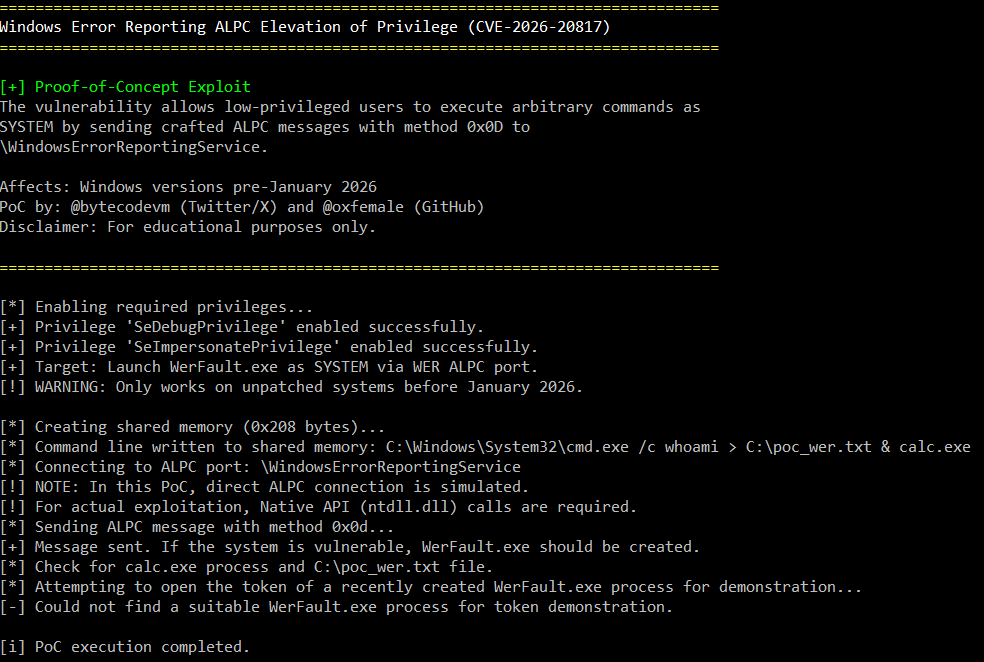
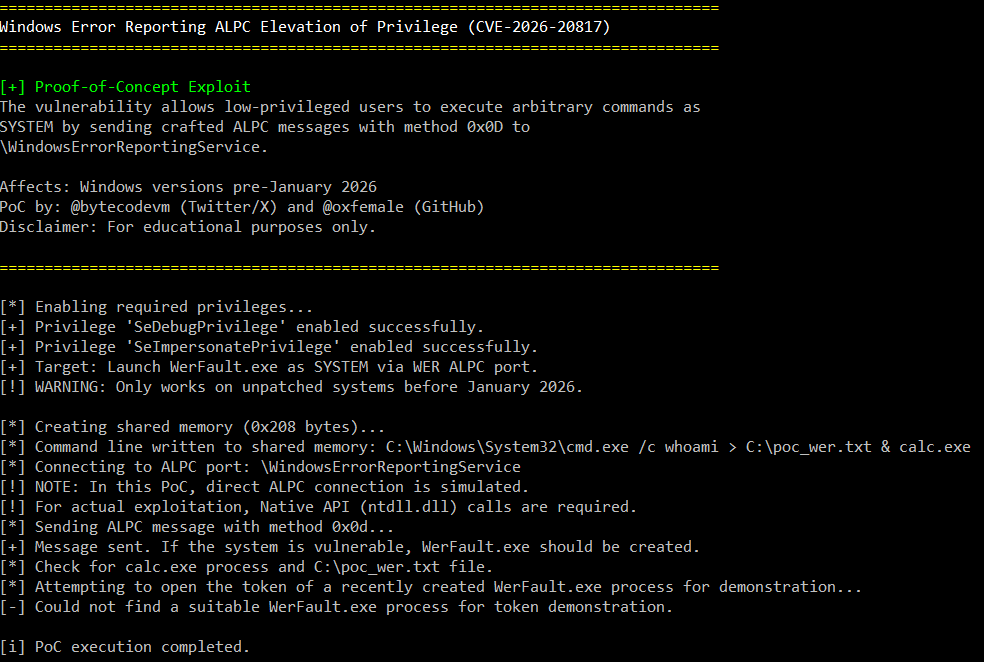
This repository contains a Proof-of-Concept (PoC) for CVE-2026-20817, a local privilege escalation vulnerability in the Windows Error Reporting (WER) service. The vulnerability allows an authenticated low-privileged user to execute arbitrary code with SYSTEM privileges by sending specially crafted ALPC messages to the WER service.

Author

Original research and PoC by:

  • Twitter/X: @bytecodevm
  • GitHub: @oxfemale

Vulnerability Details

  • CVE ID: CVE-2026-20817
  • Component: Windows Error Reporting (WER) Service
  • Attack Vector: Local (ALPC)
  • Privileges Required: Low (authenticated user)
  • Impact: Elevation to SYSTEM
  • Patched: January 2026 Security Update

Technical Overview

The WER service exposes an ALPC port named \WindowsErrorReportingService and provides various methods for interprocess communication. The vulnerability exists in the SvcElevatedLaunch method (0x0D), where the service fails to properly validate the caller's privileges before launching WerFault.exe with user-supplied command line parameters from shared memory.

How it works

  1. Create shared memory containing arbitrary command line
  2. Connect to WER ALPC port
  3. Send ALPC message with method 0x0D, including:
    • Client process ID
    • Shared memory handle
    • Command line length
  4. WER service duplicates the handle and launches WerFault.exe with the provided command line
  5. Resulting process runs with SYSTEM privileges

Privileges Obtained

The spawned WerFault.exe process runs with a SYSTEM token containing:

PrivilegeDescription
SeDebugPrivilegeDebug any process
SeImpersonatePrivilegeImpersonate any user
Various standard SYSTEM privilegesFull system access

Note: The token does NOT include SeTcbPrivilege (Act as part of the operating system).

Affected Systems

  • Windows 10 (all versions before January 2026)
  • Windows 11 (all versions before January 2026)
  • Windows Server 2019 (pre-January 2026)
  • Windows Server 2022 (pre-January 2026)

Warning

This PoC is for educational and research purposes only. Use only on systems you own or have explicit permission to test. Unauthorized use may violate laws and regulations.

Building the PoC

Requirements

  • Windows SDK
  • Visual Studio (2019 or later recommended)
  • C++17 compatible compiler

Compilation

root@kitploit:~
# Using Visual Studio Developer Command Prompt
cl /EHsc CVE-2026-20817_PoC.cpp
Download Tool