
 owasp/apts
OWASP Autonomous Penetration Testing Standard







A governance standard for autonomous penetration testing platforms. It defines what these systems must do to operate safely, transparently, and within defined boundaries, whether they are delivered by vendors, operated as a service, or built in-house by enterprise security teams for testing their own organization.
APTS is not a testing methodology. It complements PTES, OWASP WSTG, and OSSTMM by addressing the problems unique to autonomous operation: scope enforcement, safe autonomy, manipulation resistance, and accountability.
| Domain | Prefix | Requirements | Description |
|---|---|---|---|
| Scope Enforcement | SE | 26 | Defining, validating, and enforcing testing boundaries |
| Safety Controls | SC | 20 | Impact classification, blast radius, kill switches, rollback, execution sandbox |
| Human Oversight | HO | 19 | Approval gates, dashboards, escalation, operator qualifications |
| Graduated Autonomy | AL | 28 | Four autonomy levels (L1 Assisted through L4 Autonomous) |
| Auditability | AR | 20 | Logging, decision trails, evidence integrity, audit trail isolation |
| Manipulation Resistance | MR | 23 | Prompt injection, adversarial inputs, scope widening defense |
| Supply Chain Trust | TP | 22 | AI provider trust, data handling, multi-tenancy isolation, foundation model disclosure |
| Reporting | RP | 15 | Finding validation, confidence scoring, coverage disclosure |
Nineteen additional advisory practices live exclusively in the Advisory Requirements appendix under the APTS-<DOMAIN>-A0x identifier pattern. Advisory practices are not counted toward any tier and do not affect conformance.
APTS has no certification body, no mandatory third-party audit, and no fee. Platforms are assessed against the requirements and conformance is documented. The standard does not prescribe who performs the assessment; internal self-assessment, independent internal review, and external third-party assessment are all valid approaches, and the choice is left to the reader.
Requirements use the format APTS-XX-NNN where XX is the domain prefix and NNN is the requirement number (for example, APTS-SE-001). For versioned references in contracts or evaluations, use APTS-v0.1.0-SE-001.
Use this reader path to choose the shortest route through APTS based on your role and goal after reviewing the framework overview, domains, and tier structure above.
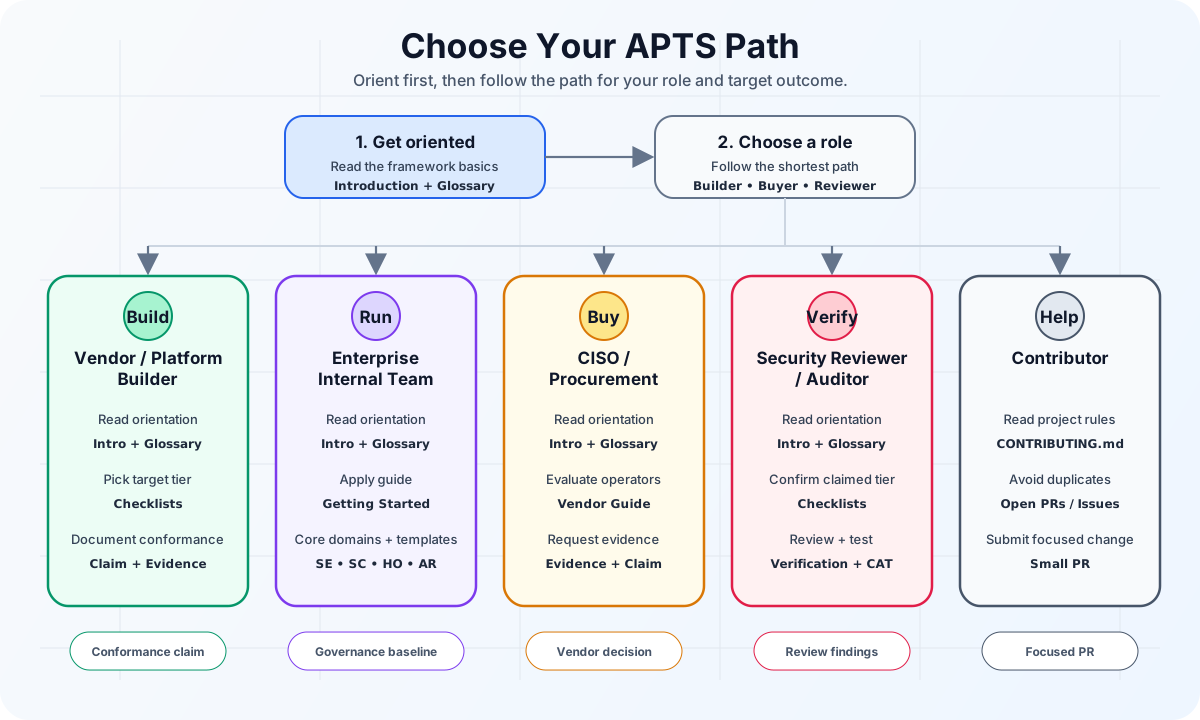
| Role | Start with | Then use | Outcome |
|---|---|---|---|
| New to APTS | Introduction, Glossary | Getting Started guide | Understand the framework and scope |
| Vendor or platform builder | Introduction, Glossary, then Checklists for target tier | Domain READMEs, Implementation Guides, Conformance Claim Template, Evidence Package Manifest | Documented conformance and evidence package |
| Enterprise internal team | Introduction, Glossary, then Getting Started | Core domains (SE, SC, HO, AR), templates | Internal governance baseline |
| CISO or procurement lead | Introduction, Glossary, then Vendor Evaluation Guide | Evidence Request Checklist, Evidence Package Manifest, conformance claim | Vendor evaluation decision |
| Security reviewer or auditor | Introduction, Glossary, then claimed tier and Checklists | Domain verification sections, Customer Acceptance Testing | Independent review findings |
| Contributor | CONTRIBUTING.md | Existing issues and PRs | Small, reviewable PR |
This orientation aid is informative and does not create or modify APTS requirements.
The full standard with all requirements, verification procedures, checklists, and appendices is in the standard/ folder.
