
Skip to content
KitploitKITPLOIT
ToolsExploitsBlog
Submit
ToolsExploitsBlog
Submit

Hacking, PenTest, and Cybersecurity Tools for Your Security Arsenal!

Kitploit is a directory of hacking, cybersecurity, and pentesting tools. Discover the latest project updates to find vulnerabilities, analyze systems, automate testing, and strengthen your security.

··Feeds·Contact·Privacy·© 2026 Kitploit

Tool Directory

Categories

View all categories
Loading categories
NetworkSandboxEngine — A deterministic network sandbox for testing nftables rules. It uses ephemeral Linux network namespaces (netns) and Scapy to validate firewall logic safely. | Kitploit
Tools/GitHubGitHub/onyks-os/networksandboxengine
Defensive ToolsPacket Sniffing & AnalysisScripting & AutomationConfiguration AuditingNetwork SecurityDevSecOps
GitHubonyks-os/networksandboxengine

NetworkSandboxEngine

A deterministic network sandbox for testing nftables rules. It uses ephemeral Linux network namespaces (netns) and Scapy to validate firewall logic safely.

View Repository
271 day agoNot yet reviewed

Most Popular

View all →

Discover the most used tools by our community.

Explore all tools

Browse our collection of tools

View all tools →
Website
Share

Network Sandbox Engine (NSE)

A Linux engine for deterministic nftables firewall testing inside isolated network namespaces.

Linux Python CI Status Documentation PyPI License

Why NSE? • Features • Requirements • Installation • Quickstart • How It Works • Project Structure


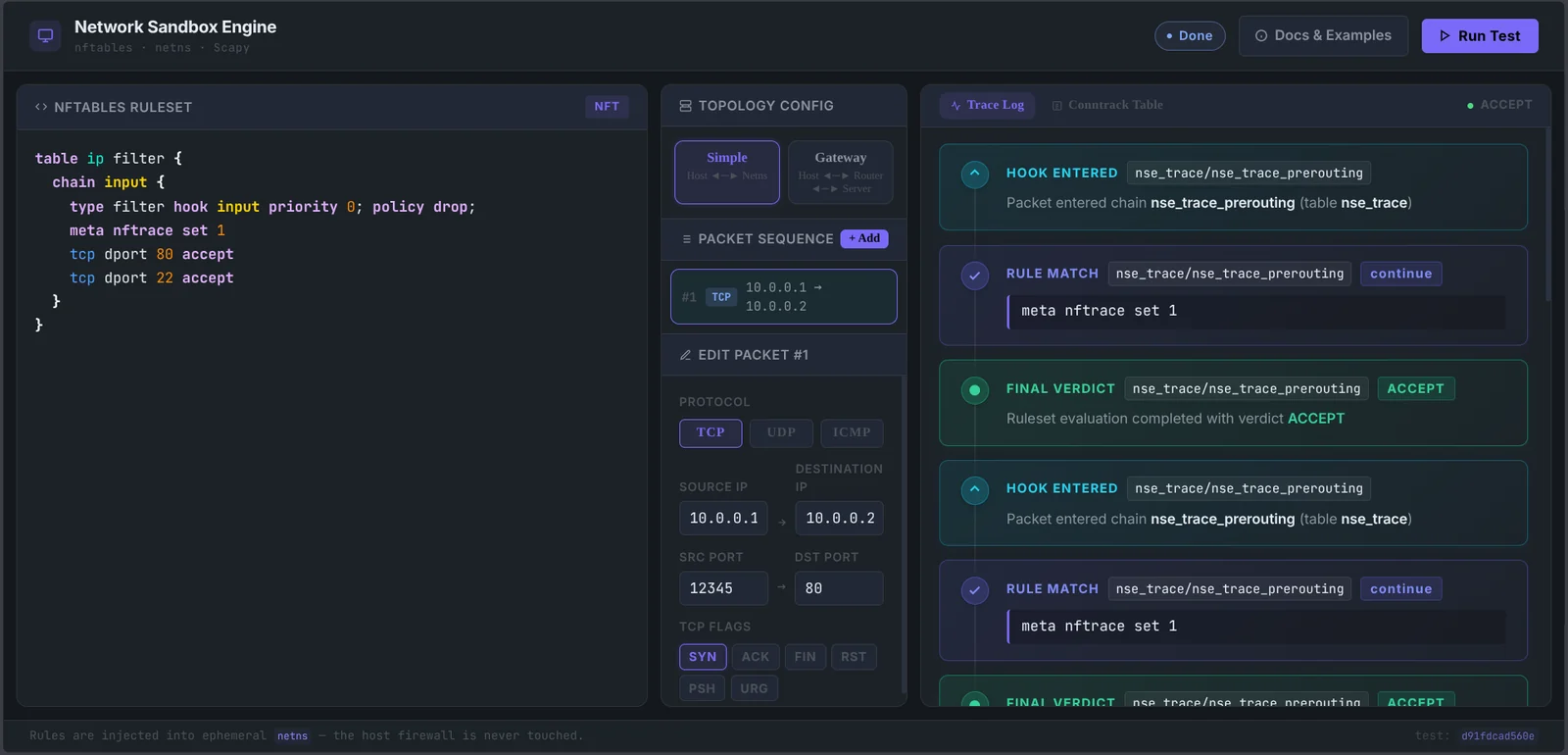
Network Sandbox Engine Interface


Why NSE?

Testing firewall rulesets on a live Linux system poses significant risks: malformed rules can drop SSH management sessions, leak cleartext traffic during testing, or leave orphan firewall tables active on the host.

Network Sandbox Engine (NSE) provides a safe, reproducible testing harness. It constructs ephemeral Linux network namespaces, wires virtual ethernet pairs, compiles nftables rulesets, and injects synthetic Layer 2 and Layer 3 packets using Scapy. All evaluation happens inside the sandbox namespace: host firewall state is never altered.

Key architectural properties:

  • Zero Host Mutation: Rulesets are loaded exclusively into ephemeral sandbox namespaces (nse_<uuid>) and are completely removed during teardown.
  • Self-verifying Oracle: Every run injects a canary packet before the test packets and again after them, and reports a result only if the kernel trace for both was observed. See The oracle contract.
  • Dual-Stack and Topologies: Native support for IPv4 and IPv6 traffic, plus multi-namespace Gateway topologies for router, NAT, and forwarding ruleset validation.
  • Small, auditable surface: One package, no web server, no JavaScript. nse/ is ~1150 statements at 98% test coverage.

Requires root

NSE creates network namespaces, loads nftables rulesets and reads kernel trace events, so it runs as root. It does not open a socket, a port or an RPC endpoint of any kind — it is a library and a CLI that you invoke, and it holds privileges only for the duration of a run.

Version 2.1.0 removed the FastAPI/Svelte web interface that earlier releases shipped. That interface ran in-process as root from 2.0.0 onward, which was a large attack surface for a testing tool; the code remains in the git history at tag v2.0.0 if you need it.


The oracle contract

A firewall test is a negative assertion — "this packet did not get through" — and a negative assertion is worth nothing unless the instrument is known to be working. A trace monitor that never attached to the kernel and a firewall that blocked everything produce byte-identical output.

NSE therefore refuses to report a verdict it cannot show it measured:

Canary packets are excluded from results by trace id, so they never appear in your verdict stream.

The suite proves this holds, rather than asserting it: make test-blind forces the parser to understand nothing, and the build fails unless the runner exits non-zero. That job runs in CI on every push.


Features

  • In-Process Engine: Direct Python API (run_test_pipeline) returning structured Pydantic models (TestRequest, TraceEvent).
  • Scapy Packet Injection: Forge arbitrary TCP (with custom SYN, ACK, FIN, RST flags), UDP, ICMP, and ICMPv6 packets.
  • Isolated Topologies:
    • Simple: Single sandbox namespace (nse_<id>) wired directly to the host.
    • Gateway: Router (nse_router_<id>) and Server (nse_server_<id>) chain for forwarding and NAT testing.
  • Automated Cleanup: Startup sweeps detect and remove leftover namespaces and veth pairs from previous aborted runs. Teardowns include exponential backoff retries.
  • CLI YAML Test Runner: Execute declarative YAML test suites for automated CI/CD pipelines (nse-runner). Exits non-zero on a wrong verdict and on a verdict it failed to observe.
  • Strict Quality Standards: Full static type checking (mypy --strict), architectural boundary enforcement (import-linter), ruff formatting, and a coverage ratchet (, floor 98%).

Requirements

  • Linux OS (Kernel 5.4 or later with network namespace and nftables support)
  • Python 3.10+
  • nftables (nft)
  • iproute2 (ip)
  • Root privileges (required for ip netns and kernel trace operations)

On Debian or Ubuntu systems:

root@kitploit:~
sudo apt update && sudo apt install -y nftables iproute2 conntrack

Installation

1. PyPI Package (Recommended)

Install the core engine with CLI support:

root@kitploit:~
pip install "network-sandbox-engine[cli]"

2. Manual Source Install

For local development:

root@kitploit:~
git clone https://github.com/onyks-os/NetworkSandboxEngine.git
cd NetworkSandboxEngine
make setup

Quickstart

1. Headless Python Library

root@kitploit:~
import asyncio
from nse.core.netns_controller import NetnsController
from nse.core.pipeline import run_test_pipeline
from nse.models.test_request import TestRequest, PacketSpec

rules = """
table ip filter {
    chain input {
        type filter hook input priority 0; policy drop;
        tcp dport 80 accept
    }
}
"""

request = TestRequest(
    rules=rules,
    packets=[
        PacketSpec(protocol="tcp", src_ip="10.0.0.1", dst_ip="10.0.0.2", dst_port=80),
        PacketSpec(protocol="tcp", src_ip="10.0.0.1", dst_ip="10.0.0.2", dst_port=22),
    ],
)


async def main():
    controller = NetnsController()
    events = await run_test_pipeline(request=request, controller=controller)
    for evt in events:
        if evt.verdict:
            print(f"[{evt.chain}] Verdict: {evt.verdict}")


asyncio.run(main())

2. YAML Test Suite Runner (CLI)

Create a test file firewall_test.yaml:

root@kitploit:~
tests:
  - name: "Allow HTTP Port 80, Drop SSH Port 22"
    topology: simple
    rules: |
      table ip filter {
        chain input {
          type filter hook input priority 0; policy drop;
          tcp dport 80 accept
        }
      }
    packets:
      - protocol: tcp
        src_ip: 10.0.0.1
        dst_ip: 10.0.0.2
        dst_port: 80
        expected_verdict: ACCEPT
      - protocol: tcp
        src_ip: 10.0.0.1
        dst_ip: 10.0.0.2
        dst_port: 22
        expected_verdict: DROP

expected_verdict is per packet. Unknown keys are rejected rather than defaulted, so a typo fails the suite instead of quietly becoming an expectation you never wrote.

Run the suite with root privileges:

root@kitploit:~
sudo nse-runner --file firewall_test.yaml

Exit codes: 0 all packets matched; 1 a verdict was wrong or the engine could not observe one. Oracle errors are reported separately from firewall failures, because they mean the measurement broke, not the ruleset.

3. In a container

root@kitploit:~
podman build -t nse .
podman run --rm --cap-add=NET_ADMIN --cap-add=NET_RAW \
    -v "$PWD/firewall_test.yaml:/suite.yaml:ro" nse --file /suite.yaml

Useful for pinning the nftables version your rules are tested against.


How It Works

NSE orchestrates Linux kernel network subsystems and trace interfaces through a structured multi-stage execution pipeline:

root@kitploit:~
graph TD
    subgraph Step1["1. Test Specification"]
        Req["<b>TestRequest</b><br/>ruleset + packets + topology"]
    end

    subgraph Step2["2. Ephemeral Netns Sandbox"]
        direction TB
        Netns["<b>Netns Setup</b><br/>nse_&lt;id&gt; & veth links"]
        RuleEng["<b>Rule Engine</b><br/>validate & load nftables"]
        Inject["<b>Scapy Injector</b><br/>L2/L3 packet injection"]
        NFT["<b>Kernel nftables</b><br/>meta nftrace set 1"]

        Netns --> RuleEng
        RuleEng --> Inject
        Inject --> NFT
    end

    subgraph Step3["3. Trace Evaluation & Oracle"]
        direction TB
        Harvester["<b>Trace Harvester</b><br/>nft monitor trace stream"]
        Oracle["<b>Deterministic Oracle</b><br/>TraceEvents & verdicts"]

        Harvester --> Oracle
    end

    Step1 --> Step2
    Step2 --> Step3
  1. Ruleset Validation: RuleEngine.validate() dry-runs the ruleset using nft --check -f.
  2. Sandbox Provisioning: NetnsController creates the isolated network namespace and configures virtual ethernet (veth) interfaces.
  3. Trace Initialization: Rulesets are loaded into the namespace with kernel tracing armed (meta nftrace set 1).
  4. Packet Injection: ScapyInjector injects synthetic frames across the veth link.
  5. Verdict Harvesting: TraceHarvester captures nft monitor trace events and returns structured TraceEvent objects.
  6. Teardown: The namespace and all associated veth interfaces are automatically deleted.

For complete technical specifications, see the Technical Architecture Guide.


Project Structure

root@kitploit:~
NetworkSandboxEngine/
├── nse/                        # Core PyPI package (network-sandbox-engine)
│   ├── core/                   # Kernel primitives, pipeline, and naming rules
│   ├── models/                 # Pydantic models (TestRequest, PacketSpec, TraceEvent)
│   └── cli/                    # Headless YAML runner entrypoint
├── docs/                       # Architecture specs and MkDocs web documentation
├── tests/                      # Unit, golden file, and privileged e2e tests
│   └── fixtures/nft_trace/     # Golden `nft monitor trace` corpus
├── pyproject.toml              # Build backend configuration
└── Makefile                    # Local automation and CI workflow

Releasing

One tag. git push origin vX.Y.Z builds, signs with Sigstore, publishes the GitHub Release, uploads to TestPyPI, installs from TestPyPI and smoke-tests it, and only then uploads to PyPI. Rehearse with make release-dry.

See docs/RELEASING.md.

Documentation

Full interactive web documentation is available at:
https://onyks-os.github.io/nse/

Build the documentation locally:

root@kitploit:~
make docs

Serve the documentation with hot-reload on http://127.0.0.1:8000:

root@kitploit:~
make docs-serve

Testing & Local CI

Run static linting and unit tests:

root@kitploit:~
make verify

Run full local CI verification (includes linting, unit tests, frontend build, docs build, PyPI smoke test, and privileged integration tests):

root@kitploit:~
make ci-local

License

This project is licensed under the MIT License.

Download Tool
GuaranteeMechanism
The monitor was attached before the first test packetA readiness canary is injected and re-injected until its kernel trace is observed. No observation, no run.
The monitor was still attached after the last oneA liveness canary runs after injection. If it is missed, the verdict stream is declared truncated.
The parser understood what the kernel saidTrace lines that no pattern matches are counted, and any count above zero is an error rather than a debug log.
The monitor did not die quietlyThe read loop records why it ended — clean stop, unexpected EOF, timeout or crash — and only a clean stop is acceptable.
A missing verdict is not a passThe CLI runner fails when the number of observed verdicts differs from the number expected, in either direction.
make test-cov