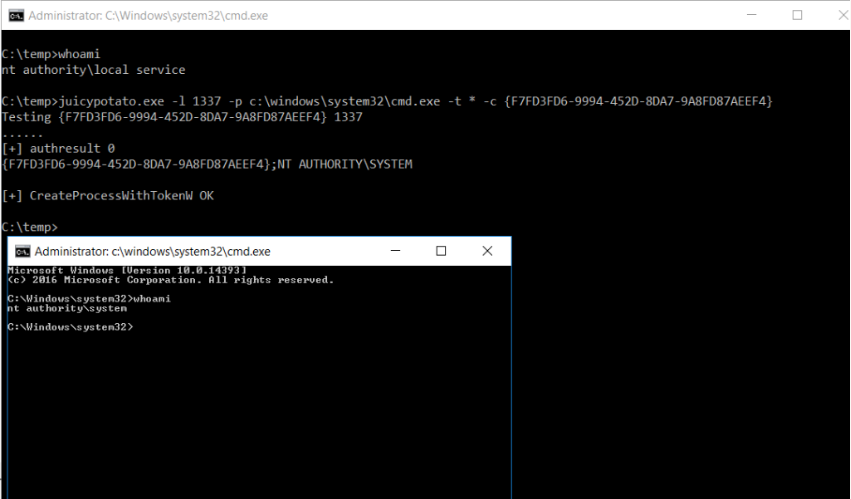
 ohpe/juicy-potato
A sugared version of RottenPotatoNG, with a bit of juice, i.e. another Local Privilege Escalation tool, from a Windows Service Accounts to NT AUTHORITY\SYSTEM.

A sugared version of RottenPotatoNG, with a bit of juice, i.e. another Local Privilege Escalation tool, from a Windows Service Accounts to NT AUTHORITY\SYSTEM
RottenPotatoNG and its variants leverages the privilege escalation chain based on BITS service having the MiTM listener on 127.0.0.1:6666 and when you have SeImpersonate or SeAssignPrimaryToken privileges. During a Windows build review we found a setup where BITS was intentionally disabled and port 6666 was taken.
We decided to weaponize RottenPotatoNG: Say hello to Juicy Potato.
For the theory, see Rotten Potato - Privilege Escalation from Service Accounts to SYSTEM and follow the chain of links and references.
We discovered that, other than BITS there are a several COM servers we can abuse. They just need to:
IMarshal interfaceAfter some testing we obtained and tested an extensive list of interesting CLSID's on several Windows versions.
JuicyPotato allows you to:
Target CLSID
pick any CLSID you want. Here you can find the list organized by OS.
COM Listening port
define COM listening port you prefer (instead of the marshalled hardcoded 6666)
COM Listening IP address
bind the server on any IP
Process creation mode
depending on the impersonated user's privileges you can choose from:
CreateProcessWithToken (needs SeImpersonate)CreateProcessAsUser (needs SeAssignPrimaryToken)bothProcess to launch
launch an executable or script if the exploitation succeeds
Process Argument
customize the launched process arguments
RPC Server address
for a stealthy approach you can authenticate to an external RPC server
RPC Server port
useful if you want to authenticate to an external server and firewall is blocking port 135...
TEST mode
mainly for testing purposes, i.e. testing CLSIDs. It creates the DCOM and prints the user of token. See here for testing
T:\>JuicyPotato.exe
JuicyPotato v0.1

Mandatory args:
-t createprocess call: <t> CreateProcessWithTokenW, <u> CreateProcessAsUser, <*> try both
-p <program>: program to launch
-l <port>: COM server listen port


Optional args:
-m <ip>: COM server listen address (default 127.0.0.1)
-a <argument>: command line argument to pass to program (default NULL)
-k <ip>: RPC server ip address (default 127.0.0.1)
-n <port>: RPC server listen port (default 135)
-c <{clsid}>: CLSID (default BITS:{4991d34b-80a1-4291-83b6-3328366b9097})
-z only test CLSID and print token's user
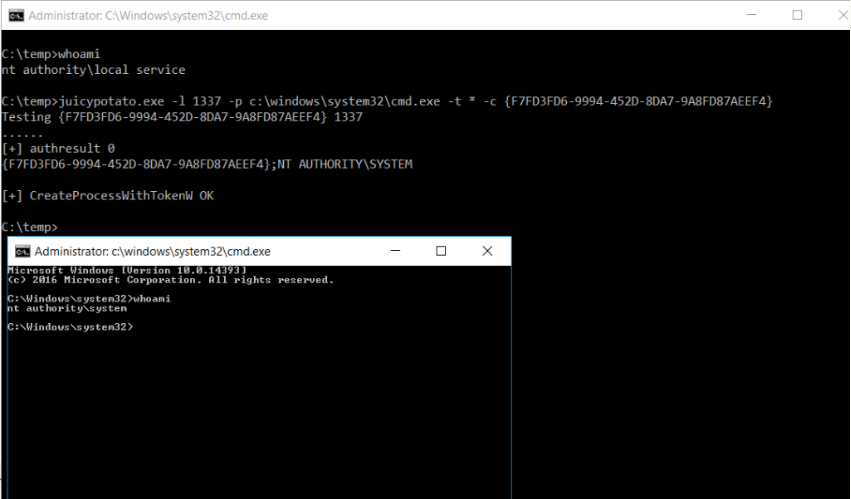
If the user has SeImpersonate or SeAssignPrimaryToken privileges then you are SYSTEM.
It's nearly impossible to prevent the abuse of all these COM Servers. You could think to modify the permissions of these objects via DCOMCNFG but good luck, this is gonna be challenging.
The actual solution is to protect sensitive accounts and applications which run under the * SERVICE accounts.
Stopping DCOM would certainly inhibit this exploit but could have a serious impact on the underlying OS.
An automatic build is available. Binaries can be downloaded from the Artifacts section here.
Also available in BlackArch.
