nicocha30/ligolo-ng
An advanced, yet simple, tunneling/pivoting tool that uses a TUN interface.

An advanced, yet simple, tunneling tool that uses TUN interfaces.


📑 Ligolo-ng Documentation (Setup/Quickstart)
[!TIP] Ligolo-ng 0.8 added a lot of new features, including:
- 🌐 API and a beautiful Web Interface thanks to L'ami du Raisin, allowing multiplayer!
- ⚙️ Simple configuration file, to keep your tunneling/proxy settings
- 🚦 Daemon mode, to run Ligolo-ng as a service
- 🔗 Auto-bind, to automatically configure tunneling whenever a specific agent connects
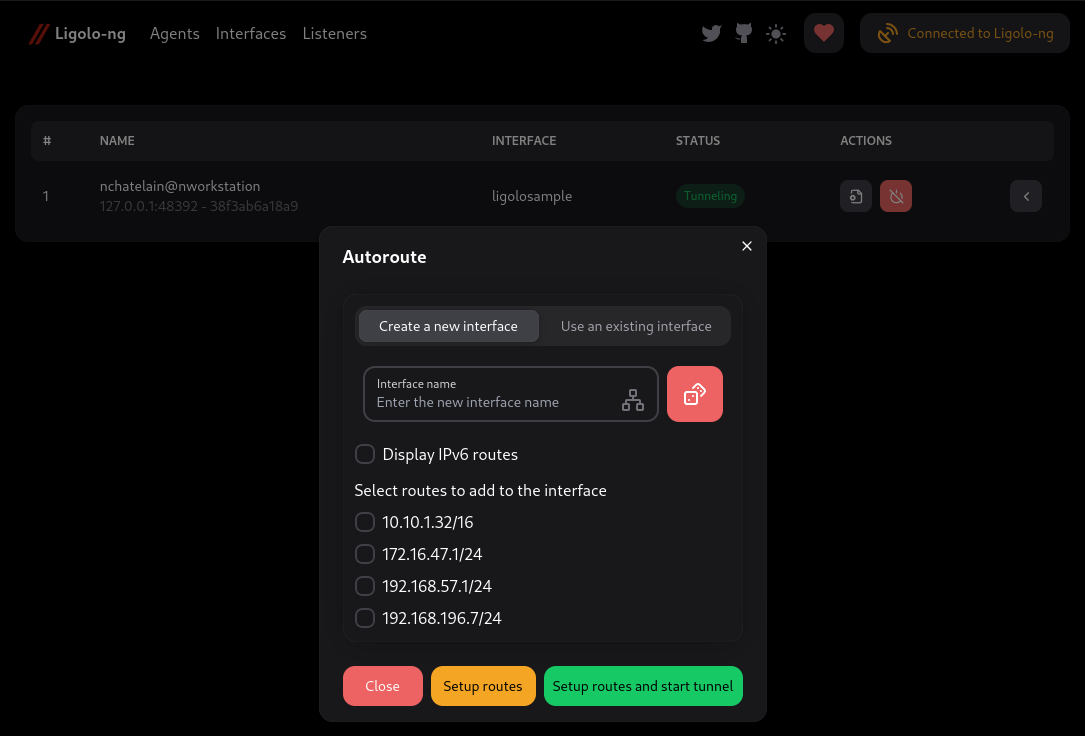
- 📶 Easy and automatic (autoroute) route and interface management on Windows, Linux, MacOS and BSD!
- 💀 Agent kill, to remotely terminate an agent
Please try it out!
Ligolo-ng is a simple, lightweight and fast tool that allows pentesters to establish tunnels from a reverse TCP/TLS connection using a tun interface (without the need of SOCKS).
Instead of using a SOCKS proxy or TCP/UDP forwarders, Ligolo-ng creates a userland network stack using Gvisor.
When running the relay/proxy server, a tun interface is used, packets sent to this interface are translated, and then transmitted to the agent remote network.
As an example, for a TCP connection:
This allows running tools like nmap without the use of proxychains (simpler and faster).
You will find the documentation for Ligolo-ng, as well as the steps to follow to get it up and running on the Ligolo-ng Documentation
On the agent side, no! Everything can be performed without administrative access.
However, on your relay/proxy server, you need to be able to create a tun interface.
You can easily hit more than 100 Mbits/sec. Here is a test using iperf from a 200Mbits/s server to a 200Mbits/s connection.
$ iperf3 -c 10.10.0.1 -p 24483
Connecting to host 10.10.0.1, port 24483
[  5] local 10.10.0.224 port 50654 connected to 10.10.0.1 port 24483
[ ID] Interval           Transfer     Bitrate         Retr  Cwnd
[  5]   0.00-1.00   sec  12.5 MBytes   105 Mbits/sec    0    164 KBytes
[  5]   1.00-2.00   sec  12.7 MBytes   107 Mbits/sec    0    263 KBytes
[  5]   2.00-3.00   sec  12.4 MBytes   104 Mbits/sec    0    263 KBytes
[  5]   3.00-4.00   sec  12.7 MBytes   106 Mbits/sec    0    263 KBytes
[  5]   4.00-5.00   sec  13.1 MBytes   110 Mbits/sec    2    134 KBytes
[  5]   5.00-6.00   sec  13.4 MBytes   113 Mbits/sec    0    147 KBytes
[  5]   6.00-7.00   sec  12.6 MBytes   105 Mbits/sec    0    158 KBytes
[  5]   7.00-8.00   sec  12.1 MBytes   101 Mbits/sec    0    173 KBytes
[  5]   8.00-9.00   sec  12.7 MBytes   106 Mbits/sec    0    182 KBytes
[  5]   9.00-10.00  sec  12.6 MBytes   106 Mbits/sec    0    188 KBytes
- - - - - - - - - - - - - - - - - - - - - - - - -
[ ID] Interval           Transfer     Bitrate         Retr
[  5]   0.00-10.00  sec   127 MBytes   106 Mbits/sec    2             sender
[  5]   0.00-10.08  sec   125 MBytes   104 Mbits/sec                  receiver
Because the agent is running without privileges, it's not possible to forward raw packets. When you perform a NMAP SYN-SCAN, a TCP connect() is performed on the agent.
When using nmap, you should use --unprivileged or -PE to avoid false positives.