 nick0ve/how-to-bypass-aslr-on-linux-x86_64
ASLR bypass without infoleak

In this article, I'll discuss about the application of the technique described by Samuel Groß in his Remote iPhone Exploitation Part 2: Bringing Light into the Darkness -- a Remote ASLR Bypass, to bypass ASLR on Linux x86_64.
To show this I'm gonna solve a pwnable challenge from Buckeye CTF, guess_god.
I'll try to keep the content as beginner friendly as possible, so feel free to skip any section if you feel confident enough and just want to see the exploit.
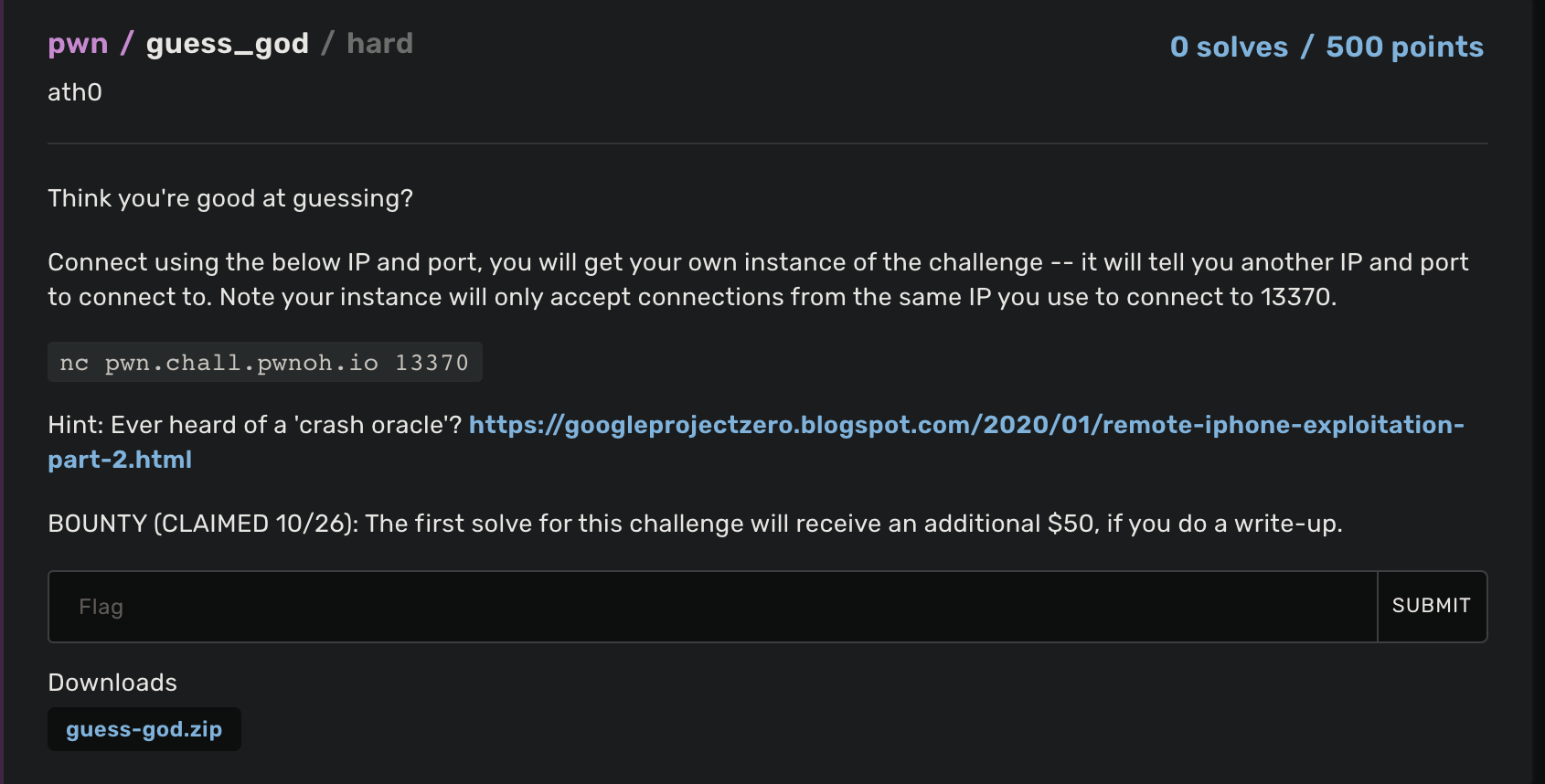
I didn't play the CTF, but I got interested in the challenge about 2hrs before the ctf end thanks to Guray00, who was asking for help in fibonhack discord about some crypto shenanigans.
I couldn't help him, but I took a look at pwnable challenges, and figured it would be good to understand the P0 blogpost and hopefully get that bounty.
Address Space Layout Randomization (ASLR) is a computer security technique which involves randomly positioning the base address of an executable and the position of libraries, heap, and stack, in a process's address space.
On linux, you can inspect the mappings of a process given its pid through procfs, by reading the file /proc/<pid>/maps.
If you are a process and you want to know your own memory mappings, you can read /proc/self/maps.
For example, you can try to read /proc/self/maps with cat:
root@088ec31b2ce9:/home/ctf/challenge# cat /proc/self/maps
55faeb01c000-55faeb01e000 r--p 00000000 fe:01 2497233                    /usr/bin/cat
55faeb01e000-55faeb023000 r-xp 00002000 fe:01 2497233                    /usr/bin/cat
55faeb023000-55faeb026000 r--p 00007000 fe:01 2497233                    /usr/bin/cat
55faeb026000-55faeb027000 r--p 00009000 fe:01 2497233                    /usr/bin/cat
55faeb027000-55faeb028000 rw-p 0000a000 fe:01 2497233                    /usr/bin/cat
55faeb115000-55faeb136000 rw-p 00000000 00:00 0                          [heap]
7fe15dfb1000-7fe15dfd5000 rw-p 00000000 00:00 0
7fe15dfd5000-7fe15dffb000 r--p 00000000 fe:01 2761561                    /usr/lib/x86_64-linux-gnu/libc-2.33.so
7fe15dffb000-7fe15e166000 r-xp 00026000 fe:01 2761561                    /usr/lib/x86_64-linux-gnu/libc-2.33.so
7fe15e166000-7fe15e1b2000 r--p 00191000 fe:01 2761561                    /usr/lib/x86_64-linux-gnu/libc-2.33.so
7fe15e1b2000-7fe15e1b5000 r--p 001dc000 fe:01 2761561                    /usr/lib/x86_64-linux-gnu/libc-2.33.so
7fe15e1b5000-7fe15e1b8000 rw-p 001df000 fe:01 2761561                    /usr/lib/x86_64-linux-gnu/libc-2.33.so
7fe15e1b8000-7fe15e1c3000 rw-p 00000000 00:00 0
7fe15e1c7000-7fe15e1c8000 r--p 00000000 fe:01 2761539                    /usr/lib/x86_64-linux-gnu/ld-2.33.so
7fe15e1c8000-7fe15e1ef000 r-xp 00001000 fe:01 2761539                    /usr/lib/x86_64-linux-gnu/ld-2.33.so
7fe15e1ef000-7fe15e1f9000 r--p 00028000 fe:01 2761539                    /usr/lib/x86_64-linux-gnu/ld-2.33.so
7fe15e1f9000-7fe15e1fb000 r--p 00031000 fe:01 2761539                    /usr/lib/x86_64-linux-gnu/ld-2.33.so
7fe15e1fb000-7fe15e1fd000 rw-p 00033000 fe:01 2761539                    /usr/lib/x86_64-linux-gnu/ld-2.33.so
7fff4388f000-7fff438b0000 rw-p 00000000 00:00 0                          [stack]
7fff43989000-7fff4398d000 r--p 00000000 00:00 0                          [vvar]
7fff4398d000-7fff4398f000 r-xp 00000000 00:00 0                          [vdso]
ffffffffff600000-ffffffffff601000 r-xp 00000000 00:00 0                  [vsyscall]

root@088ec31b2ce9:/home/ctf/challenge# cat /proc/self/maps
55ffc0b1b000-55ffc0b1d000 r--p 00000000 fe:01 2497233                    /usr/bin/cat
55ffc0b1d000-55ffc0b22000 r-xp 00002000 fe:01 2497233                    /usr/bin/cat
55ffc0b22000-55ffc0b25000 r--p 00007000 fe:01 2497233                    /usr/bin/cat
55ffc0b25000-55ffc0b26000 r--p 00009000 fe:01 2497233                    /usr/bin/cat
55ffc0b26000-55ffc0b27000 rw-p 0000a000 fe:01 2497233                    /usr/bin/cat
55ffc2108000-55ffc2129000 rw-p 00000000 00:00 0                          [heap]
7f1ec6e0f000-7f1ec6e33000 rw-p 00000000 00:00 0
7f1ec6e33000-7f1ec6e59000 r--p 00000000 fe:01 2761561                    /usr/lib/x86_64-linux-gnu/libc-2.33.so
7f1ec6e59000-7f1ec6fc4000 r-xp 00026000 fe:01 2761561                    /usr/lib/x86_64-linux-gnu/libc-2.33.so
7f1ec6fc4000-7f1ec7010000 r--p 00191000 fe:01 2761561                    /usr/lib/x86_64-linux-gnu/libc-2.33.so
7f1ec7010000-7f1ec7013000 r--p 001dc000 fe:01 2761561                    /usr/lib/x86_64-linux-gnu/libc-2.33.so
7f1ec7013000-7f1ec7016000 rw-p 001df000 fe:01 2761561                    /usr/lib/x86_64-linux-gnu/libc-2.33.so
7f1ec7016000-7f1ec7021000 rw-p 00000000 00:00 0
7f1ec7025000-7f1ec7026000 r--p 00000000 fe:01 2761539                    /usr/lib/x86_64-linux-gnu/ld-2.33.so
7f1ec7026000-7f1ec704d000 r-xp 00001000 fe:01 2761539                    /usr/lib/x86_64-linux-gnu/ld-2.33.so
7f1ec704d000-7f1ec7057000 r--p 00028000 fe:01 2761539                    /usr/lib/x86_64-linux-gnu/ld-2.33.so
7f1ec7057000-7f1ec7059000 r--p 00031000 fe:01 2761539                    /usr/lib/x86_64-linux-gnu/ld-2.33.so
7f1ec7059000-7f1ec705b000 rw-p 00033000 fe:01 2761539                    /usr/lib/x86_64-linux-gnu/ld-2.33.so
7ffc72fa4000-7ffc72fc5000 rw-p 00000000 00:00 0                          [stack]
7ffc72fe7000-7ffc72feb000 r--p 00000000 00:00 0                          [vvar]
7ffc72feb000-7ffc72fed000 r-xp 00000000 00:00 0                          [vdso]
ffffffffff600000-ffffffffff601000 r-xp 00000000 00:00 0                  [vsyscall]
If you do this a couple of times, you could deduce that:
Let's discuss what you can do to bypass ASLR when no information leak is possble.
This is my attempt to summarize what I got from reading Saelo's blogpost.
To bypass ASLR you need:
A memory spraying technique, which lets you map contiguous memory of a given size, on a given range of addresses.
As he says there are two ways of doing it:
An isAddressMapped oracle, which given an address tells you wheter or not that address is mapped.
Let's try to reproduce saelo's PoC to completely break aslr on Linux.
