 neurosaki987/tvm-recover
Devirtualizes Tencent VM .tvm0 sections: lifts VM handlers to guest-level listings and LLVM IR, recovers CFG and dispatch, and patches recovered code back into the PE.


Related Zenodo record: 10.5281/zenodo.23474767.
⚠️ Disclaimer: This project is intended strictly for authorized security research, interoperability analysis, and education. It does not include or provide any bypass functionality for commercial anti-cheat systems. Users are solely responsible for ensuring they have the legal right to analyze the target binaries.
A devirtualizer for Tencent VM . Recovers the virtualized code in a .tvm0
section, lifts what each VM handler does to the guest's registers and memory, and can write the
recovered functions back into the binary as a normal read+execute section.
It is a tool: point it at a module, get structure and code back out.
.tvm0 section -> VM semantics -> guest-level listing -> LLVM IR -> patched PE
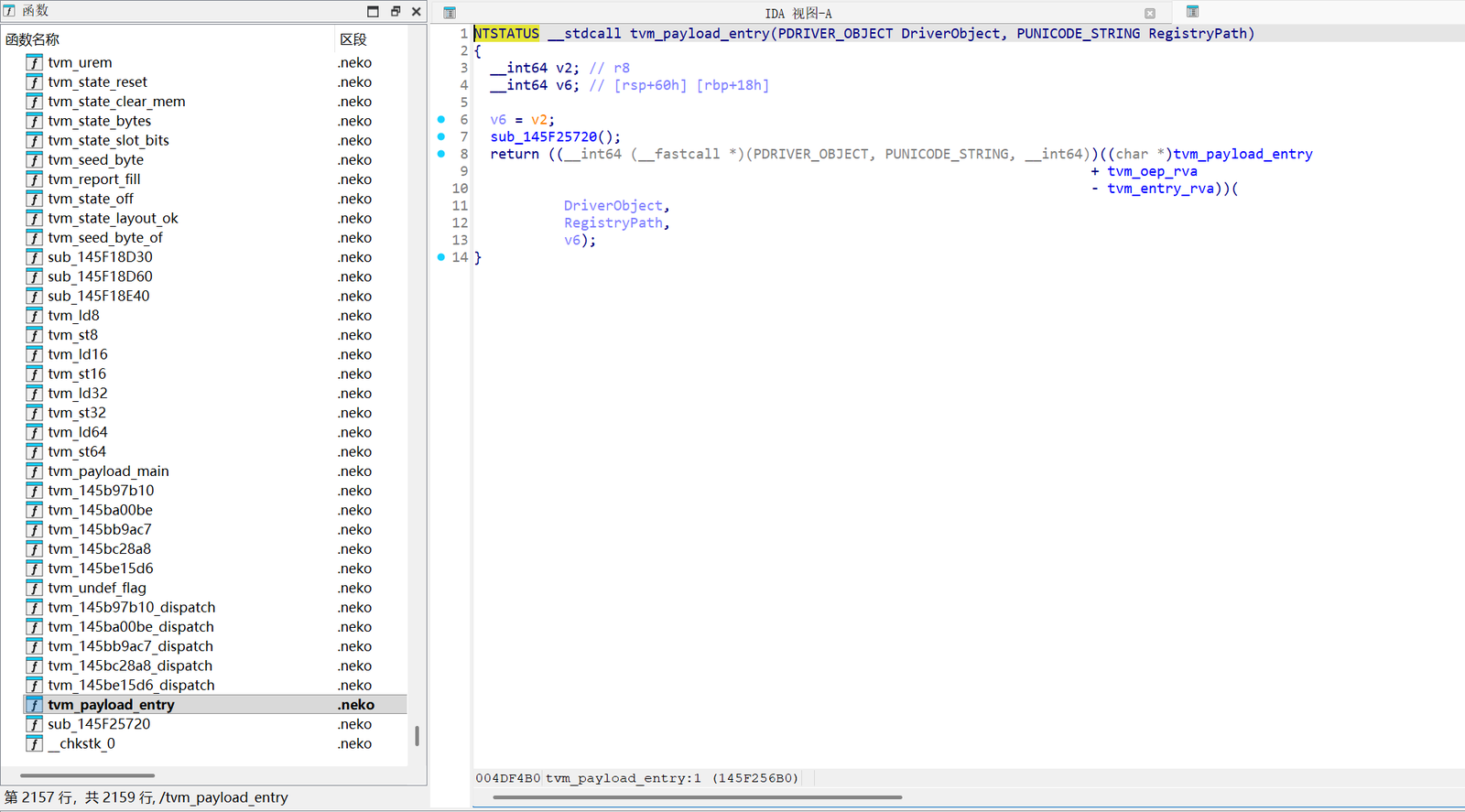
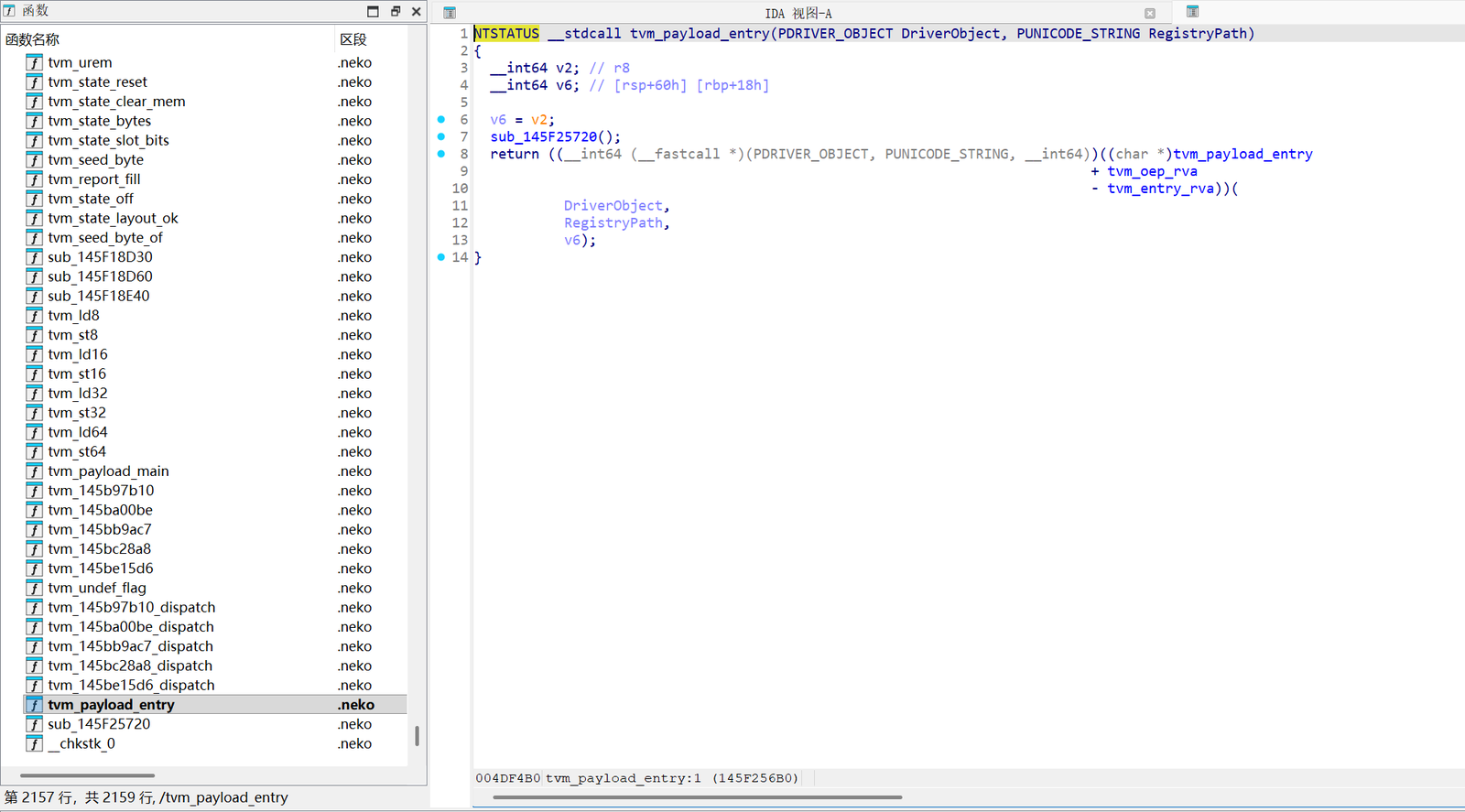
Devirtualized listing of a VM root, with the guest register file bound across blocks.
python -m venv .venv
source .venv/Scripts/activate      # Windows: .venv\Scripts\Activate.ps1
pip install -r requirements.txt
Python 3.13, capstone. For the backend: llvmlite==0.50.0 and, on Windows, MSVC
link.exe/cl.exe. z3-solver is optional — without it path conditioning stays and only the
bounded dispatch proof is skipped.
Copy .env.example to .env and fill in the paths for this machine. .env is git-ignored, and
every setting also has a command-line flag, so the file only supplies defaults.
| key | meaning |
|---|---|
TVM_MODULE | the module to analyse, for probes run without a positional argument |
TVM_LISTINGS | listing corpus the backend reads |
TVM_OUT | root for all output (default out/) |
TVM_STEPS | steps per block before a block is truncated (default 900000) |
TVM_BLOCKS | block budget per root (default 512) |
TVM_PAYLOAD_OPT | payload codegen level 0–3 |
TVM_PAYLOAD_MEM | sealed | absolute guest-memory mode |
TVM_MSVC_BIN | directory holding link.exe/cl.exe, instead of relying on PATH |
Precedence: command-line flag → .env → environment → built-in default.
Engine commands run from engine/; backend commands from the repository root.
cd engine
python -m probe.scan_tvm0 /path/to/dir        # which files carry a .tvm0, and its roots
python -m probe.trampoline_forms input.exe    # what the entry trampolines look like
python -m probe.mnemonic_census input.exe     # what x86 the VM contains
python -m core.devirt input.exe --out ../out/listings
One 0x<root>.txt listing and one 0x<root>.guest-state.json per function. Options:
| flag | default | meaning |
|---|---|---|
--out=DIR | stdout | write listings + guest state |
--root=0x… | all discovered | restrict to one VM entry |
--show[=N] | off | print the first N lines |
--steps=N | 900000 | steps per block before truncation |
--blocks=N | 512 | block budget per root |
--caller-entry=0x… --call-site=0x… | off | caller-specialize the entry |
The header of each listing says whether the run was truncated; a truncated listing is a lower bound, not the function.
python -m probe.cfg_run         input.exe 0x14015fc2e    # walk it, print the CFG
python -m probe.guest_effect    input.exe 0x14015fc2e    # what handlers do to guest registers
python -m probe.ctx_map         input.exe 0x14015fc2e    # which context slot holds which register

python -m probe.why_unresolved  input.exe 0x14015fc2e    # why a dispatch did not resolve
python -m probe.block_exits     input.exe 0x14015fc2e    # why a block has no successor
python -m probe.stop_debug      input.exe 0x14015fc2e    # why evaluation stopped
python -m probe.unresolved_detail input.exe 0x14015fc2e  # per-block detail
Drill into a specific value or store:
python -m probe.trace_window    input.exe 0x14015fc2e 0x14015fc40 0x14015fc90
python -m probe.reg_history     input.exe 0x14015fc2e rax
python -m probe.who_wrote       input.exe 0x14015fc2e 0x18
python -m probe.flags_at        input.exe 0x14015fc2e 0x14015fc60
python -m probe.stack_at        input.exe 0x14015fc2e
.\write-devirt.ps1 -Module 'C:\path\to\SGuardSvc64.exe'
Runs payload → inject → load → differential and stops at the first stage that fails. Options:
-Listings, -Out, -Opt 0..3, -Mem sealed|absolute, -SkipDifferential, -Force.
The stages individually:
cd llvm
python payload.py  --listings=../out/hard-cases-listings-final --out=../out/write-devirt --opt=0 --mem=sealed
python peinject.py --host=input.exe --payload=../out/write-devirt --out=../out/write-devirt/input.neko.exe
python miniload.py ../out/write-devirt/input.neko.exe
python diff_payload.py --payload=../out/write-devirt --patched=../out/write-devirt/input.neko.exe
diff_payload.py is the check that matters: it runs the code inside the patched image and
compares it byte for byte against the interpreter over the same listing. miniload.py only proves
the image loads and its entry runs.
ACE replaces a native function with a trampoline into a VM dispatcher. The dispatcher executes native x86 handlers, but the protected function's architectural state lives in the VM context.
flowchart TB
    subgraph TOP[ ]
        direction LR

        subgraph TEXT[.text]
            ENTRY["<b>Function entry</b><br/>jump to VM entry"]
        end

        subgraph VM[.tvm0 section]
            direction LR
            CORE["<b>Shared dispatcher and handlers</b><br/>execute x86 - resolve next handler"]
            CTX["<b>Guest context</b><br/>GPRs - RFLAGS - VIP"]
            CORE <--> CTX
        end
    end

    subgraph NATIVE[Native execution outside the VM]
        direction LR
        BOXED["<b>Boxed instruction</b><br/>execute original x86"]
        CALL["<b>Guest call</b><br/>invoke native target"]
        EXIT["<b>Guest return or tail call</b><br/>resume native execution"]
        BOXED ~~~ CALL ~~~ EXIT
    end

    TEXT --> VM
    VM <--> NATIVE

    style TOP fill:transparent,stroke:transparent
Some operations execute outside the VM. A boxed instruction runs its original x86 encoding after the VM restores the registers it needs, then returns its effects to the guest context. A guest call invokes a native target and resumes with the return value and Windows x64 ABI clobbers represented in guest state. Guest returns and tail calls leave the dispatcher entirely.
The context holds all sixteen guest general-purpose registers, including the guest RSP, plus
packed guest flags. Its layout varies by protector build, so it is located by observing the VM's
save/restore behaviour rather than assumed — probe.ctx_map reports the mapping measured at the
stores, and every emitted listing brackets a context access with its slot offset.
Conditional control flow is dispatch arithmetic: a handler extracts a guest flag or predicate, uses
it to pick the next virtual program counter, and computes the next handler's address. The
devirtualizer evaluates that symbolically and forks when the choice depends on an unresolved guest
value. A block's identity is the pair (handler, vip), not the handler alone.
