
Skip to content
KitploitKITPLOIT
ToolsBlog
Submit
ToolsBlog
Submit

Hacking, PenTest, and Cybersecurity Tools for Your Security Arsenal!

Kitploit is a directory of hacking, cybersecurity, and pentesting tools. Discover the latest project updates to find vulnerabilities, analyze systems, automate testing, and strengthen your security.

··Feeds·Contact·Privacy·© 2026 Kitploit

Tool Directory

Categories

View all categories
Loading categories
CVE-2020-1337 — CVE-2020-1048 bypass: binary planting PoC | Kitploit
Tools/GitHubGitHub/neofito/cve-2020-1337
Privilege EscalationPersistence MechanismsVulnerability AnalysisExploitationPost-ExploitationPayload DevelopmentBinary Exploitation
GitHubneofito/cve-2020-1337

CVE-2020-1337

CVE-2020-1048 bypass: binary planting PoC

View Repository
3266 years agoReviewed by Kitploit

Most Popular

View all →

Discover the most used tools by our community.

Explore all tools

Browse our collection of tools

View all tools →
Share

CVE-2020-1337 - Binary Planting (CVE-2020-1048 bypass)

Peleg Hadar (@peleghd) and Tomer Bar at SafeBreach (@safebreach) were acknowledged by Microsoft by the CVE-2020-1048, a Windows Spooler Vulnerability that allows an elevation of privilege on Windows 7 and later.

Some details were disclosed by Alex Ionescu (@aionescu) and Yarden Shafir (@yarden_shafir) on his cool blog post PrintDemon: Print Spooler Privilege Escalation, Persistence & Stealth (CVE-2020-1048 & more). Using this knowledge I found a bypass for the patch using Windows junction points and symlinks (kudos to James Forshaw @tiraniddo).

My report was a dupe because the root cause was previously reported by someone else and the report was assigned the CVE-2020-1337, a really c00l CVE :-)

This C# code allows to place a malicious DLL to the local C:\windows\system32 directory in order to be loaded by a DLL hijacking vulnerable application or service.

Blog post: CVE-2020-1337: my two cents; also in spanish.

How to compile

Use Visual Studio in order to get a self-contained binary. The magic is done using the next Nuget packages:

  • NtApiDotNet
  • IlMerge 3.0.40
  • MSBuild.ILMerge.Task

How to use

Place the binary and your malicious file in the same path and execute the first step:
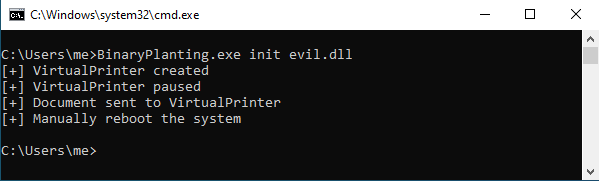
First Step

Manually reboot the system and execute the second step to finally plant your DLL with its final name:
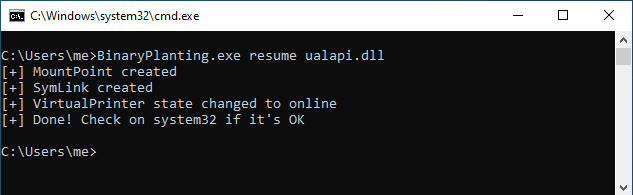
Second Step

Acknowledgements

  • Alex Ionescu (@aionescu) and Yarden Shafir (@yarden_shafir)
  • Peleg Hadar (@peleghd) and Tomer Bar
  • James Forshaw (@tiraniddo)
  • BC Security (@BCSecurity1)
  • All the partners that help me testing the PoC: Marc (@h4ng3r), Ignasi (@Ny4nyi), Iñaki (@virtualminds_es) and Hector (@3v4Si0N).
Download Tool