Web3 Decoder
Web3 Decoder is a Burp Suite Extension that helps to analyze what is going on
with the operations involving smart contracts of the web3. This is mainly JSON-RPC calls to Ethereum Nodes,
and nodes of other compatible networks (like Polygon, Arbitrum, BSC...)
Download & Install
Download the latest extension JAR — this link always serves the newest release:
⬇ web3-decoder.jar (latest)
Older versions are on the Releases page.
Then load it in Burp Suite:
- Go to Extensions → Installed → Add.
- Set Extension type to Java and select the downloaded
web3-decoder.jar.
- Click Next — the
Web3 tab and the Web3 Request/Web3 Response editor
tabs appear once it loads.
Requires a Burp release bundled with JRE 21 (current Burp Suite versions). The
JAR is self-contained — all dependencies (web3j, etc.) are included.
Building from source
./gradlew jar
The extension JAR is always written to a constant path — web3-decoder/build/libs/web3-decoder.jar —
regardless of version, so you can point Burp at it once and let it auto-reload on
rebuilds. Releasing is documented in docs/RELEASING.md.
Screenshots
This is how our improved Web3 editor tabs look after successfully decoding your JSON-RPC requests and responses:
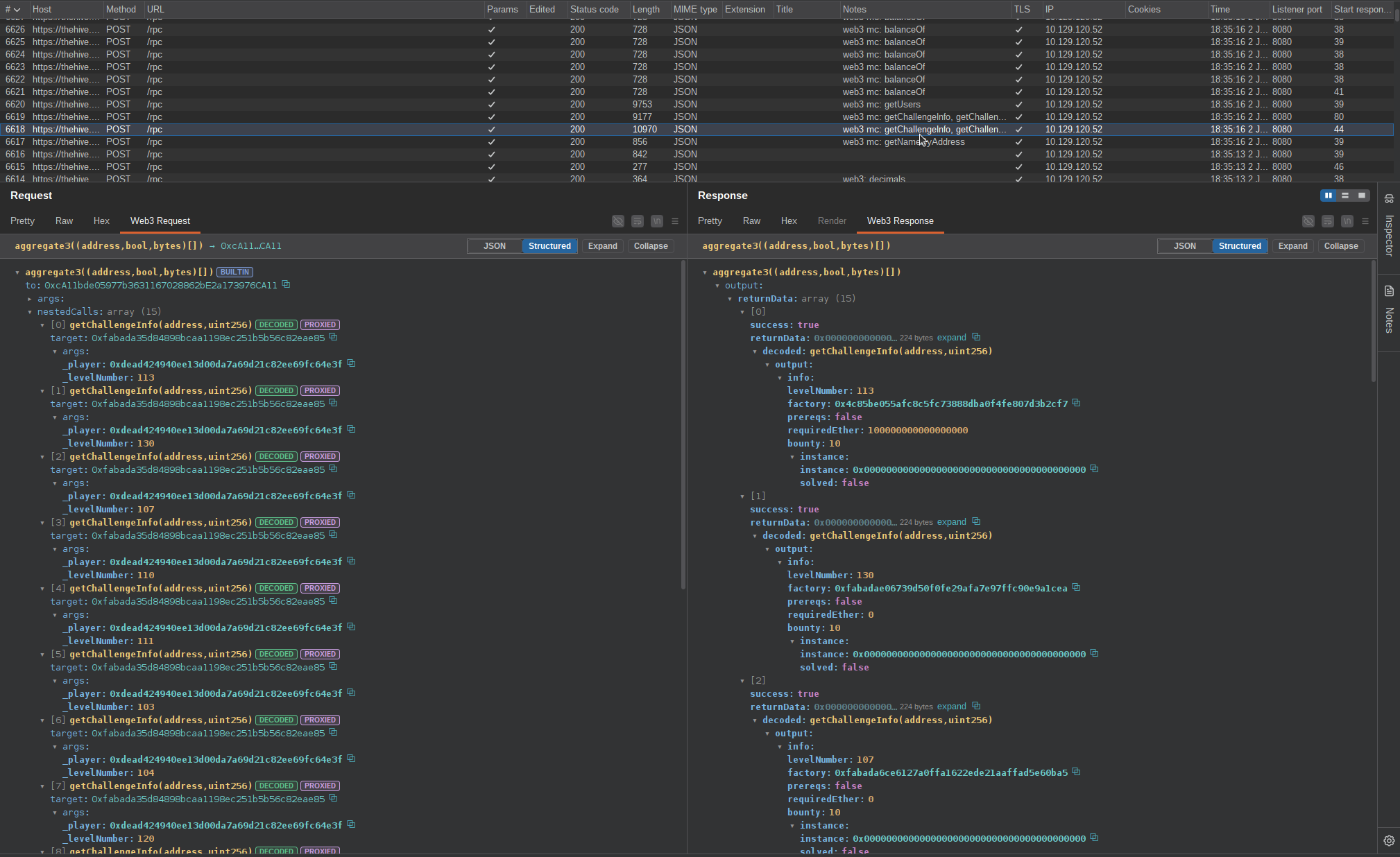
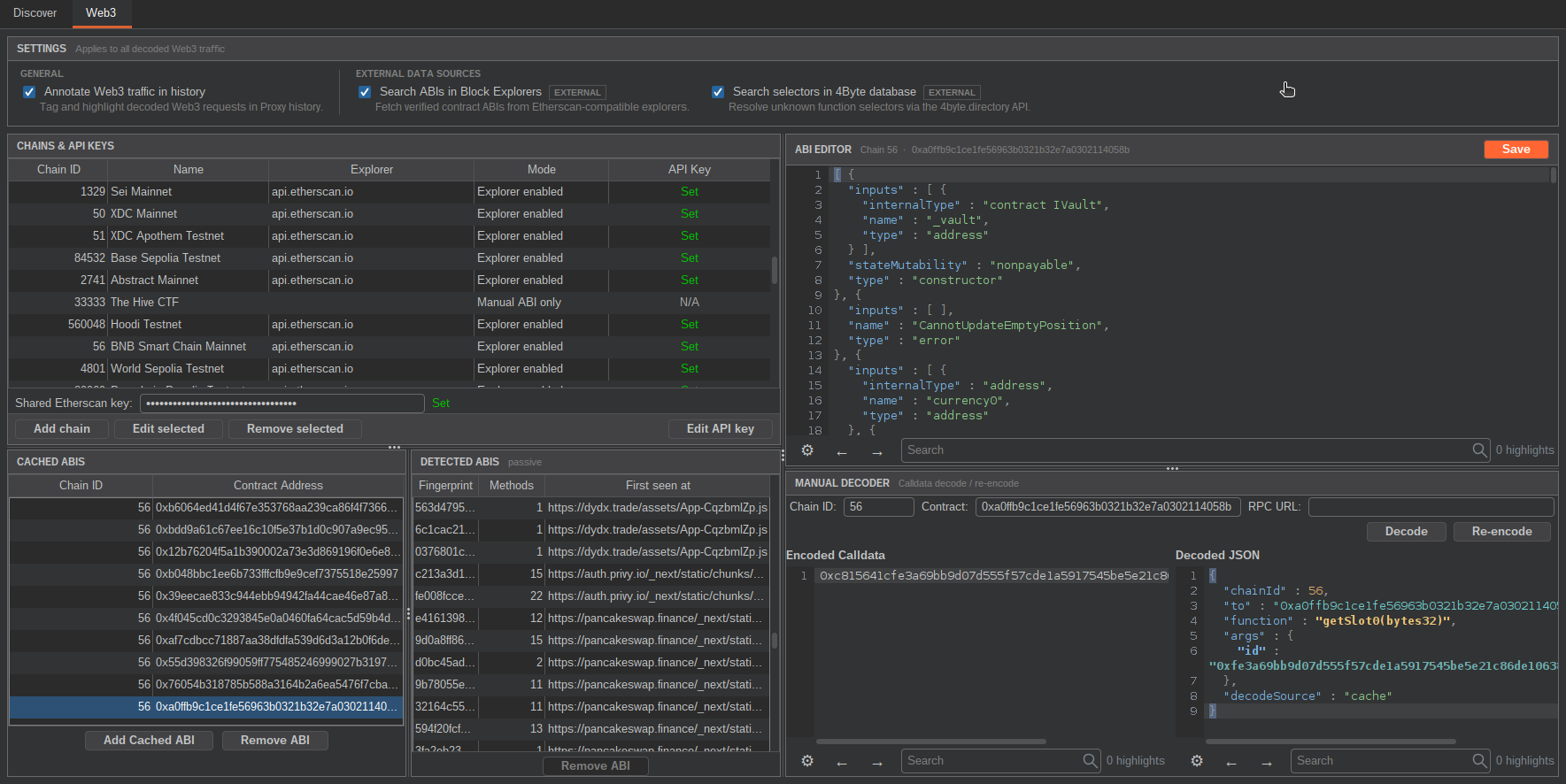
Below the redesigned Web3 Tab, with all the settings, detected ABIs, and more! (Thanks Claude Design!)
Documentation
Detailed documentation lives in the docs/ folder:
- Architecture — layers, components, and the key decode/encode flows (with diagrams).
- Project Structure — directory layout and package-by-package responsibilities.
- Tech Stack — dependencies, build/packaging, runtime, and CLI mode.
- Features — full capability catalogue with implementation pointers.
Block explorers API Keys
Most block explorers supported, like etherscan.io require an API key to allow more than 1 request each 5 seconds.
The new interface allows you to manage the chains, block explorers and API keys
Manually adding a contract's ABI
The extension caches the downloaded ABIs from the block explorers like etherscan. You can also add them directly from the Web3 tab, obtaining them automatically from the block explorer, or adding them manually.
Implemented Features
- Burp integration
Web3 Request editor tab for JSON-RPC requests (hidden on traffic with no eth_call / eth_sendRawTransaction).Web3 Response editor tab for matching JSON-RPC responses.- Dedicated
Web3 suite tab with chain/ABI/calldata tools.
- Proxy history rows annotated with the decoded function signature in their note (decoded off-thread, persisted on the live history row).
- Decoded editor experience
- Both editor tabs ship a structured tree view by default, with a JSON view a toggle away — the JSON remains the source of truth for re-encoding.
- JSON view keeps syntax + semantic highlighting, line numbers, bracket matching, live validity, and a search bar.
- JSON-RPC request decoding
- Decodes
eth_call calldata into function + typed args.
- Supports single-request and batch JSON-RPC payloads.
- For batch payloads, each item is reported with status (
decoded, skipped, error) and reason when skipped/failed.
- JSON-RPC response decoding
- Decodes
result for previously decoded eth_call requests.
- Supports single and batch responses, matching entries by JSON-RPC
id (or by index fallback).
- Re-encoding and edit workflow
- You can edit decoded arguments in the request editor and write them back to encoded calldata.
- Standalone calldata tool can decode and re-encode outside request history.
- ABI resolution and caching
- ABI lookup priority: cached ABI → builtin → block explorer (Etherscan-compatible) → passively-detected pool → 4byte.
- Downloaded ABIs are cached automatically for future decodes.
- ABI source is tracked (
cache, builtin, etherscan, detected, or 4byte) in decoded output.
- Passive ABI detection (new)
- A Burp
PassiveScanCheck scans HTTP response bodies (typically minified dapp JS bundles) for Solidity ABIs
and stores everything it finds in a project-scoped pool indexed by function selector.
- Handles both strict JSON and the JS-object-literal form found in minified bundles, including the
!0 / !1 boolean shortcuts emitted by Terser/esbuild/Svelte.
- When the existing cache → builtin → etherscan chain misses, the decoder consults the detected pool before
falling through to 4byte. Decoded output is tagged
decodeSource: "detected".
- Works even when
eth_chainId can't be determined: the detected pool and 4byte are chain-agnostic, so the
decoder still attempts them rather than refusing outright.
- Each new ABI raises an informational Burp issue ("Solidity contract ABI detected") with the full method
list — every function/event/error with its canonical signature and 4-byte selector — and the URL where
the ABI was found.
- 4byte fallback decoding
- If ABI lookup fails, function selector lookup is performed against
api.4byte.sourcify.dev.
- Synthetic ABI definitions are generated from candidate signatures and used for decode/re-encode flows.
- Proxy-aware decoding
- Detects implementation contracts for delegate proxy patterns and decodes against implementation ABI.
- Implemented proxy detectors:
ERC1967 slot and legacy ZeppelinOS/OpenZeppelin slot.
- Multicall recursive decoding
- Decodes nested calls for common Multicall variants:
aggregate, tryAggregate, aggregate3, aggregate3Value, blockAndAggregate, tryBlockAndAggregate.
- Recursively decodes nested calls with depth limiting and per-node status.
- Chain and explorer management UI
- Add/edit/remove chain definitions (chain ID, name, explorer).
- Per-chain explorer API key management.
- Shared Etherscan-family API key support with per-chain override.
- Loads default chains from
chains.json and persists customizations in Burp preferences.
- Includes migration of deprecated chain IDs to modern replacements (for persisted configs).
- Cached ABI management UI
- Add cached ABI manually (paste JSON) or fetch from configured explorer.
- Remove cached ABI entries.
- Open cached ABIs in editor, validate JSON, and save updates.
- Detected ABI browser UI (new)
- Side-by-side panel under the
Web3 tab listing every ABI the passive scanner has accumulated.
- Each row shows a short fingerprint, function count, and the URL the ABI was first seen at.
- Click a row to view the ABI JSON read-only in the ABI editor; remove unwanted entries from the pool.
- Calldata Decode / Re-encode panel
- Decode calldata using chain ID + contract address context.
- Optional RPC URL support for proxy-aware decoding in the standalone tool.
- Displays nested multicall decode details when applicable.
- Decode of
eth_sendRawTransaction JSON-RPC calls (and their inner functions)
Chains Supported so far
 nccgroup/web3-decoder
