
 nac-l/mergen
Deobfuscation via optimization with usage of LLVM IR and parsing assembly.

Mergen is a tool engineered to convert Assembly code into LLVM Intermediate Representation (IR). This tool is designed for:
To build and run the project, take a look at docs/BUILDING.md.
Rewrite work should keep the baseline regression gate green. The gate builds focused PE samples, runs lifter, and verifies lifted IR outputs.
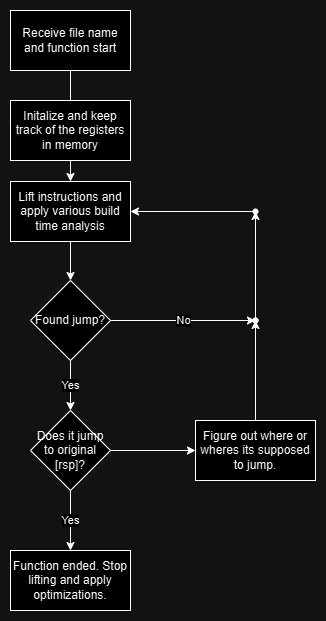
scripts\\rewrite\\run.cmdWe symbolicly execute (or symbolicly lift) the target, the idea here is not lifting individual instructions, but lifting a whole function. We dont expect one instruction nor one basic block to behave same each time, instead treat them like they can be and are for different purposes each time. We try to keep the generated IR simple and optimizeable as possible. We also have different needs than an usual compiler. We use analysis to evaluate control flow. We can't depend on LLVM for all of our analysis, because they are created for different goals and could be unoptimal for our use-case.
This is the practical example to illustrate how Mergen solves against virtualized programs.
This is our target program
struct test {
    int a;
    int b;
    int c;
};

int maths(test a, int b, int c) {
        return a.a  + b - c;
}
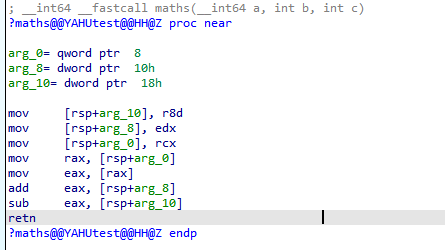
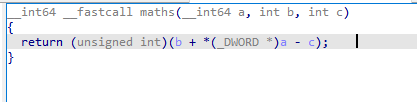
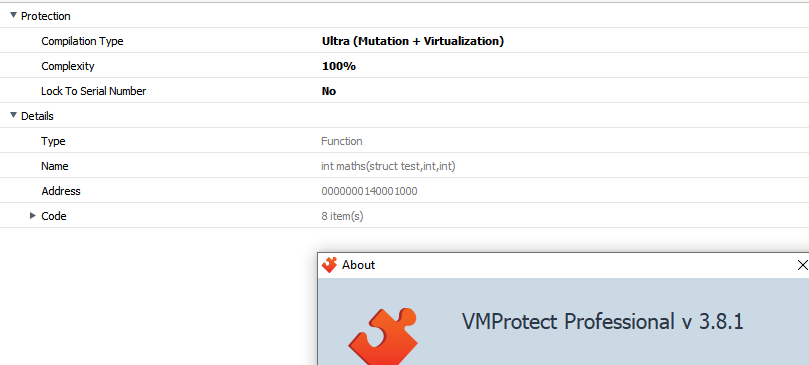
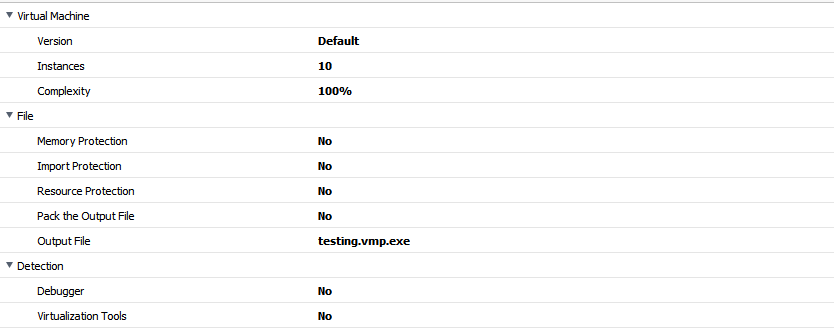
VMProtect settings, everything is turned off, we virtualize the function on ultra setting. (Tested versions 3.4.0-3.6.0 3.8.1)
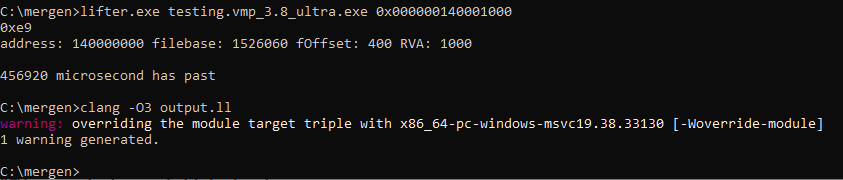
Here, we run mergen. First argument is the name of the file and the second argument is the address of the function. Look how simple it is to run. And we can compile the output so we can explore it using our favorite decompiler.
; ModuleID = 'my_lifting_module'
source_filename = "my_lifting_module"

; Function Attrs: mustprogress nofree norecurse nosync nounwind willreturn memory(argmem: read)
define i64 @main(i64 %rax, i64 %rcx, i64 %rdx, i64 %rbx, i64 %0, i64 %rbp, i64 %rsi, i64 %rdi, i64 %r8, i64 %r9, i64 %r10, i64 %r11, i64 %r12, i64 %r13, i64 %r14, i64 %r15, ptr nocapture readonly %memory) local_unnamed_addr #0 {
entry:
  %stackmemory = alloca i128, i128 13758960, align 8
  %1 = trunc i64 %r8 to i32
  %2 = trunc i64 %rdx to i32
  %GEPLoadxd-5369456437- = getelementptr i8, ptr %memory, i64 %rcx
  %3 = load i32, ptr %GEPLoadxd-5369456437-, align 4
  %adc-temp-5370242400- = sub i32 %2, %1
  %realnot-5369532059- = add i32 %adc-temp-5370242400-, %3
  %stackmemory10243.sroa.55.1375304.insert.ext10255 = zext i32 %realnot-5369532059- to i64
  ret i64 %stackmemory10243.sroa.55.1375304.insert.ext10255
}

attributes #0 = { mustprogress nofree norecurse nosync nounwind willreturn memory(argmem: read) }
After compiling:
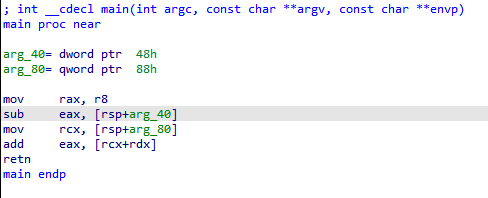
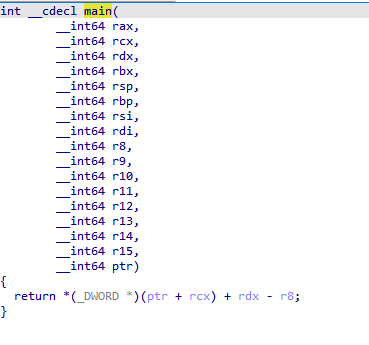
Now you might notice the registers are a little bit off. This is because of we dont follow the calling conventions, if we were to follow the calling conventions, function signature would look like this:
define i64 @main(i64 %rcx, i64 %rdx, i64 %rdx, i64 %r8, i64 %r9 ...)
So, we just adjust the function signature to look normally. If you have more questions about this part, I suggest you research calling conventions and ABI.
So, lets say we have this code. VM's will take the below code then turn it to an indirect jump, its slightly more unconvenient for the reverser.
int maths(int a, int b, int c) {
    if (a > b)
        return a + b + c;
    else
        return a - b - c;
}
next_handler = xxx;
if ( a-b > 0 )
  next_handler = yyy;
jump next_handler;
We try to always analyze values and keep track of them. This allows us to understand control flow. For jumptable-like branches Optimized output would be a simple
define i64 @main(i64 %rax, i64 %rcx, i64 %rdx, i64 %rbx, i64 %rsp, i64 %rbp, i64 %rsi, i64 %rdi, i64 %r8, i64 %r9, i64 %r10, i64 %r11, i64 %r12, i64 %r13, i64 %r14, i64 %r15, ptr nocapture readnone %TEB, ptr nocapture readnone %memory) local_unnamed_addr #0 {
fake_ret:
  %0 = lshr i64 %rcx, 62
  %common.ret.op = and i64 %0, 2
  ret i64 %common.ret.op
}
Unoptimized output. (DCE'd for readability)
source_filename = "my_lifting_module"

define i64 @main(i64 %rax, i64 %rcx, i64 %rdx, i64 %rbx, i64 %rsp, i64 %rbp, i64 %rsi, i64 %rdi, i64 %r8, i64 %r9, i64 %r10, i64 %r11, i64 %r12, i64 %r13, i64 %r14, i64 %r15, ptr %TEB, ptr %memory) {
  %lsb = and i64 %rcx, 255
  %pf1 = mul i64 %lsb, 72340172838076673
  %pf2 = and i64 %pf1, -9205322385119247871
  %pf3 = urem i64 %pf2, 511
  %pf4 = and i64 %pf3, 1
  %pf5 = icmp eq i64 0, %pf4
  %0 = zext i1 %pf5 to i64
  %createrflag2 = shl i64 %0, 2
  %creatingrflag = or i64 2, %createrflag2
  %zeroflag = icmp eq i64 %rcx, 0
  %1 = zext i1 %zeroflag to i64
  %createrflag21 = shl i64 %1, 6
  %creatingrflag2 = or i64 %creatingrflag, %createrflag21
  %signflag = icmp slt i64 %rcx, 0
  %2 = zext i1 %signflag to i64
  %createrflag23 = shl i64 %2, 7
  %creatingrflag4 = or i64 %creatingrflag2, %createrflag23
  %GEPSTORE-5368713221- = getelementptr i8, ptr %memory, i64 1376032
  store i64 %creatingrflag4, ptr %GEPSTORE-5368713221-, align 4
  %realand-5368713229- = and i64 %creatingrflag4, 128
  %shr-lshr-5368713233- = lshr i64 %realand-5368713229-, 7
  %3 = mul i64 %shr-lshr-5368713233-, 4
  %bvalue_indexvalue = add i64 5368713249, %3
  %4 = icmp eq i64 %bvalue_indexvalue, 5368713253
  %lolb- = select i1 %4, i64 5368713264, i64 5368713257
  %GEPSTORE-5368713248- = getelementptr i8, ptr %memory, i64 1376032
  store i64 %lolb-, ptr %GEPSTORE-5368713248-, align 4
  br i1 %4, label %real_ret, label %real_ret41

real_ret:                                         ; preds = %fake_ret
  %inc-5368713273- = add i64 %shr-lshr-5368713233-, 1
  ret i64 %inc-5368713273-
