 mym0us3r/copy-fail-detection-with-wazuh-4.14.4
Wazuh 4.14.4 detection rules for CVE-2026-31431 (Copy Fail) - Linux Local Privilege Escalation via authencesn page cache write

Detection engineering for the Copy Fail kernel LPE · Ubuntu / RHEL / SUSE / Amazon Linux 2023 / Kali




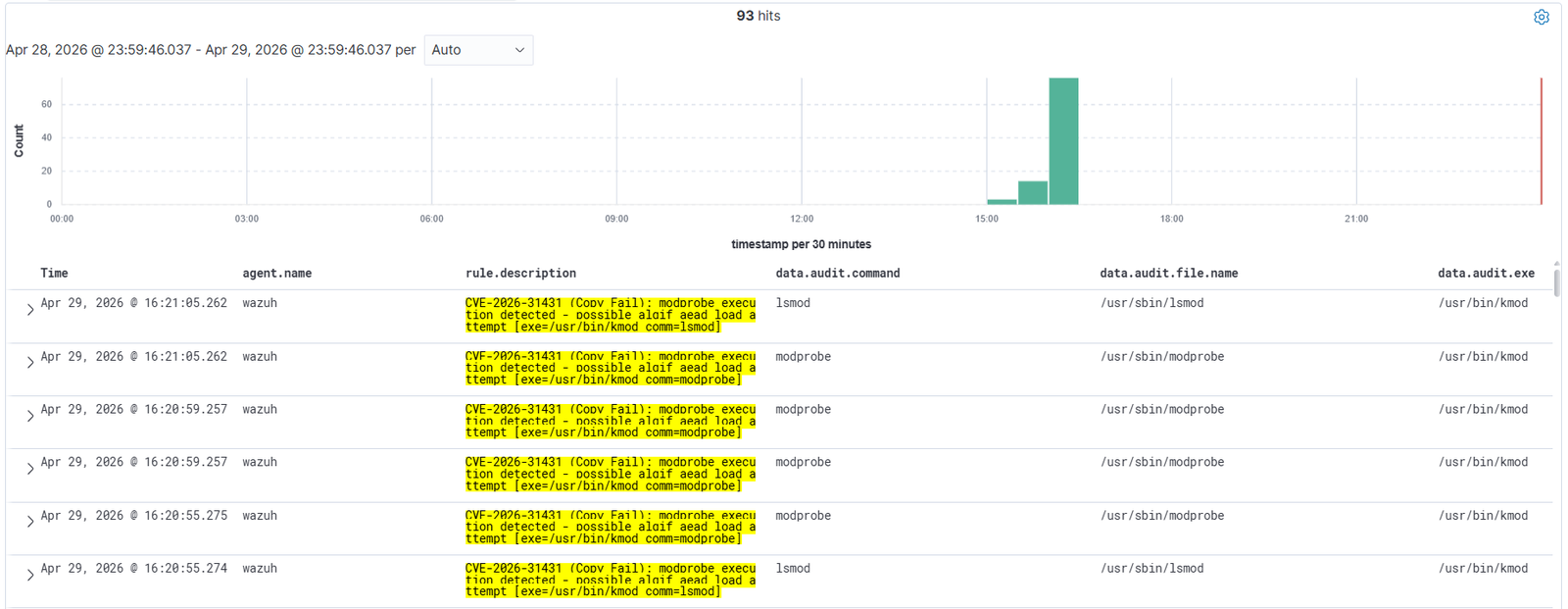
CVE-2026-31431 is a logic bug in the Linux kernel's authencesn cryptographic template. It allows any unprivileged local user to perform a deterministic, controlled 4-byte write into the page cache of any readable file on the system - without requiring race conditions, kernel offsets, or elevated privileges.
A 732-byte Python 3.10+ script using only standard library modules (os, socket, zlib) exploits the vulnerability to obtain root on all major Linux distributions shipped since 2017.
The on-disk file remains unchanged, making traditional file integrity monitoring (FIM) completely blind.
Discovered by Taeyang Lee (Theori / Xint) with the assistance of the Xint Code AI tool.
The write targets only the in-memory page cache. The kernel never marks the page as dirty, so the writeback mechanism never persists it to disk. The on-disk binary remains byte-for-byte identical to the original.
Traditional FIM approach:
  read file from disk -> compute hash -> compare -> no anomaly reported

Copy Fail reality:
  on-disk file = UNCHANGED
  page cache   = CORRUPTED
  FIM result   = BLIND
The only effective detection is behavioral, via syscall monitoring. This repository provides production-validated Wazuh rules that detect the exploit chain at the kernel syscall level.
Step 1: socket(38, 5, 0)       AF_ALG socket - no privileges required
Step 2: bind()                  Bind to authencesn - activates vulnerable code
Step 3: sendmsg()               Craft AAD payload - bytes 4-7 = value to write
Step 4: splice()          [!]   TRIGGER - page cache pages enter writable SGL
Step 5: recv()                  authencesn writes seqno_lo into page cache
Step 6: execve(/usr/bin/su)     Corrupted setuid binary runs shellcode as UID 0
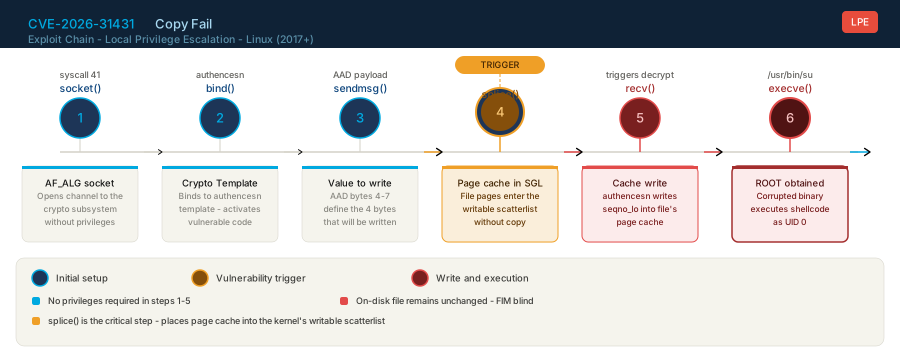
splice() is the critical step. It delivers page cache pages into the AF_ALG socket's writable scatterlist without copying - a 2017 in-place optimization in algif_aead.c that made pages from the pipe buffer reusable in the destination SGL. When authencesn.decrypt() runs, it writes into those pages, which happen to be the page cache of your target file.
All Linux distributions shipping kernels since commit 72548b093ee3 (2017) are affected.
Container escape: Copy Fail is also a container escape vector. The page cache is shared across all processes on the host, including across container boundaries. Part 2 by Xint covers Kubernetes exploitation.
COPY-FAIL-Detection-with-Wazuh-4.14.4/
│
├── rules/
│   └── local_rules.xml              # 8 Wazuh detection rules (199600-199607)
│
├── auditd/
│   └── cve-2026-31431.rules         # auditd syscall sensor rules
│
├── sca/
│   └── cve_2026_31431.yml           # SCA policy - kernel-version independent
│
└── docs/
    ├── pentlab_uid.png               # PoC execution - root obtained on Kali
    ├── Rule-199604-TRIGs.png         # Rule 199604 - 80 hits on pentlab
    ├── Rule_199604_Wazuh_Server_only.png  # Rule 199604 - first validation
    ├── Splice_-_Non-root_process.png # Rules 199600/199601/199604 firing
    ├── Modprobe_-_Possible_Algif_aed_load_attempt.png  # Rule 199603
    ├── Pentlab-PoC.png               # Rule 199603 on pentlab agent
    ├── exploit_chain_timeline.svg    # Exploit Chain
    └── SCA_CVE-2026-31431.png        # SCA policy score 75%
Two independent layers — neither depends on kernel version.
The uid!=0 filter covers users beyond interactive accounts: service accounts (www-data, postgres, jenkins), containers, and web shells with no login session.
Auditd sensor rules (auditd/cve-2026-31431.rules):
-a always,exit -F arch=b64 -S socket -F a0=0x26 -F uid!=0 -k copy_fail_af_alg
-a always,exit -F arch=b32 -S socket -F a0=0x26 -F uid!=0 -k copy_fail_af_alg
-a always,exit -F arch=b64 -S splice -F uid!=0 -k copy_fail_splice
-w /usr/bin/su    -p x -k copy_fail_execve_su
-w /usr/bin/kmod  -p x -k copy_fail_modload
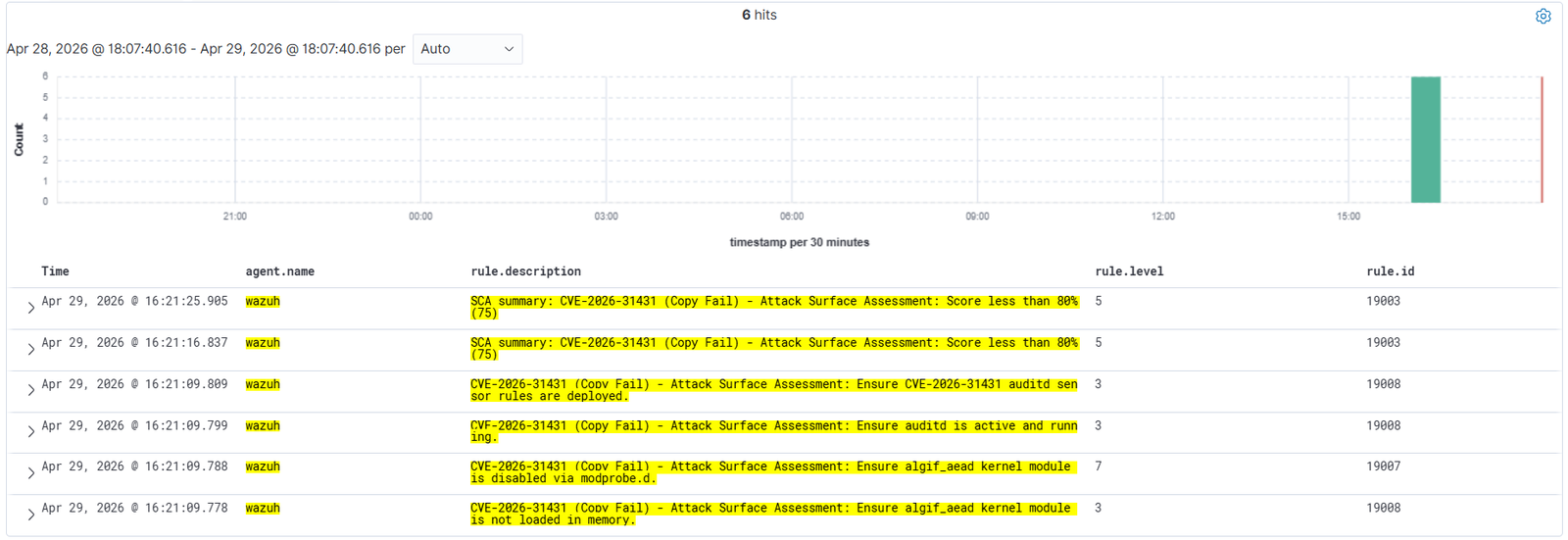
Automated configuration checks every 12 hours via sca/cve_2026_31431.yml. No kernel version required.
Engineering note: Rules 199600 and 199601 must be children of rule 92600 (Python process, depth 1), not of 80700. The Wazuh rule engine follows one chain path per event. Placing detection rules at depth 2 under 92600 guarantees they win chain evaluation over sibling rules (e.g. 92603-92606 in 0850-audit_rules.xml which also match
if_group=audit + exe=python).
# Ubuntu / Debian / Kali
apt install auditd audispd-plugins -y
systemctl enable --now auditd
auditctl -s | grep enabled
# RHEL / Amazon Linux
yum install audit -y
systemctl enable --now auditd
# SUSE
zypper install audit -y
systemctl enable --now auditd
cp auditd/cve-2026-31431.rules /etc/audit/rules.d/
augenrules --load
auditctl -l | grep copy_fail
Expected output:
-a always,exit -F arch=b64 -S socket -F a0=0x26 -F uid!=0 -F key=copy_fail_af_alg
-a always,exit -F arch=b32 -S socket -F a0=0x26 -F uid!=0 -F key=copy_fail_af_alg
-a always,exit -F arch=b64 -S splice -F uid!=0 -F key=copy_fail_splice
-w /usr/bin/su -p x -k copy_fail_execve_su
-w /usr/bin/kmod -p x -k copy_fail_modload
The rules are provided in rules/local_rules.xml. You can either merge the content into your existing /var/ossec/etc/rules/local_rules.xml or deploy as a standalone file:
# Option A - standalone file
cp rules/local_rules.xml /var/ossec/etc/rules/cve-2026-31431_rules.xml

# Option B - append to local_rules.xml
cat rules/local_rules.xml >> /var/ossec/etc/rules/local_rules.xml
# Validate syntax - must exit 0 with zero warnings
/var/ossec/bin/wazuh-analysisd -t 2>&1 | tail -5

# Restart manager
systemctl restart wazuh-manager
cp sca/cve_2026_31431.yml /var/ossec/etc/shared/default/
Add to ossec.conf inside the <sca> block:
<policies>
  <policy>/var/ossec/etc/shared/default/cve_2026_31431.yml</policy>
</policies>
systemctl restart wazuh-manager
Ensure Wazuh ingests the auditd log:
<!-- Add inside <ossec_config> -->
<localfile>
  <log_format>audit</log_format>
  <location>/var/log/audit/audit.log</location>
</localfile>
# Create a test user if needed
useradd -m testuser 2>/dev/null || true

# Generate SIGNAL 1 - AF_ALG socket
su - testuser -c "python3 -c \"import socket; socket.socket(38, 5, 0); print('AF_ALG OK')\""

# Generate SIGNAL 3 - /usr/bin/su execution
su - testuser -c "/usr/bin/su --help 2>/dev/null || true"

# Verify auditd captured events
ausearch -k copy_fail_af_alg -ts recent 2>/dev/null | grep "key=\|exe=\|uid=" | head -5

# Verify Wazuh generated alerts
grep -E "199600|199602" /var/ossec/logs/alerts/alerts.log | tail -10
grep -E "31431|cve_2026" /var/ossec/logs/alerts/alerts.log | tail -10
Expected SCA score (unmitigated system): 75% (3 passed / 1 failed - algif_aead not blacklisted)
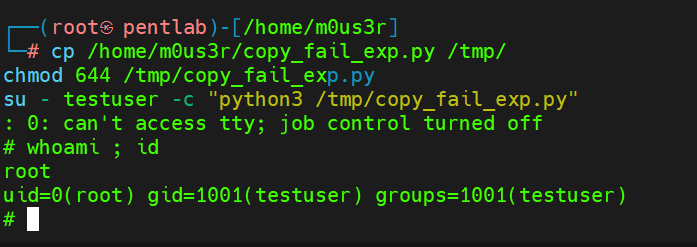
testuser (uid=1001) executed the 732-byte PoC and obtained root shell:
AF_ALG socket + splice() from same python process - pid=46784 - IMMEDIATE INVESTIGATION REQUIRED:
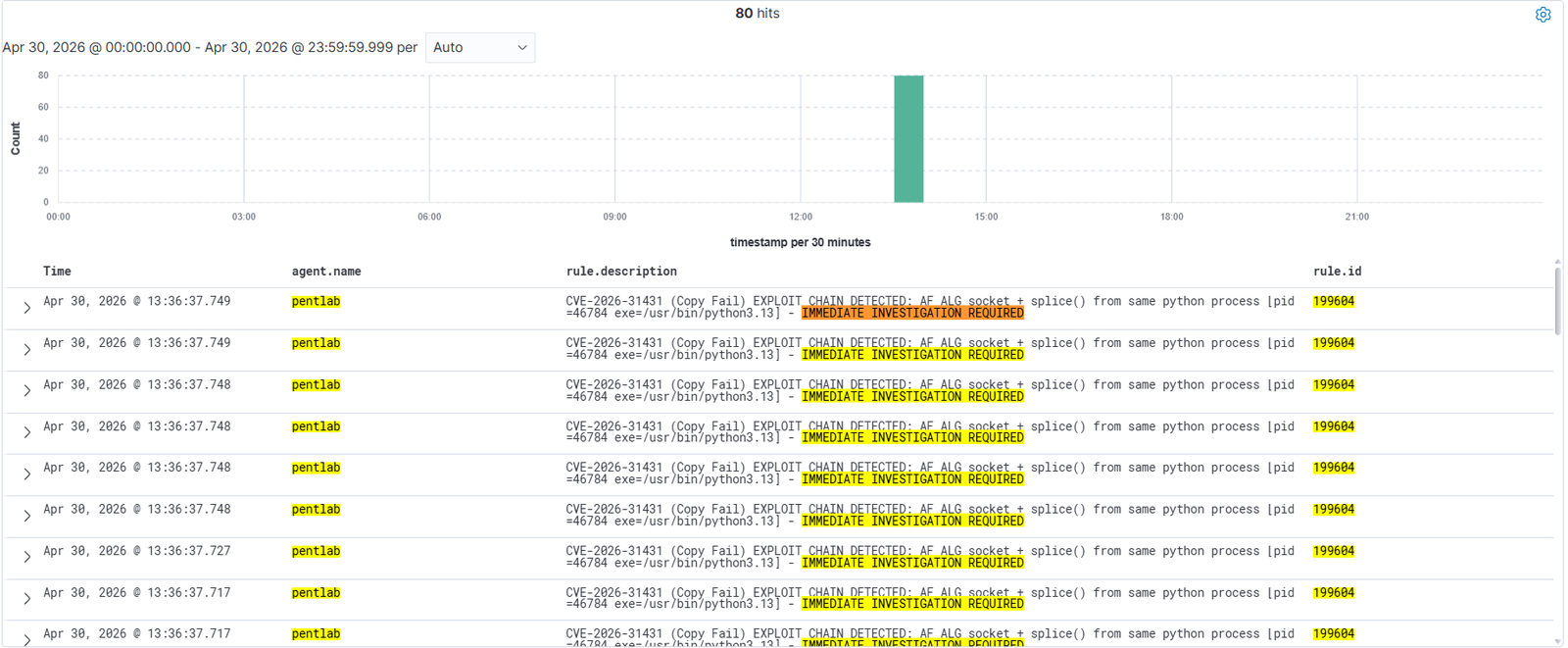
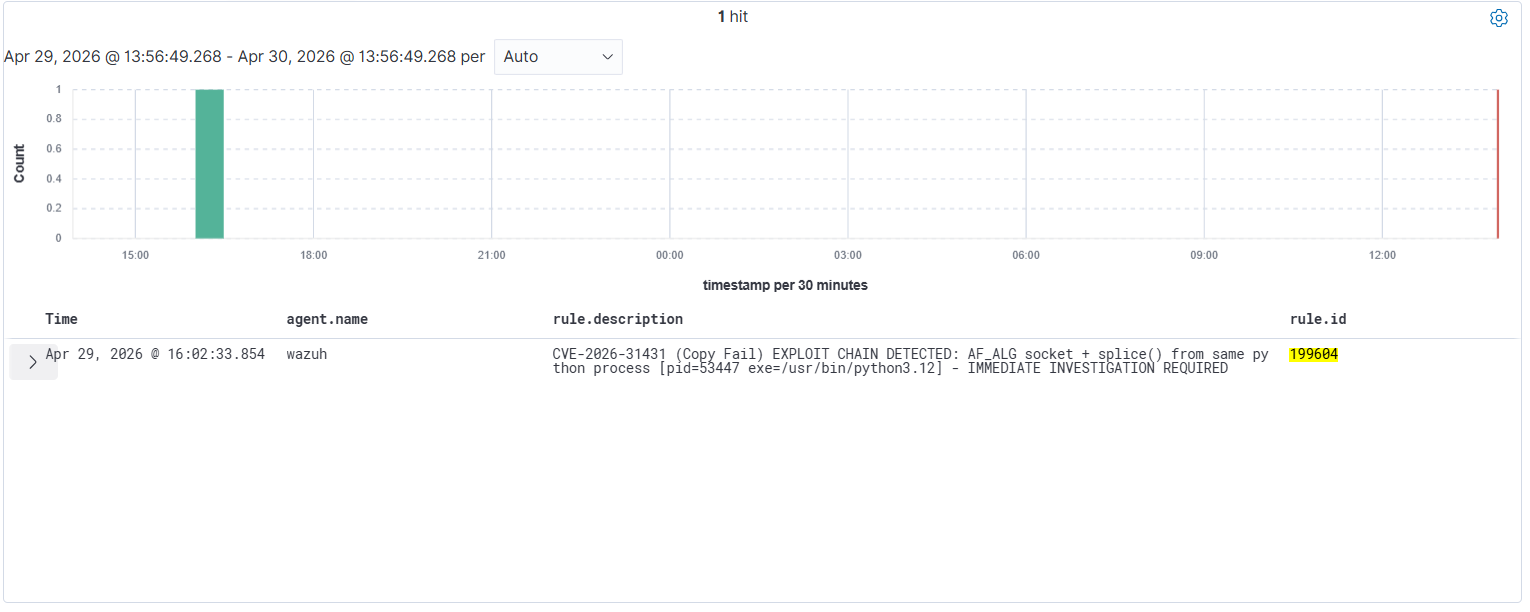
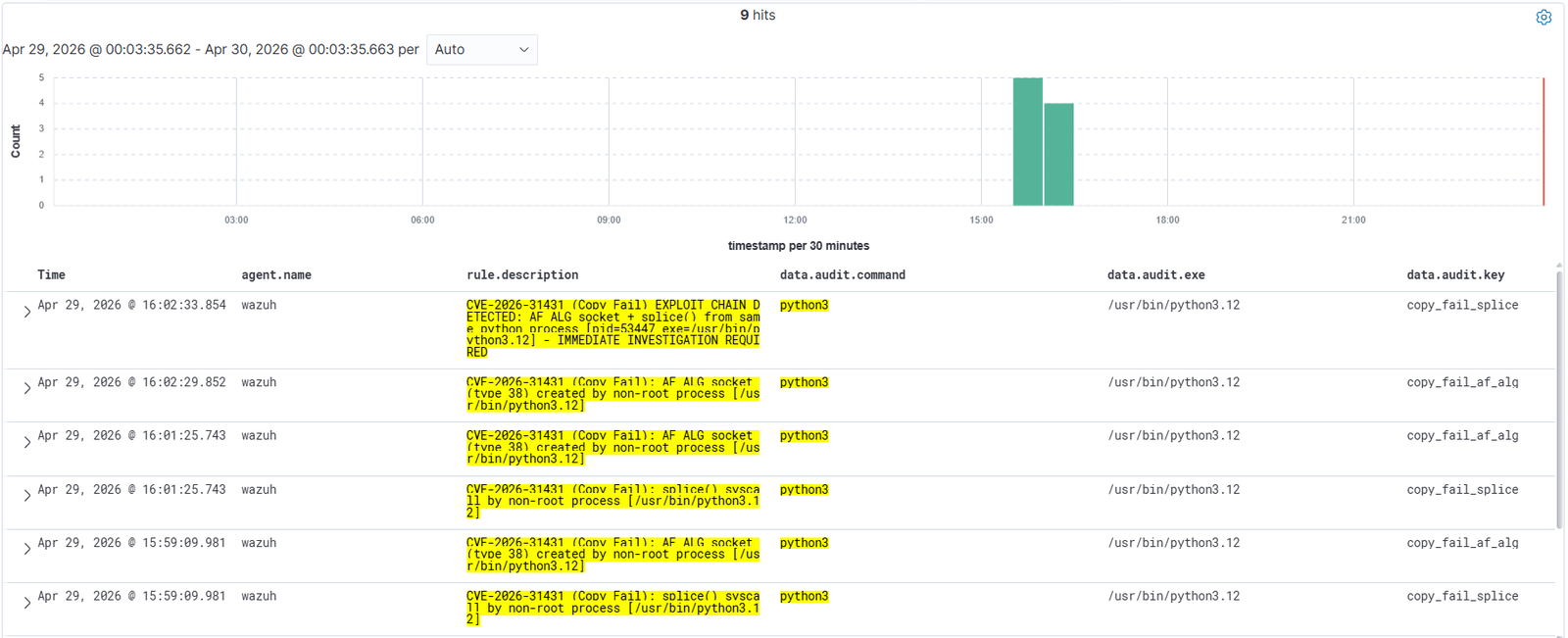
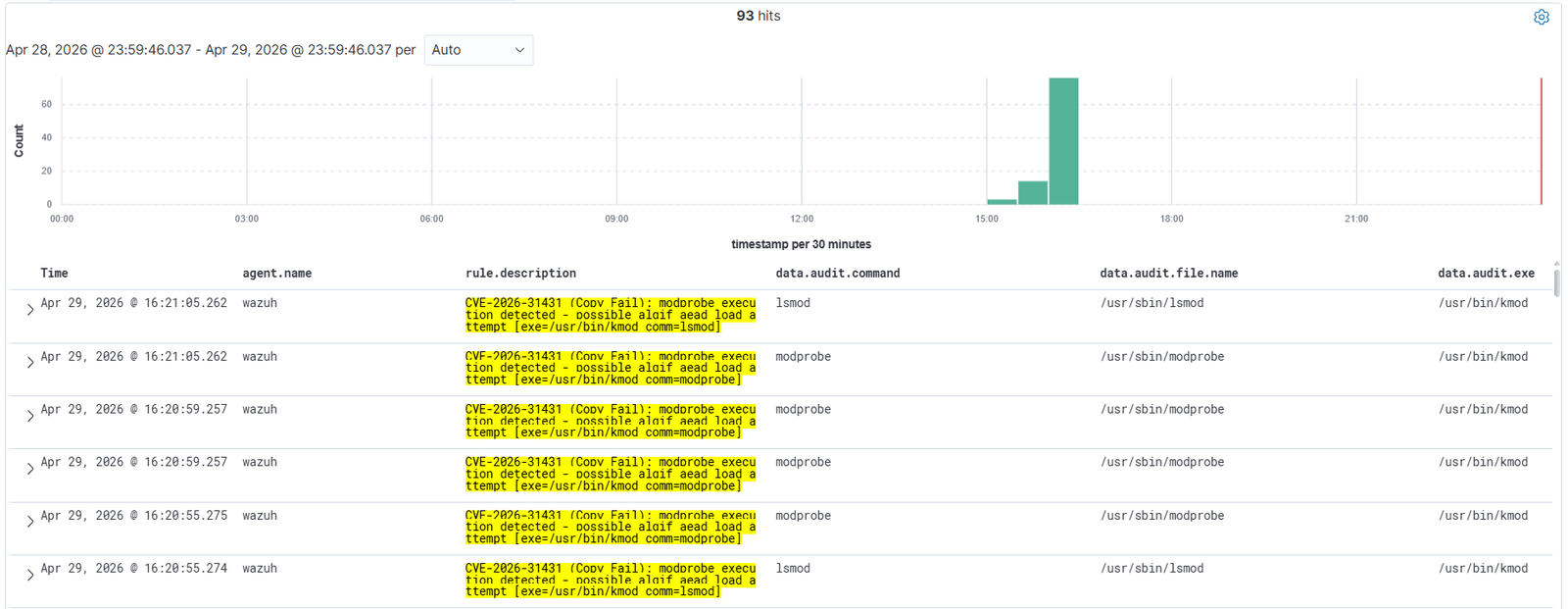
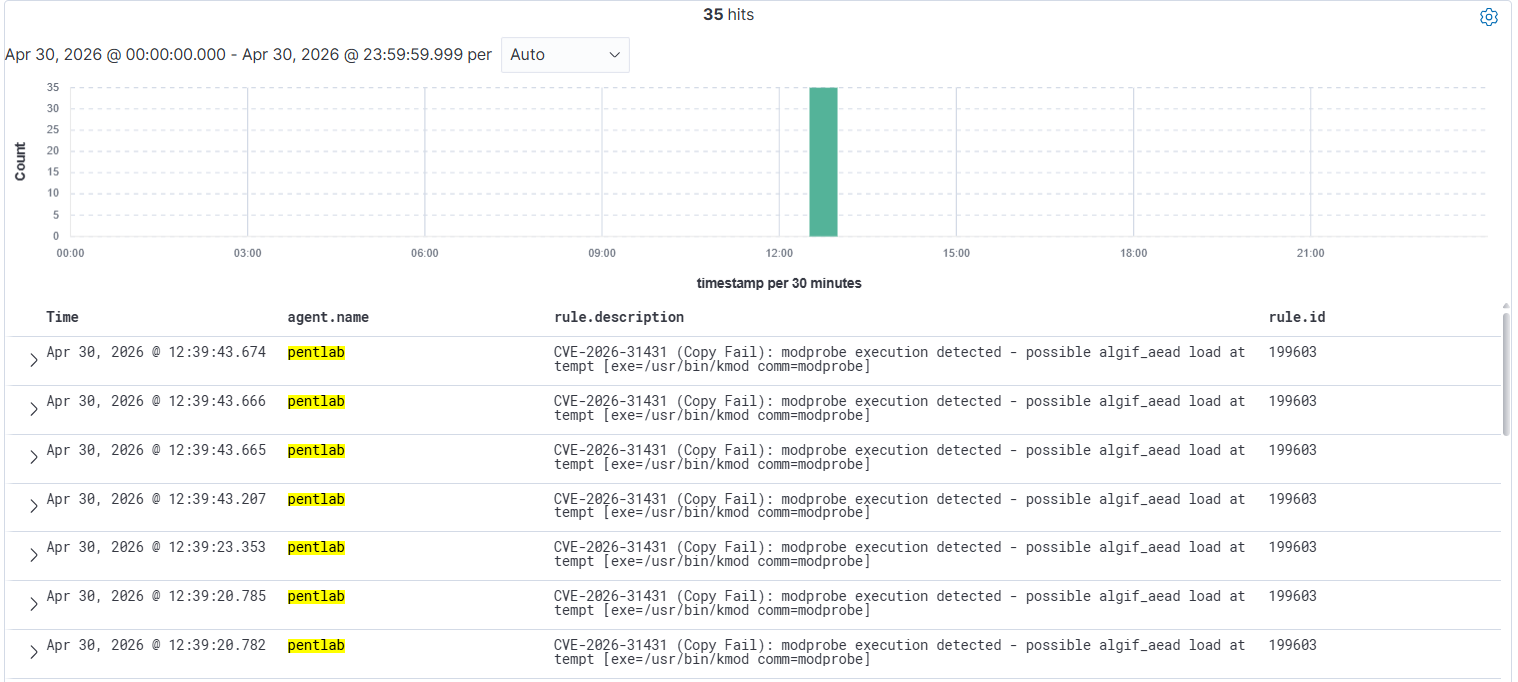
Wazuh Dashboard Discover results (agent=pentlab, Today):
wazuh-analysisd -t: exit 0 - zero warnings - all 8 rules loaded.
rmmod algif_aead 2>/dev/null || true
echo 'install algif_aead /bin/false' > /etc/modprobe.d/disable-algif-aead.conf
This does not affect dm-crypt/LUKS, kTLS, IPsec, OpenSSL, GnuTLS, or SSH.
Apply kernel commit a664bf3d603d via your distribution's kernel update. It reverts the 2017 in-place optimization in algif_aead.c, separating req->src (TX SGL, where splice delivers pages) from req->dst (RX SGL, user buffer). All major distributions are shipping the fix.
# Ubuntu / Debian
apt update && apt upgrade linux-generic

# RHEL / Amazon Linux
dnf update kernel

# SUSE
zypper update kernel-default
Kislley Rodrigues (m0us3r) Wazuh Ambassador | Detection Engineering | Blue Team
Detection rules, auditd sensor configuration and SCA policy validated on Wazuh 4.14.4, Ubuntu 24.04.2 LTS (kernel 6.8.0-106-generic) and Kali GNU/Linux 2026.1 (kernel 6.18.12+kali-amd64).
| Source | Link |
|---|---|
| CISA Adds Actively Exploited Linux Root Access Bug CVE-2026-31431 to KEV | https://thehackernews.com/2026/05/cisa-adds-actively-exploited-linux-root.html |
This project was developed as part of the Wazuh Ambassador Program.
Wazuh is a free, open source security platform that provides unified XDR and SIEM protection. Learn more at wazuh.com.
| Resource | Link |
|---|
| Official CVE Site | https://copy.fail/ |
| Technical Write-up - Xint Research | https://xint.io/blog/copy-fail-linux-distributions |
| PoC - copy_fail_exp.py | https://github.com/theori-io/copy-fail-CVE-2026-31431/blob/main/copy_fail_exp.py |
| Kernel Fix - a664bf3d603d | https://github.com/torvalds/linux/commit/a664bf3d603d |
| Vulnerable Commit - 72548b093ee3 | https://github.com/torvalds/linux/commit/72548b093ee3 |
| MITRE ATT&CK T1068 | https://attack.mitre.org/techniques/T1068/ |
| Distribution | Kernel | Status |
|---|
| Ubuntu 24.04 LTS | 6.17.0-1007-aws | ROOT CONFIRMED |
| Amazon Linux 2023 | 6.18.8-9.213.amzn2023 | ROOT CONFIRMED |
| RHEL 10.1 | 6.12.0-124.45.1.el10_1 | ROOT CONFIRMED |
| SUSE 16 | 6.12.0-160000.9-default | ROOT CONFIRMED |
| Kali GNU/Linux 2026.1 | 6.18.12+kali-amd64 | ROOT CONFIRMED |
| Rule | Parent | Signal | Depth | Level |
|---|
| 80700 | decoded_as=auditd | auditd anchor (Wazuh built-in) | 0 | 0 |
| 92600 | 80700 | Python process execution (Wazuh built-in) | 1 | 0 |
| 199600 | 92600 | AF_ALG socket - python chain | 2 | 10 |
| 199601 | 92600 | splice() syscall - python chain | 2 | 10 |
| 199604 | 199601 + if_matched=199600 | EXPLOIT CHAIN - python (same pid/120s) | 3 | 15 |
| 199602 | 80700 | /usr/bin/su execution | 1 | 6 |
| 199603 | 80700 | modprobe/kmod execution | 1 | 12 |
| 199605 | 80700 | AF_ALG socket - non-python | 1 | 10 |
| 199606 | 80700 | splice() syscall - non-python | 1 | 10 |
| 199607 | 199606 + if_matched=199605 | EXPLOIT CHAIN - non-python (same pid/120s) | 2 | 15 |
| Rule | Hits | Description |
|---|
| 199604 | 80 | EXPLOIT CHAIN DETECTED - pid=46784 exe=/usr/bin/python3.13 |
| 199600 | 40 | AF_ALG socket created by non-root process |
| 199603 | 28 | modprobe execution detected |
| 199602 | 12 | /usr/bin/su executed |
| Date | Event |
|---|
| 2026-03-23 | Vulnerability reported to Linux kernel security team |
| 2026-03-24 | Initial confirmation received |
| 2026-03-25 | Patches proposed and reviewed |
| 2026-04-01 | Patch committed to mainline kernel (a664bf3d603d) |
| 2026-04-22 | CVE-2026-31431 assigned |
| 2026-04-29 | Public disclosure - Xint write-up + PoC published |
| Dirty Cow (2016-5195) | Dirty Pipe (2022-0847) | Copy Fail (2026-31431) |
|---|
| Race condition | Yes - multiple attempts | No | No - deterministic logic |
| Can crash system | Yes | No | No |
| Portability | Limited | Version-specific | All distros 2017+ |
| Exploit size | Kilobytes (C) | Hundreds of bytes | 732 bytes (Python stdlib) |
| FIM detection | Possible | Possible | Not possible |
| Check | Title | Risk |
|---|
| 31431001 | algif_aead not loaded in memory | CRITICAL |
| 31431002 | algif_aead disabled via modprobe.d | HIGH |
| 31431003 | auditd active and running | HIGH |
| 31431004 | CVE-2026-31431 sensor rules deployed | HIGH |
| Known Exploited Vulnerabilities Catalog | https://www.cisa.gov/known-exploited-vulnerabilities-catalog |
| CVE-2026-31431 - crypto: algif_aead - Revert to operating out-of-place | https://www.cve.org/CVERecord?id=CVE-2026-31431 |

