
Skip to content
KitploitKITPLOIT
ToolsBlog
Submit
ToolsBlog
Submit

Hacking, PenTest, and Cybersecurity Tools for Your Security Arsenal!

Kitploit is a directory of hacking, cybersecurity, and pentesting tools. Discover the latest project updates to find vulnerabilities, analyze systems, automate testing, and strengthen your security.

··Feeds·Contact·Privacy·© 2026 Kitploit

Tool Directory

Categories

View all categories
Loading categories
Tools/GitHubGitHub/montysecurity/infrahunter
OSINT (Open Source Intelligence)Phishing ToolsReconnaissanceInformation GatheringThreat Intelligence
GitHubmontysecurity/infrahunter

InfraHunter

Actively hunt for attacker infrastructure by filtering Shodan results with URLScan data.

View Repository
64112 years agoReviewed by Kitploit

Most Popular

View all →

Discover the most used tools by our community.

Explore all tools

Browse our collection of tools

View all tools →
Share
InfraHunter — Actively hunt for attacker infrastructure by filtering Shodan results with URLScan data. | Kitploit

InfraHunter

Actively hunt for attacker infrastructure by filtering Shodan results with URLScan data.

Requirements

  • Shodan API Key
  • URLScan API Key
  • python3 -m pip install -r requirements.txt

Usage Examples

python3 .\hunter.py -q "http.html:'titan stealer'" -s {Shodan API Key} -u {URLScan API Key}
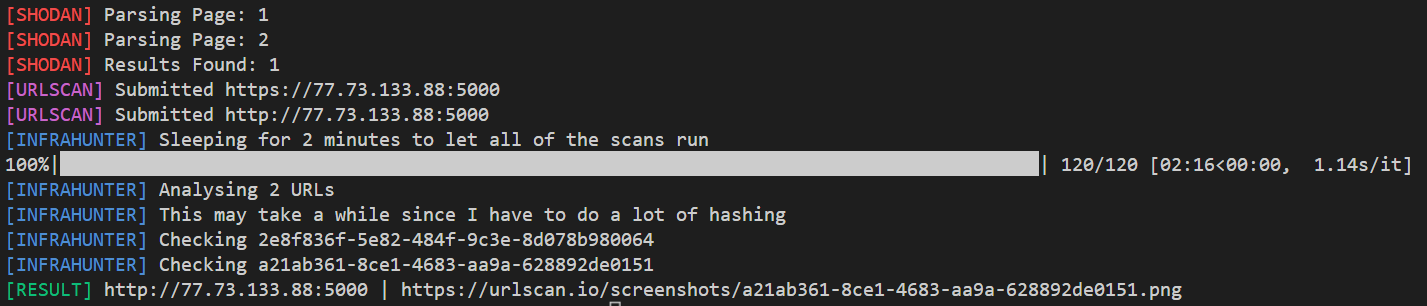
Usage Example

Builtin Queries

You can use pre-built queries by supplying their name with -q. To list all builtin queries, run python .\hunter.py -l.

python3 .\hunter.py -s {Shodan API Key} -u {URLScan API Key} -q google-phishing-http-title

Discord

You can also provide a URL to a Discord webhook with -d, --discord. This will send the results to that webhook instead of opening them in a browser.

What do I do?

  1. Search Shodan with the query provided by -q, --query
  2. For each combination of IP/port/protocol and domain/port/protocol, submit it to URLScan
    • If it has multiple open ports, all ports will be submitted
    • Submits http and https URLs
    • Same process for all domains
  3. For each URLScan
    • Check to see if the page scanned returned a HTTP OK (200)
    • Check to see if it has an screenshot of the web page in the URLScan results
    • Download the image and calculate its SHA256 and delete the image
    • Check the SHA256 against a list of hashes to exclude (this list is stuff I have deemed non-malicious but plan on making a way to bypass this check) (the list exists because I use this tool to hunt on a schedule)
    • For each remaining result not excluded by the hash check, return the result

API Rate Limiting

The tool is harcoded to sleep 20 seconds between URLScan submissions to be nice. By default it uses public scans, this can be changed with --scan-type.

Download Tool