AI-powered SAST scanner that finds auth bypass, IDOR, and logic bugs Semgrep/CodeQL miss. Free GitHub Action. Supports Python, JS/TS, Go, PHP, Ruby.
AI-powered code security scanner that finds vulnerabilities Semgrep and CodeQL miss.




Quick Start • GitHub Action • Comparison • Languages • FAQ
Traditional SAST tools rely on pattern matching and AST rules. They excel at catching known vulnerability patterns, but they fundamentally cannot reason about intent.
If your API has 20 endpoints and 19 of them verify authorization before acting on a resource, Semgrep has no way to flag the one that doesn't - because there is no pattern to match against. The vulnerability is the absence of a pattern.
VulnHawk analyzes code with AI, and for every piece of code it examines, it includes related code from elsewhere in your codebase as context. This enrichment step lets the AI compare how similar components handle security - and spot the one that doesn't.
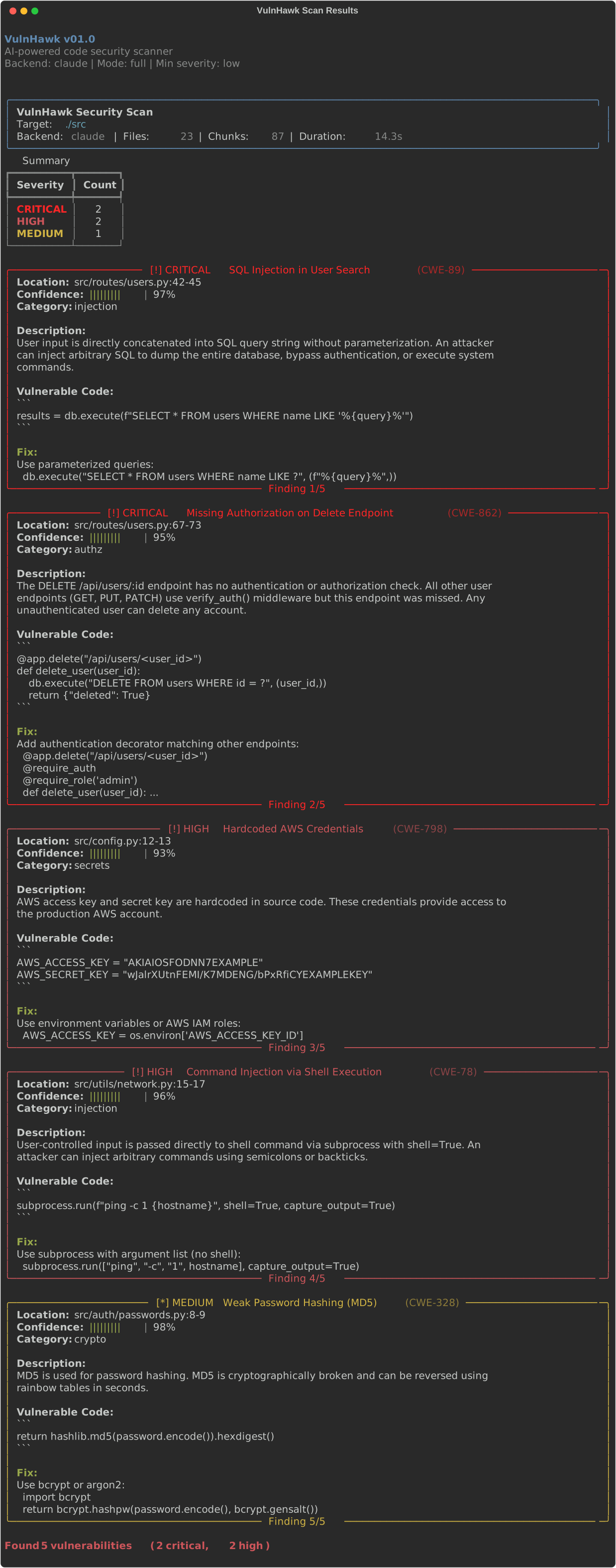
pip install vulnhawk
Choose a backend:
# Claude Code CLI - FREE for subscribers (recommended)
vulnhawk scan ./src -b claude-code

# Codex CLI - FREE for ChatGPT Pro/Plus subscribers
vulnhawk scan ./src -b codex

# Claude API
export ANTHROPIC_API_KEY=sk-ant-...
vulnhawk scan ./src

# OpenAI API
vulnhawk scan ./src -b openai -m gpt-4o

# Ollama - free, local, fully private
vulnhawk scan ./src -b ollama -m llama3.1
No config files. No rules to write. No database to build.
Claude Code and Codex backends are free for users with existing subscriptions. VulnHawk pipes prompts through your local CLI, so there are no additional API costs.
| Capability | VulnHawk | Semgrep | CodeQL | Snyk Code | Checkmarx | SonarQube |
|---|---|---|---|---|---|---|
| Detection method | AI reasoning | AST patterns | QL data flow | ML + rules | Patterns + flow | Patterns |
| Business logic flaws | Yes | No | Limited | Limited | Limited | No |
| Cross-file context | Automatic | Custom rules | Custom queries | Partial | Paid tier | Limited |
| Setup complexity | Zero config | Rule config | DB build + QL | Config file | Complex | Server setup |
| Custom rules required | No | Yes (YAML) | Yes (QL) | Partial | Yes | Yes |
| Context-aware fixes | Yes | Generic | Generic | Generic | Generic | Generic |
| Local / private mode | Ollama | Yes | Yes | No | No | Self-hosted |
| CI/CD integration | 1-line Action | Action | Action | Action | Plugin | Plugin |
| SARIF input (chain tools) | Yes | No | No | No | No | No |
| Pricing | Free* | Free / Paid | Free / Paid | Free / $$$ | $$$$$ | Free / $$$ |
*Free with Claude Code, Codex CLI, or Ollama. API backends cost ~$0.50-$2.00 per scan.
| Vulnerability class | Why rule-based tools miss it |
|---|---|
| Missing authorization on 1-of-N endpoints | No pattern to match - the bug is the absence of a check |
| IDOR / BOLA | Requires understanding that the user ID in the JWT should match the ID in the URL |
| Payment amount manipulation | Business logic - the amount field shouldn't be trusted from the client |
| Inconsistent input validation | 5 handlers sanitize, the 6th doesn't - needs cross-file comparison |
| Stored input misuse | Input saved safely, but eval()'d or raw-SQL'd 3 files away |
| Race conditions in state updates | Concurrent balance modifications without locking |
VulnHawk is designed as a complementary layer, not a replacement:
| Layer | Tool | Purpose |
|---|---|---|
| 1 | Semgrep | Fast, deterministic gatekeeping on known-bad patterns |
| 2 | CodeQL | Deep taint tracking across complex call chains |
| 3 | VulnHawk | Business logic, auth gaps, IDOR, and inconsistencies rules can't express |
vulnhawk scan ./src                      # Full scan (default)
vulnhawk scan ./src --mode auth          # Auth bypass, missing checks, session flaws
vulnhawk scan ./src --mode injection     # SQLi, command injection, SSTI, XSS
vulnhawk scan ./src --mode secrets       # Hardcoded keys, tokens, passwords
vulnhawk scan ./src --mode config        # Debug mode, permissive CORS, insecure cookies
vulnhawk scan ./src --mode crypto        # Weak hashing, hardcoded keys, bad RNG
vulnhawk scan ./src -o json -f results.json        # JSON
vulnhawk scan ./src -o sarif -f results.sarif       # SARIF (GitHub Code Scanning)
vulnhawk scan ./src -o markdown -f report.md        # Markdown report
vulnhawk scan ./src --severity high      # Critical + High only
vulnhawk scan ./src --severity info      # Everything
Feed Semgrep, CodeQL, or any SARIF-producing tool's output into VulnHawk. It uses those findings as additional context to validate, expand, and chain them into deeper vulnerabilities.
# Run Semgrep first, then enrich with VulnHawk
semgrep --config auto ./src -o semgrep.sarif --sarif
vulnhawk scan ./src --sarif-input semgrep.sarif
What this enables:
vulnhawk info ./src # Preview files, chunks, and language breakdown
VulnHawk runs as a baseline scan on your default branch and incrementally on every pull request.
name: VulnHawk Security Scan
on:
  push:
    branches: [main, master]
  pull_request:

permissions:
  security-events: write
  contents: read

jobs:
  vulnhawk:
    runs-on: ubuntu-latest
    steps:
      - uses: actions/checkout@v4
      - uses: momenbasel/vulnhawk@main
        with:
          target: '.'
          backend: 'claude-code'
          claude-code-oauth-token: ${{ secrets.CLAUDE_CODE_OAUTH_TOKEN }}
          severity: 'medium'
          fail-on-findings: 'true'
Findings are automatically uploaded to GitHub's Security > Code Scanning tab via SARIF.
| Backend | Configuration |
|---|---|
| Claude Code (free) |
Get your token: |
| Codex (free) |