 minanagehsalalma/cve-2026-34474-zte-h298a-h108n-sensitive-data-exposure
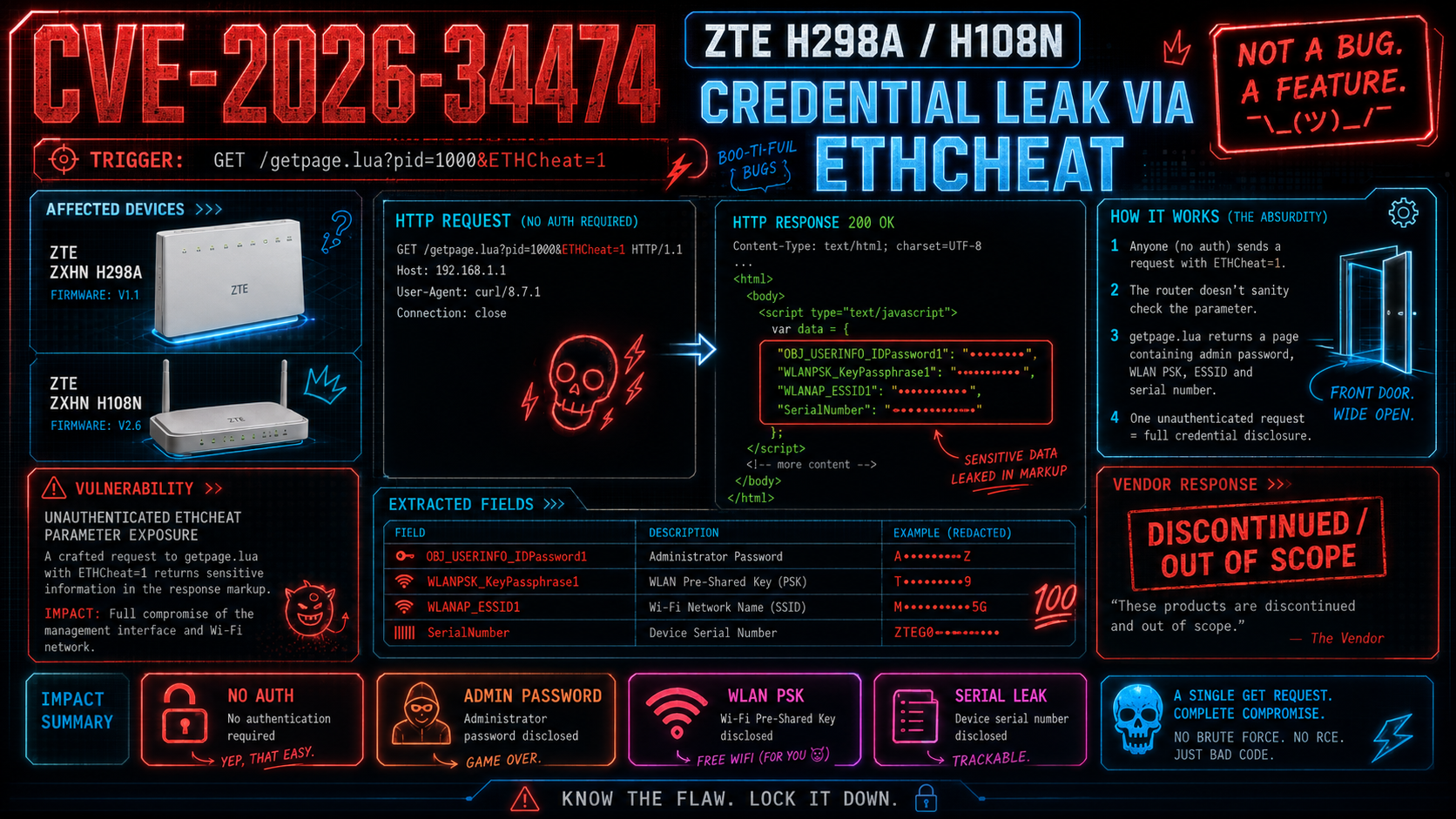
CVE-2026-34474: unauthenticated ETHCheat=1 requests leak the admin password and Wi-Fi PSK from ZTE H298A/H108N routers.

Technical breakdown of CVE-2026-34474, where an unauthenticated ETHCheat=1 request causes affected ZTE ZXHN H298A 1.1 and H108N 2.6 routers to return the live administrator password, ESSID, and WLAN PSK in the response markup.
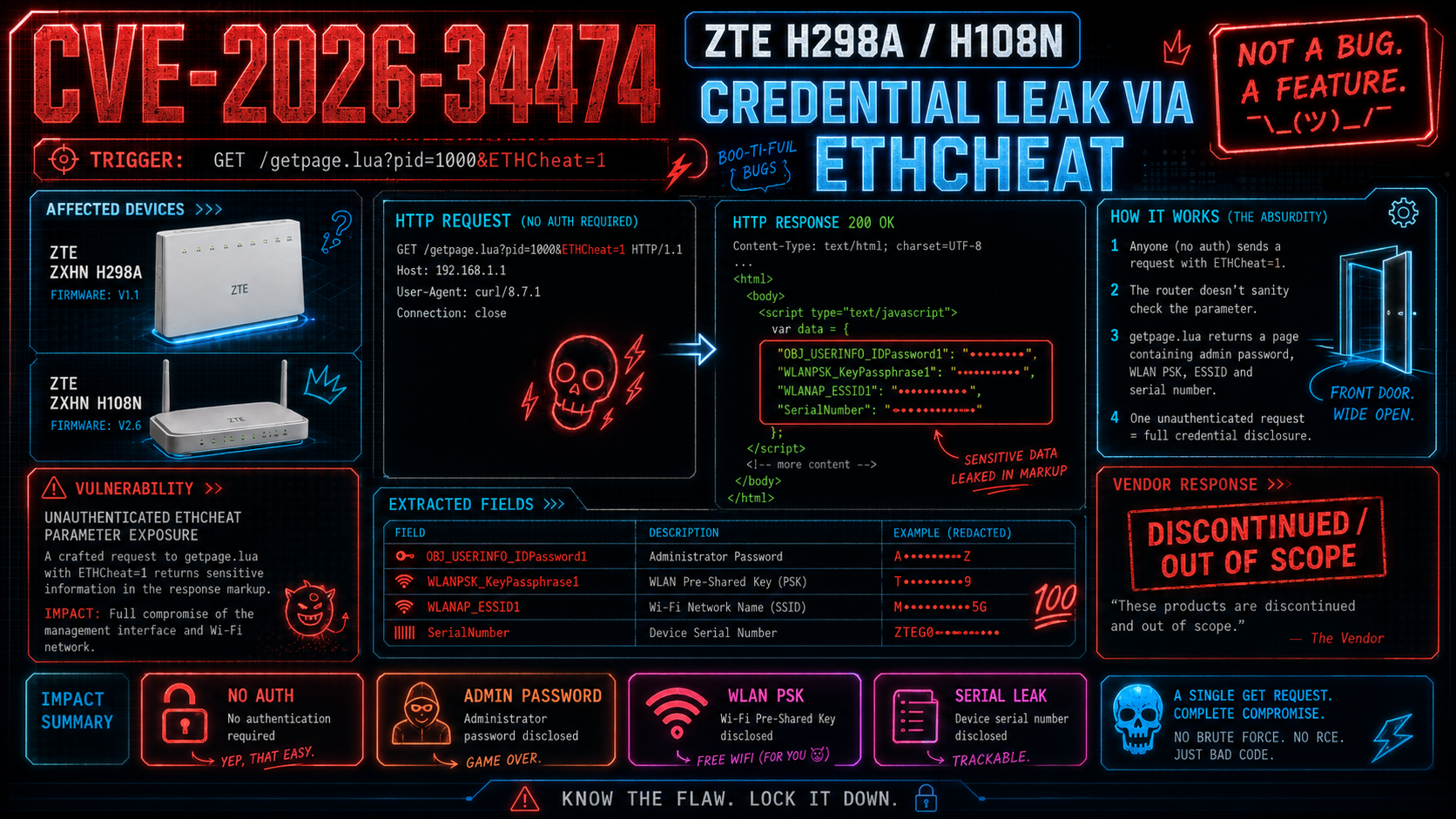
The observed exploit path is an unauthenticated management-page disclosure. A crafted GET request to getpage.lua?pid=1000ÐCheat=1 returns HTML containing fields such as OBJ_USERINFO_IDPassword1, WLANPSK_KeyPassphrase1, and WLANAP_ESSID1. On the reported H298A and H108N builds, that means the router discloses the live administrator password and WLAN PSK directly to an unauthenticated caller.
The local PoC material also includes a companion request to wizard_page/wizard_overETHfail_set_lua.lua, which exposes the serial number in structured output. Some same-model variants reportedly leaked a reduced identifier set instead of the full password-and-PSK combination, but the authentication boundary still failed in the same direction.
As of 2026-05-18, the public record shows CVE-2026-34474 as published on 2026-05-06. ZTE's stated position in the 2026 correspondence was that the impacted products had been discontinued in 2022 and 2023, and it declined vendor-side CVE assignment on that basis.
ZXHN H298A 1.1ZXHN H108N 2.6The currently preserved evidence supports the following chain:
GET /getpage.lua?pid=1000ÐCheat=1.This is why the issue crosses from information disclosure into practical compromise: the management interface itself returns the live secrets an attacker needs for administrator and Wi-Fi access.
index.html: main public write-upassets/: page CSS and JavaScriptimages/: local screenshots and sanitized publication artworkpoc/: extraction scripts and validation notes2024-05-02: original report sent to ZTE PSIRT2024-05-06: ZTE acknowledged receipt2024-05-08: ZTE verified the issue and referenced EOS announcements2026-01-17: MITRE service request 1980204 opened with the H298A / H108N package2026-02-02: ZTE declined vendor-side CVE assignment due to product discontinuation2026-03-27: MITRE assigned CVE-2026-344742026-03-30: public reference sent to MITRE and follow-up opened under service request 20160462026-05-06: CVE-2026-34474 published on cve.orgThe strongest current technical evidence in this repo is the preserved response behavior and the field names extracted from the returned markup. Recovering the exact server-side implementation for the ETHCheat branch remains an open reverse-engineering track.
