
 mgeeky/shellcodefluctuation
An advanced in-memory evasion technique fluctuating shellcode's memory protection between RW/NoAccess & RX and then encrypting/decrypting its contents
A PoC implementation for an another in-memory evasion technique that cyclically encrypts and decrypts shellcode's contents to then make it fluctuate between RW (or NoAccess) and RX memory protection.
When our shellcode resides in RW or NoAccess memory pages, scanners such as Moneta or pe-sieve will be unable to track it down and dump it for further analysis.
After releasing ThreadStackSpoofer I've received a few questions about the following README's point:
Change your Beacon's memory pages protection to RW (from RX/RWX) and encrypt their contents before sleeping (that could evade scanners such as Moneta or pe-sieve)
Beforewards I was pretty sure the community already know how to encrypt/decrypt their payloads and flip their memory protections to simply evade memory scanners looking for anomalous executable regions. Questions proven otherwise so I decided to release this unweaponized PoC to document yet another evasion strategy and offer sample implementation for the community to work with.
This PoC is a demonstration of rather simple technique, already known to the offensive community (so I'm not bringin anything new here really) in hope to disclose secrecy behind magic showed by some commercial frameworks that demonstrate their evasion capabilities targeting both aforementioned memory scanners.
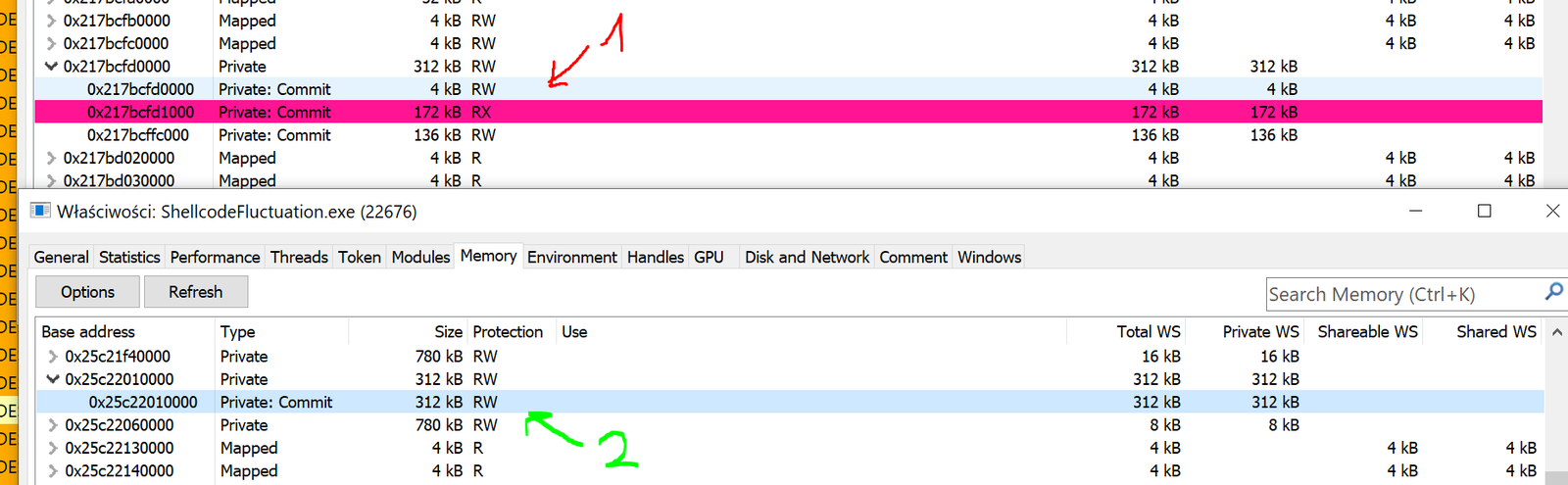
Here's a comparison when fluctuating to RW (another option is to fluctuate to PAGE_NOACCESS - described below):
This implementation along with my ThreadStackSpoofer brings Offensive Security community sample implementations to catch up on the offering made by commercial C2 products, so that we can do no worse in our Red Team toolings. 💪
This program performs self-injection shellcode (roughly via classic VirtualAlloc + memcpy + CreateThread).
When shellcode runs (this implementation specifically targets Cobalt Strike Beacon implants) a Windows function will be hooked intercepting moment when Beacon falls asleep kernel32!Sleep.
Whenever hooked MySleep function gets invoked, it will localise its memory allocation boundaries, flip their protection to RW and xor32 all the bytes stored there.
Having awaited for expected amount of time, when shellcode gets back to our MySleep handler, we'll decrypt shellcode's data and flip protection back to RX.
PAGE_READWRITE works as followskernel32!Sleep pointing back to our callback.VirtualAlloc + memcpy + CreateThread. In contrary to what we had in ThreadStackSpoofer, here we're not hooking anything in ntdll to launch our shellcode but rather jump to it from our own function. This attempts to avoid leaving simple IOCs in memory pointing at modified ntdll memory.MySleep callback gets invoked.RWkernel32!Sleep to avoid leaving simple IOC in memory pointing that Sleep have been trampolined (in-line hooked).::Sleep is made to let the Beacon's sleep while waiting for further communication.RX and then re-hook kernel32!Sleep to ensure interception of subsequent sleep.PAGE_NOACCESS works as followskernel32!Sleep pointing back to our callback.VirtualAlloc + memcpy + CreateThread ...MySleep callback gets invoked.PAGE_NOACCESSkernel32!Sleep to avoid leaving simple IOC in memory pointing that Sleep have been trampolined (in-line hooked).::Sleep is made to let the Beacon's sleep while waiting for further communication.kernel32!Sleep to ensure interception of subsequent sleep.RX and shellcode's is resumed.The technique is not brand new, nothing that I've devised myself. Merely an implementation showing the concept and its practical utilisation to let our Offensive Security community catch up on offering made by commercial C2 frameworks.
Actually, I've been introduced to the idea of flipping shellcode's memory protection couple of years back through the work of Josh Lospinoso in his amazing Gargoyle.
Here's more background:
Gargoyle takes the concept of self-aware and self-fluctuating shellcode a way further, by leveraging ROP sequence calling out to VirtualProtect.
However the technique is impressive, its equally hard to leverage it with Cobalt Strike's Beacon without having to kill its thread and keep re-initializing Beacon while in memory.
That's far from perfect, however since we already operate from the grounds of our own self-injection loader process, we're able to do whatever we want with the environment in which shellcode operate and hide it however we like. This technique (and the previous one being ThreadStackSpoofer) shows advantages from running our shellcodes this way.
The implementation of fluctuating to PAGE_NOACCESS is inspired by ORCA666's work presented in his https://github.com/ORCA666/0x41 injector.
He showed that:
This implementation contains this idea implemented, available with option 2 in <fluctuate>.
Be sure to check out other his projects as well.
The tool ShellcodeFluctuation accepts three parameters: first one being path to the shellcode and the second one modifier of our functionality.
Usage: ShellcodeFluctuation.exe <shellcode> <fluctuate>
<fluctuate>:
        -1 - Read shellcode but dont inject it. Run in an infinite loop.
        0 - Inject the shellcode but don't hook kernel32!Sleep and don't encrypt anything
        1 - Inject shellcode and start fluctuating its memory with standard PAGE_READWRITE.
        2 - Inject shellcode and start fluctuating its memory with ORCA666's PAGE_NOACCESS.
C:\> ShellcodeFluctuation.exe beacon64.bin -1
