 merbanan/rtl_433
Program to decode radio transmissions from devices on the ISM bands (and other frequencies)

rtl_433 (despite the name) is a generic data receiver, mainly for the 433.92 MHz, 868 MHz (SRD), 315 MHz, 345 MHz, and 915 MHz ISM bands.
The official source code is in the https://github.com/merbanan/rtl_433/ repository.
See also a list of software that works with rtl_433 in the wiki. For more documentation and related projects, particularly those that help with rtl_433 development, see the https://triq.org/ site.
It works with RTL-SDR and/or SoapySDR. Actively tested and supported are Realtek RTL2832 based DVB dongles (using RTL-SDR) and LimeSDR (LimeSDR USB and LimeSDR mini engineering samples kindly provided by MyriadRf), PlutoSDR, HackRF One (using SoapySDR drivers), as well as SoapyRemote.
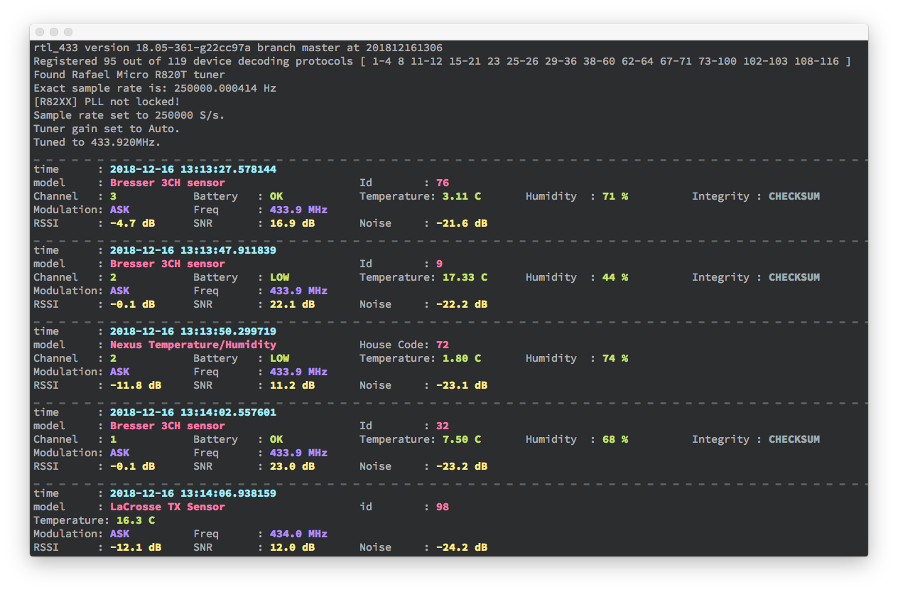
rtl_433 is written in portable C (C99 standard) and known to compile on Linux (also embedded), FreeBSD, MacOS, and Windows systems. Older compilers and toolchains are supported as a key-goal. Low resource consumption and very few dependencies allow rtl_433 to run on embedded hardware. Most common 32-bit and 64-bit CPU architectures like amd64, arm64, armhf, i386, ppc64el, riscv64, s390x and others are well supported.
See BUILDING.md
Linux (Debian, Ubuntu): sudo apt install rtl-433. For other distributions see repology or pkgs.org.
FreeBSD: pkg install rtl-433.
MacOS: brew install rtl_433.
Docker images with rtl_433 are available on the github page of hertzg.
See CONTRIBUTING.md.
rtl_433 -h
  A "rtl_433.conf" file is searched in "./", XDG_CONFIG_HOME e.g. "$HOME/.config/rtl_433/",
  SYSCONFDIR e.g. "/usr/local/etc/rtl_433/", then command line args will be parsed in order.
		= General options =
  [-V] Output the version string and exit
  [-v] Increase verbosity (can be used multiple times).
       -v : verbose notice, -vv : verbose info, -vvv : debug, -vvvv : trace.
  [-c <path>] Read config options from a file
		= Tuner options =
  [-d <RTL-SDR USB device index> | :<RTL-SDR USB device serial> | <SoapySDR device query> | rtl_tcp | help]
  [-g <gain> | help] (default: auto)
  [-t <settings>] apply a list of keyword=value settings to the SDR device
       e.g. for SoapySDR -t "antenna=A,bandwidth=4.5M,rfnotch_ctrl=false"
       for RTL-SDR use "direct_samp[=1]", "offset_tune[=1]", "digital_agc[=1]", "biastee[=1]"
  [-f <frequency>] Receive frequency(s) (default: 433920000 Hz)
  [-H <seconds>] Hop interval for polling of multiple frequencies (default: 600 seconds)
  [-p <ppm_error>] Correct rtl-sdr tuner frequency offset error (default: 0)
  [-s <sample rate>] Set sample rate (default: 250000 Hz)
  [-D quit | restart | pause | manual] Input device run mode options (default: quit).
		= Demodulator options =
  [-R <device> | help] Enable only the specified device decoding protocol (can be used multiple times)
       Specify a negative number to disable a device decoding protocol (can be used multiple times)
  [-X <spec> | help] Add a general purpose decoder (prepend -R 0 to disable all decoders)
  [-Y auto | classic | minmax] FSK pulse detector mode.
  [-Y level=<dB level>] Manual detection level used to determine pulses (-1.0 to -30.0) (0=auto).
  [-Y minlevel=<dB level>] Manual minimum detection level used to determine pulses (-1.0 to -99.0).
  [-Y minsnr=<dB level>] Minimum SNR to determine pulses (1.0 to 99.0).
  [-Y autolevel] Set minlevel automatically based on average estimated noise.
  [-Y squelch] Skip frames below estimated noise level to reduce cpu load.
  [-Y ampest | magest] Choose amplitude or magnitude level estimator.
  [-Y filter=<value>] Manual FM low-pass filter cutoff to separate simultaneous transmissions: us (1-9999, e.g. 20), Hz (10000+), or ratio of sample rate (0.0-1.0).
		= Analyze/Debug options =
  [-A] Pulse Analyzer. Enable pulse analysis and decode attempt.
       Disable all decoders with -R 0 if you want analyzer output only.
  [-y <code>] Verify decoding of demodulated test data (e.g. "{25}fb2dd58") with enabled devices
		= File I/O options =
  [-S none | all | unknown | known] Signal auto save. Creates one file per signal.
       Note: Saves raw I/Q samples (uint8 pcm, 2 channel). Preferred mode for generating test files.
  [-r <filename> | help] Read data from input file instead of a receiver
  [-w <filename> | help] Save data stream to output file (a '-' dumps samples to stdout)
  [-W <filename> | help] Save data stream to output file, overwrite existing file
		= Data output options =
  [-F log | kv | json | csv | mqtt | influx | syslog | trigger | rtl_tcp | http | null | help] Produce decoded output in given format.
       Append output to file with :<filename> (e.g. -F csv:log.csv), defaults to stdout.
       Specify host/port for syslog with e.g. -F syslog:127.0.0.1:1514
  [-M time[:<options>] | protocol | level | noise[:<secs>] | stats | bits | help] Add various meta data to each output.
  [-K FILE | PATH | <tag> | <key>=<tag>] Add an expanded token or fixed tag to every output line.
  [-C native | si | customary] Convert units in decoded output.
  [-n <value>] Specify number of samples to take (each sample is an I/Q pair)
  [-T <seconds>] Specify number of seconds to run, also 12:34 or 1h23m45s
  [-E hop | quit] Hop/Quit after outputting successful event(s)
  [-h] Output this usage help and exit
       Use -d, -g, -R, -X, -F, -M, -r, -w, or -W without argument for more help
