 melvinsh/worse_finder
Browse and export the data containers of every app on an iPhone, via the worse_query sandbox escape.


Browse and export the data containers of every app on an iPhone.
No jailbreak, no kernel exploit, just a symlink the container manager follows.

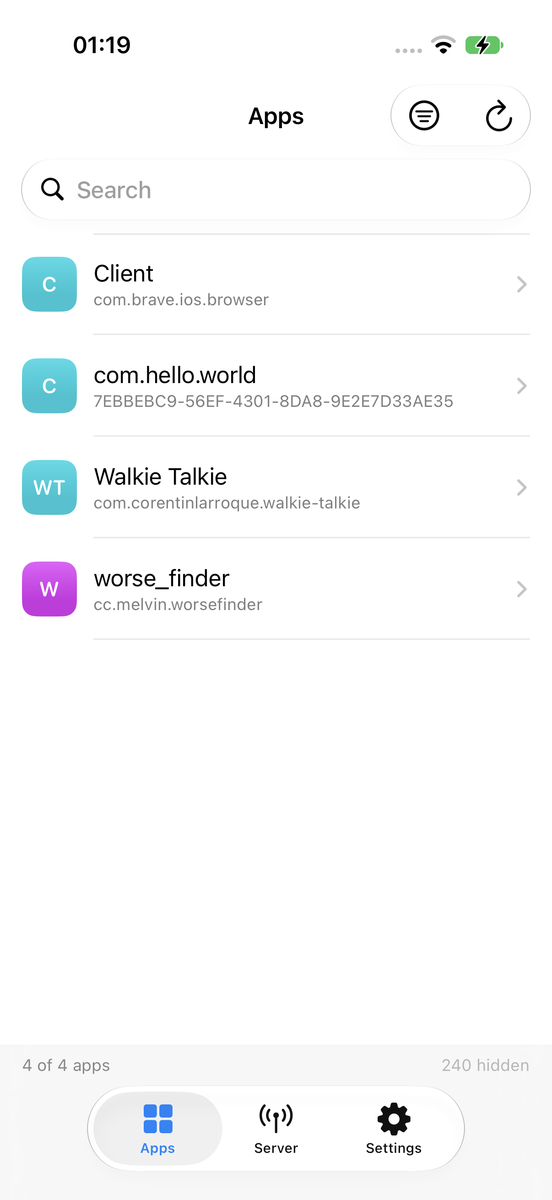
worse_finder lists every app's data container on an iOS 26 or 27 device, opens it like a folder, and exports it as a ZIP. App Group containers are reachable too, and on iOS 27 so are some system containers.
The escape comes from worse_query. An app that
holds an App Group entitlement can replace its group's Library/Caches with a symlink, then ask
containermanagerd for a sandbox extension on that path. The manager resolves the symlink and
issues the extension for the target without checking that the target is still inside the
container. The app consumes the token and the sandbox covers whatever it points at.
No kernel bug is involved, and iOS 27.2.1 does not patch it. docs/technique.md
has the writeup: container manager internals, the CSStore2 record layout used to name apps, and
what iOS blocks and what it does not.
LSApplicationProxy. System apps are hidden by default and can be shown from Settings.| Apps you installed. System containers stay hidden. | Safari, with its App Groups and export |
| Inside Safari's container | What the scan found, and what stays hidden |
| The same folder, from the web server |
app group Library/Caches  ──symlink──▶  any path
        │
        ▼
container_query(class 7, part 3)  ──▶  containermanagerd resolves the part
        │
        ▼
container_copy_sandbox_token()    ──▶  token for the resolved target
        │
        ▼
sandbox_extension_consume()       ──▶  read-write on that path
The escape itself is one function in worse_finder/Escape.m. The rest is the app on top of it:
LSStore.m parses lsd's bdsl CSStore to turn container UUIDs into bundle IDs, MCM.m reads
names and App Groups from LaunchServices, ZipWriter.m writes the archives, and Store.swift
with Server.swift does the rest.
Xcode 27, deployment target iOS 26.0. The app needs an App Group, since that is the mechanism, and it will not work without one.
worse_finder.xcodeproj, select the target, then Signing & Capabilities.worse_finder/worse_finder.entitlements at that group.com.example.worsefinder is a placeholder.Then:
xcodebuild -project worse_finder.xcodeproj -target worse_finder -configuration Debug \
  -sdk iphoneos -allowProvisioningUpdates build

xcrun devicectl device install app --device <udid> build/Debug-iphoneos/worse_finder.app
Sideloading tools that drop the App Group entitlement, such as Sideloadly or wildcard profiles, produce an app that reports "no accessible App Group" on every screen. Use a signer that keeps the entitlement.
Pass them as launch arguments, for example
xcrun devicectl device process launch --console <bundle> --serve.
| flag | effect |
|---|---|
--serve | start the HTTPS server at launch and print every address |
--server-tab, --settings-tab | open on that tab |
--app <bundleID> | push an app's detail page |
--browse-path <path> | open the file browser on a path |
--show-system | start with system apps visible |
--fixture | write symlink, broken-link, empty and nested fixtures into Documents |
--fixture-check | print what the browser model sees for those paths |
--export-check | export empty, nested and 56 MB containers, then run a cancel test |
--walkie | report every container for one bundle |
--empty | force the Apps empty state |
iconDataForVariant: returns the same 16 KB
placeholder for every bundle ID. The real artwork sits in an IconServices asset store that
needs its own parser, so rows fall back to gradient initials.worse_query, by Taj C (forcequit) and
0xjohnny. The escape, and the pathleak inode enumeration idea.docs/icon.py.GPL-3.0, the same license as worse_query and WQ Files, whose code and layout knowledge this
builds on.
This edits files iOS normally keeps out of reach. Back up the device before you point it at a container you care about.