 mein-0/fortiless
Proof-of-concept and analysis of a type-3 kernel out-of-bounds write in FortiClient's FortiShield_74.sys minifilter, including port protocol details and BSOD crash evidence.

hi hackers.
FortiClient 7.4.8.2066 ships FortiShield_74.sys, a signed minifilter at altitude 320000. It creates \FortiShieldPort with FltBuildDefaultSecurityDescriptor, so only SYSTEM and Administrators can connect. A normal user gets 0x80070005. No UAC bypass, no standard-user fairy tale.
The port protocol is tiny. Type 0 is the "authentication": MD5("%08x" pid + fc_1A2Brown3Fox4Jumped5Over6A7Lazy8Dog). The secret is a static string in .rdata. Peak 2026 security. With it you add your PID to the bypass list and flip protection (type 1/2). Type 3 is the bug. It takes a wide path string and copies it to the end of a global buffer with no length check. 4000 wchars later you have smashed the protect path at +0x400 and the driver is writing into .pdata. No heap grooming, no race. It just walks off the page.
Bugcheck 0x000000BE ATTEMPTED_WRITE_TO_READONLY_MEMORY
Faulting instruction: FortiShield_74+0xb56b (mov [rcx],ax)
Write address: DAT_14001b690 + 0x1970
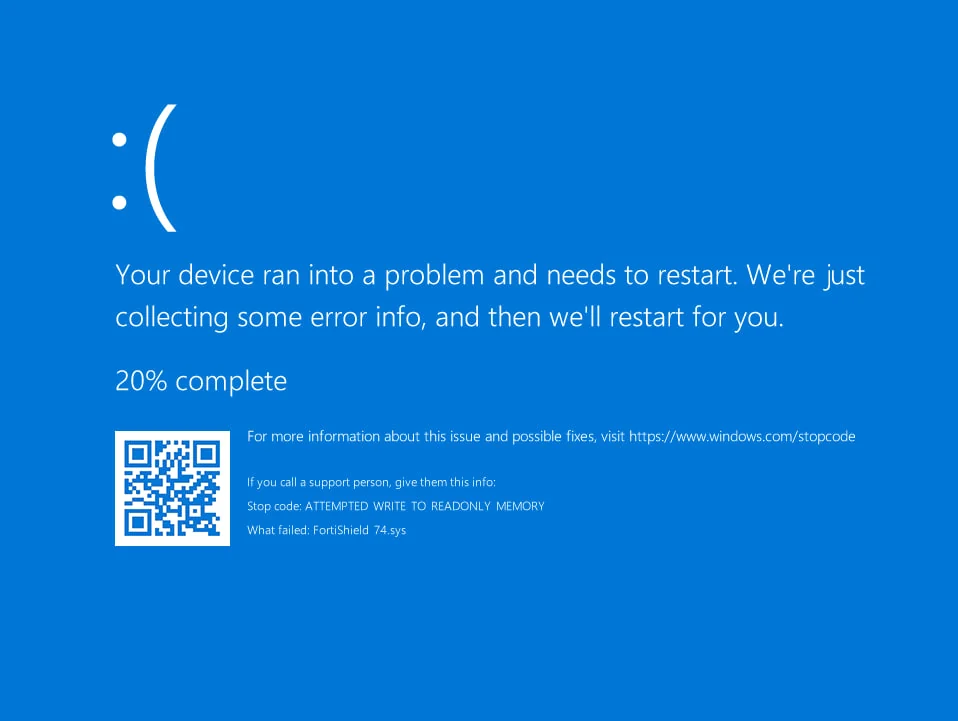
The copy loop is at +0xb560, destination DAT_14001b690+0x2e. It eats the FortiClient protect path before it hits the read-only page. Fortinet calls it a shield; it shields the BSOD from nothing. Tested on Windows 10 x64 22H2 (build 19045.6456) with FortiClient 7.4.8.2066. The ZTNA installer does not even register the minifilter, so I loaded it by hand
plus an Instances\<name> key with Altitude=320000.
I couldn't report Fortnite because people blocked me. No CVE, no fix.
Stay tuned, and keep hacking.
