 mcgill-dmas/kam1n0-community
Scalable assembly analysis platform for indexing, clone search, and executable classification using static, dynamic, and machine-learning techniques across multiple architectures.

 What Is Kam1n0 v2?




Kam1n0 v2.x is a scalable assembly management and analysis platform. It allows a user to first index a (large) collection of binaries into different repositories and provide different analytic services such as clone search and classification. It supports multi-tenancy access and management of assembly repositories by using the concept of Application. An application instance contains its own exclusive repository and provides a specialized analytic service. Considering the versatility of reverse engineering tasks, Kam1n0 v2.x server currently provides three different types of clone-search applications: Asm-Clone, Sym1n0, and Asm2Vec, and an executable classification based on Asm2Vec. New application type can be further added to the platform.
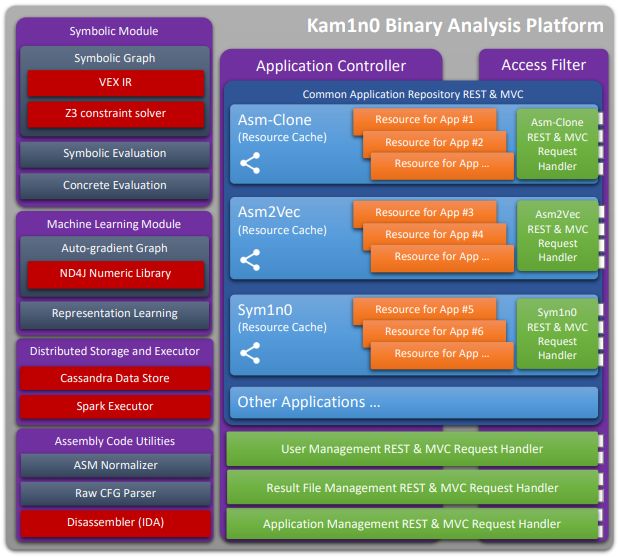
A user can create multiple application instances. An application instance can be shared among a specific group of users. The application repository read-write access and on-off status can be controlled by the application owner. Kam1n0 v2.x server can serve the applications concurrently using several shared resource pools.
Kam1n0 was developed by Steven H. H. Ding and Miles Q. Li under the supervision of Benjamin C. M. Fung of the Data Mining and Security Lab at McGill University in Canada. It won the second prize at the Hex-Rays Plug-In Contest 2015. If you find Kam1n0 useful, please cite our paper:
S. H. H. Ding, B. C. M. Fung, and P. Charland. Kam1n0: MapReduce-based Assembly Clone Search for Reverse Engineering. In Proceedings of the 22nd ACM SIGKDD International Conference on Knowledge Discovery and Data Mining (SIGKDD), pages 461-470, San Francisco, CA: ACM Press, August 2016.
S. H. H. Ding, B. C. M. Fung, and P. Charland. Asm2Vec: boosting static representation robustness for binary clone search against code obfuscation and compiler optimization. In Proceedings of the 40th IEEE Symposium on Security and Privacy (S&P), 18 pages, San Francisco, CA: IEEE Computer Society, May 2019.
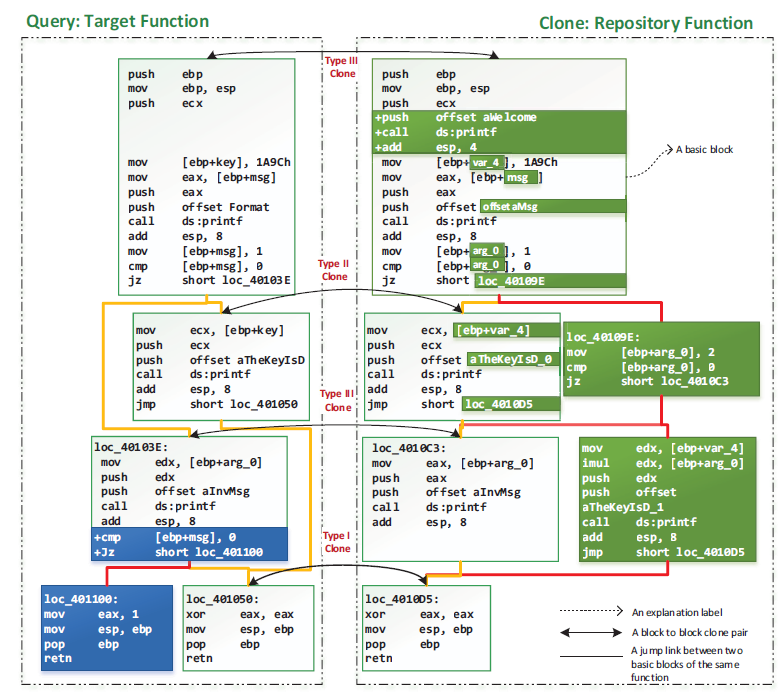
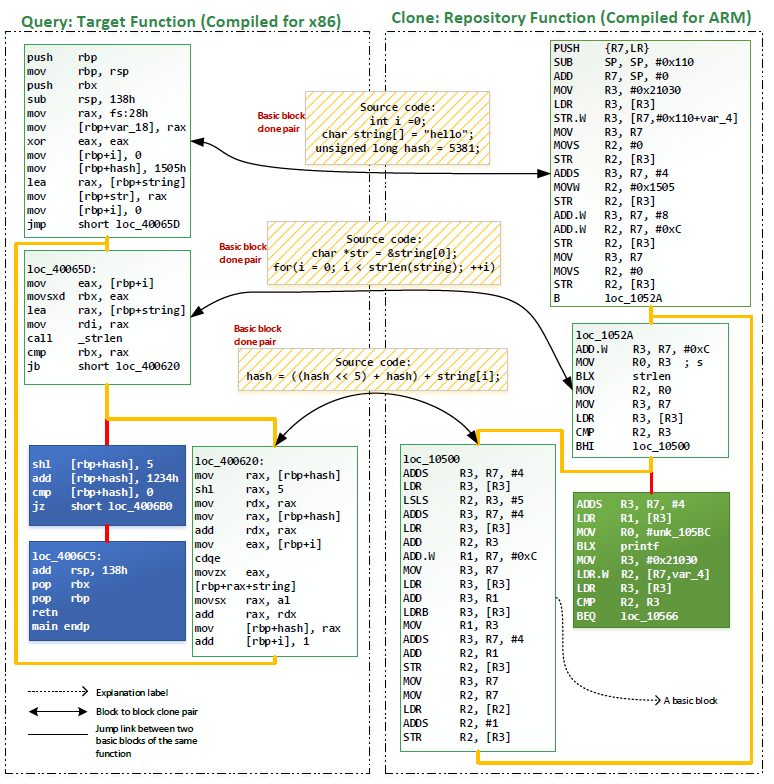
Asm-Clone applications try to solve the efficient subgraph search problem (i.e. graph isomorphism problem) for assembly functions (<1.3s average query time and <30ms average index time with 2.3M functions). Given a target function (the one on the left as shown below), it can identify the cloned subgraphs among other functions in the repository (the one on the right as shown below).
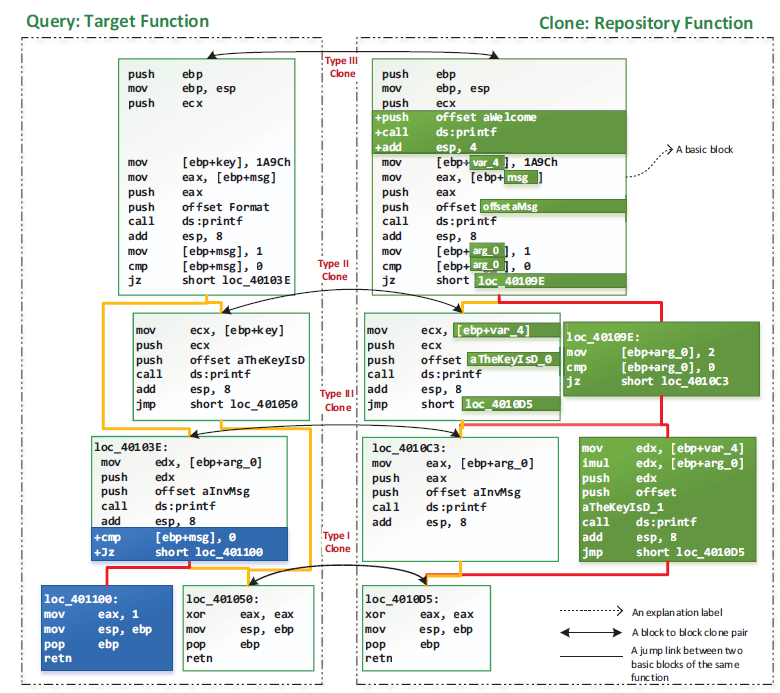
Semantic clone search by differentiated fuzz testing and constraint solving. An efficient and scalable dynamic-static hybrid approach (<1s average query time and <100ms average index time with 1.5M functions). Given a target function (the one on the left as shown below), it can identify the cloned subgraphs among other functions in the repository (the one on the right as shown below). Support visualization of abstract syntax graph.
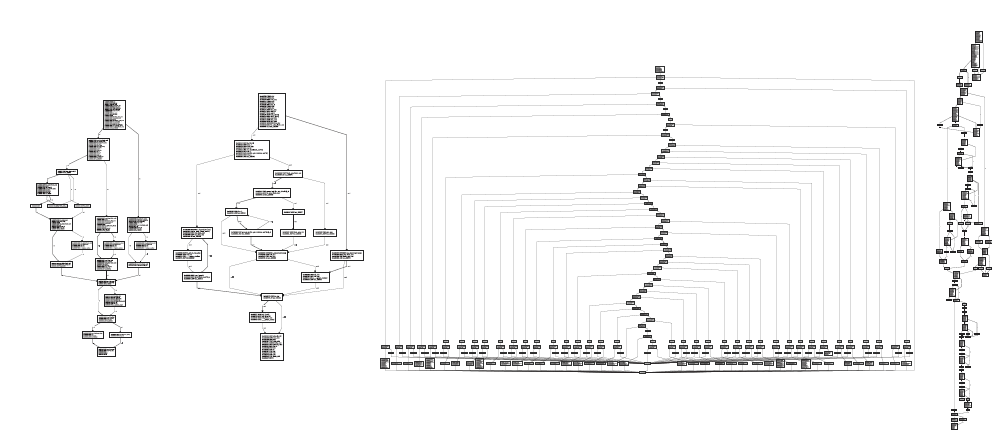
Asm2Vec leverages representation learning. It understands the lexical semantic relationship of assembly code. For example, xmm* registers are semantically related to vector operations such as addps. memcpy is similar to strcpy. The graph below shows different assembly functions compiled from the same source code of gmpz_tdiv_r_2exp in libgmp. From left to right, the assembly functions are compiled with GCC O0 option, GCC O3 option, O-LLVM obfuscator Control Flow Graph, Flattening option, and LLVM obfuscator Bogus Control Flow Graph option. Asm2Vec can statically identify them as clones.