
Skip to content
KitploitKITPLOIT
ToolsBlog
Submit
ToolsBlog
Submit

Hacking, PenTest, and Cybersecurity Tools for Your Security Arsenal!

Kitploit is a directory of hacking, cybersecurity, and pentesting tools. Discover the latest project updates to find vulnerabilities, analyze systems, automate testing, and strengthen your security.

··Feeds·Contact·Privacy·© 2026 Kitploit

Tool Directory

Categories

View all categories
Loading categories
ONUS — Locally-hosted, air-gapped VAPT platform that runs 8 parallel scanning modules, deterministically scores findings with CVSS v3.1, and generates PDF reports with optional AI-generated remediation via local LLM. | Kitploit
Tools/GitHubGitHub/maverickaayush/onus
ReconnaissanceVulnerability ScannersNetwork MappingPort ScanningDNS & Subdomain EnumerationWeb SecurityPenetration TestingLearning & EducationAI Security
GitHubmaverickaayush/onus

ONUS

Locally-hosted, air-gapped VAPT platform that runs 8 parallel scanning modules, deterministically scores findings with CVSS v3.1, and generates PDF reports with optional AI-generated remediation via local LLM.

10227 days agoNot yet reviewed

Most Popular

View all →

Discover the most used tools by our community.

Explore all tools

Browse our collection of tools

View all tools →
Share
View RepositoryWebsite

ONUS - Automated Vulnerability Assessment & Penetration Testing

License: MIT CI

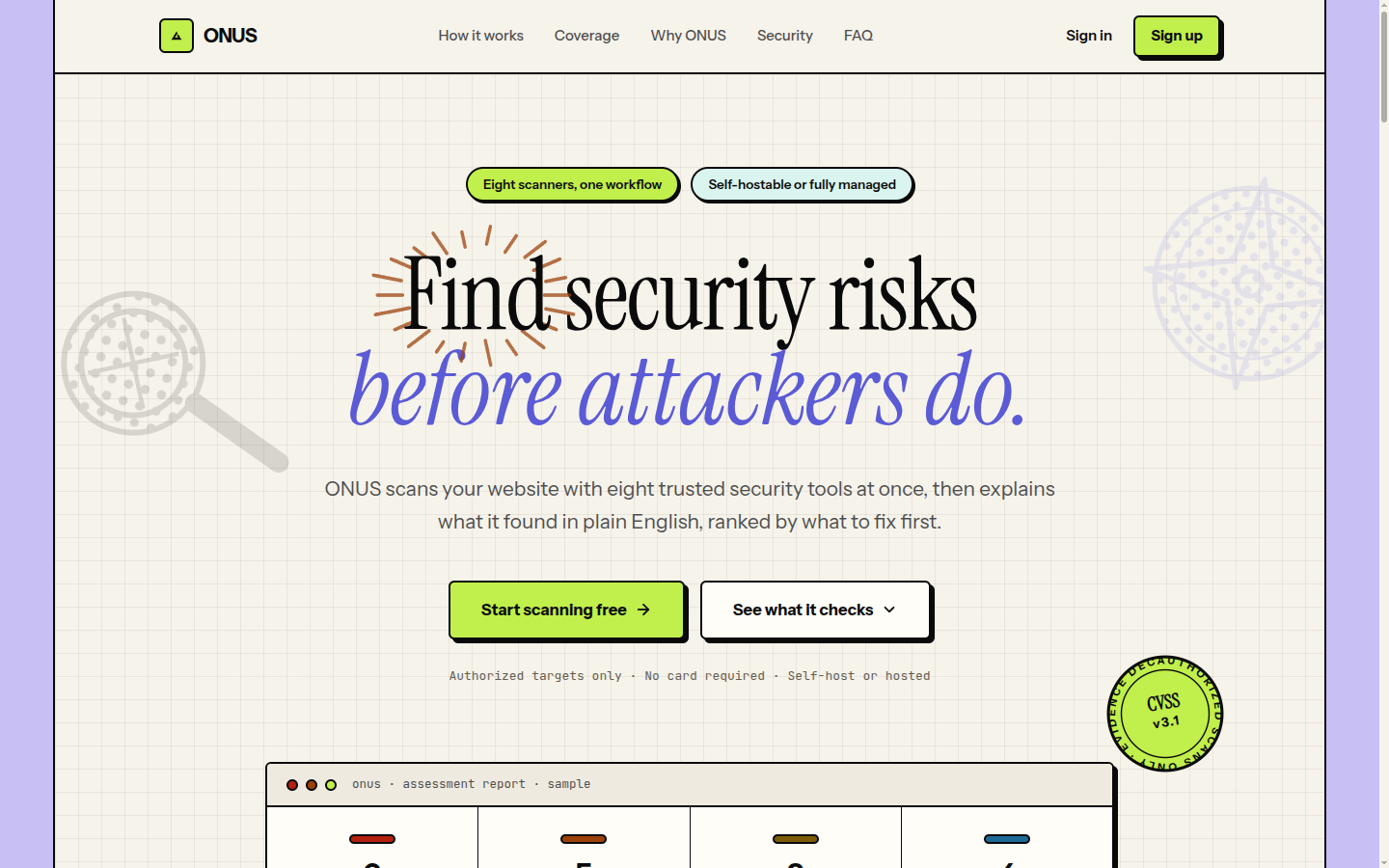
ONUS - Find security risks before attackers do.

Built by maverickaayush.

A locally-hosted, air-gapped VAPT tool: point it at an authorized target domain and it runs 8 scanning modules in parallel, deterministically scores every finding (CVSS v3.1), optionally adds AI-generated plain-English descriptions via a local LLM, and produces a PDF report plus a live web dashboard. No external API calls - everything runs on your own network.

Two ways to run ONUS:

  • Self-hosted (this repo): docker compose up → enter a domain → tick the authorization box → scan. No account, no sign-in, no email verification - it's single-operator by design, and everything below covers this path.
  • Hosted: a managed instance is live at tryonus.tech. It layers on production-only features (accounts / OAuth sign-in, a scan queue, per-user history) that default off in this repo, so self-hosting stays simple. See Self-hosted vs hosted.

Features

  • 8 parallel scanning modules (Celery) - network recon (ports/services/subdomains/DNS/WHOIS), web app scanning (ZAP + Nikto + Katana), SSL/TLS config, HTTP security headers, OWASP Top 10 checks, tech fingerprinting/WAF detection, CVE scanning (Nuclei), directory enumeration (FFUF).
  • Deterministic CVSS v3.1 scoring - severity, CVSS score/vector, priority, and OWASP category are computed from a rule catalogue, never guessed by an LLM. Two runs of the same scan produce byte-identical numeric fields.
  • Confidence verification - findings are passively re-checked (non-destructive re-observation only) and tagged confirmed / probable / unverified rather than silently dropped.
  • Optional local AI analysis - Ollama + Qwen 2.5 7B turns scored findings into plain-English descriptions and remediation steps. Fully air-gapped; the tool works without it (see Quick start below).
  • Context-aware, actionable remediation - every finding ends with a concrete next step. Stable issues use deterministic templates; genuinely context-dependent ones use the AI; and managed-platform detection (Vercel / Cloudflare / Netlify / GitHub Pages / …) means a platform-owned TLS finding says who controls that layer and what to do next, instead of impossible "edit your server config" advice.
  • PDF report + web dashboard - WeasyPrint-rendered report and a Next.js dashboard, both driven by the same scored/described findings.

Self-hosted vs hosted

The self-hosted default path is intentionally the simple one: no sign-up, no email verification, no OAuth. The hosted-only features (authentication, scan queue) live behind config flags that default off (REQUIRE_AUTH=false, HOSTED_QUEUE_ENABLED=false; see Configuration) and are not set in docker-compose.yml - so running ONUS locally never puts you behind a login. Prefer zero setup? Use the hosted site at tryonus.tech.

Screenshots

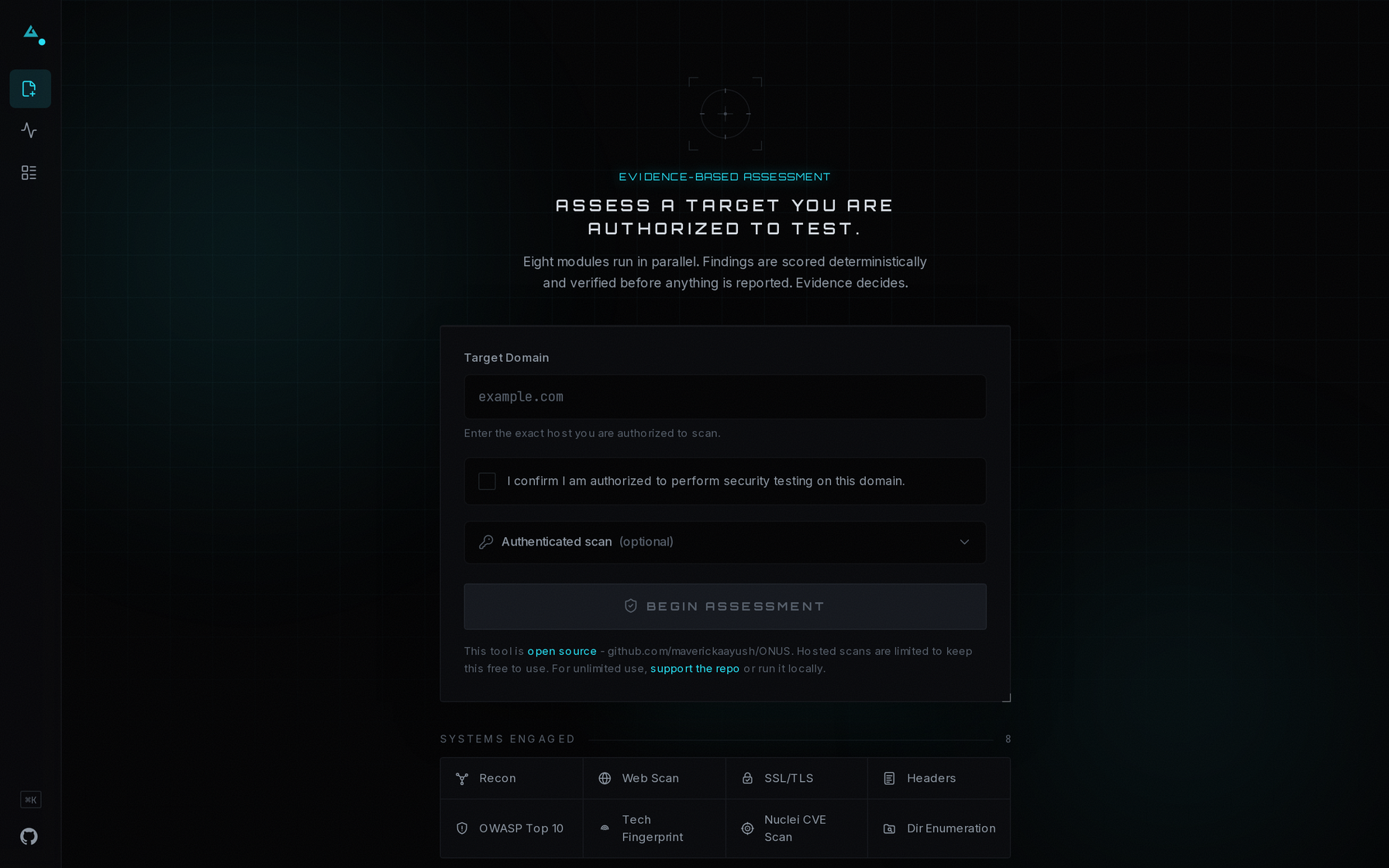
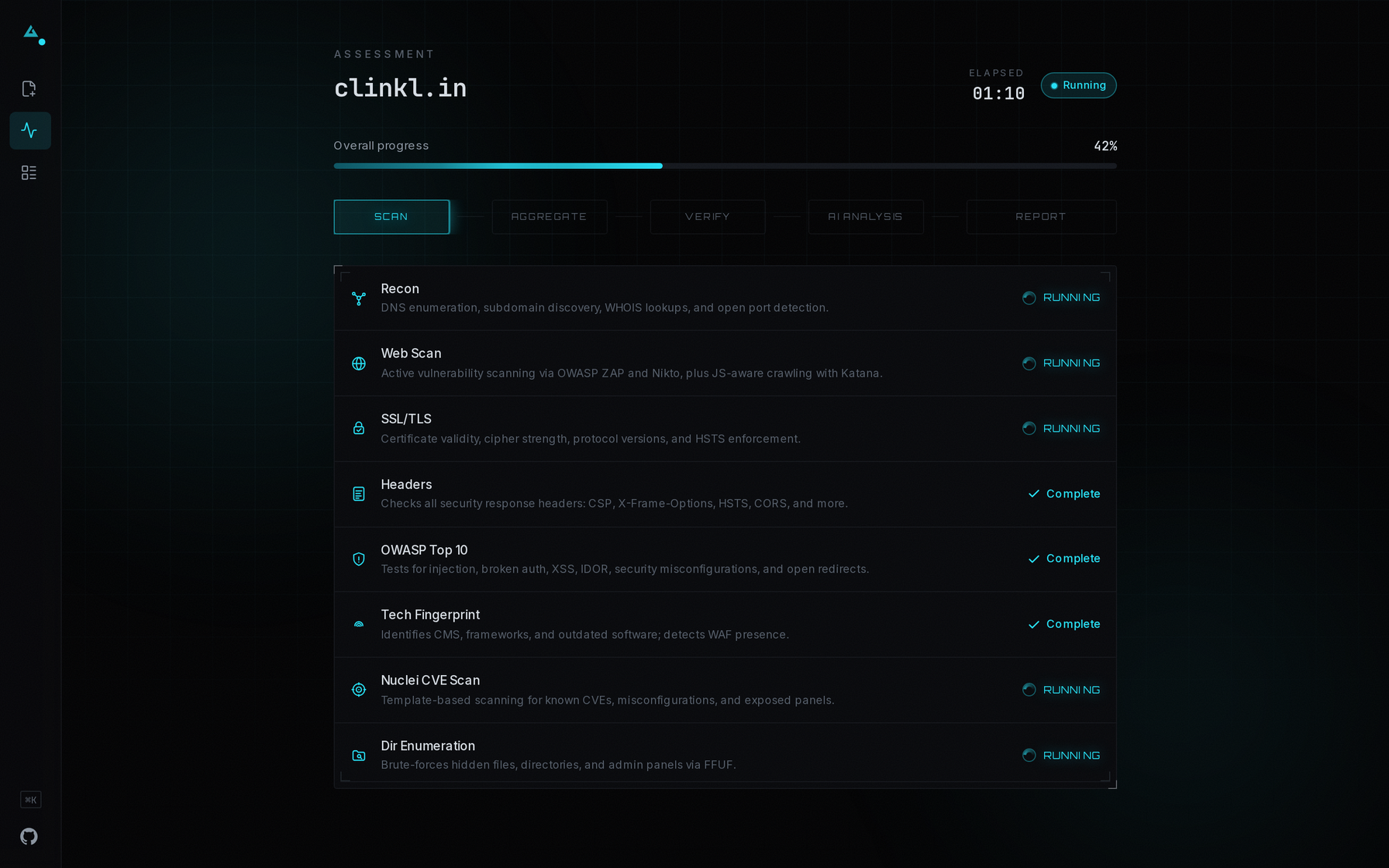
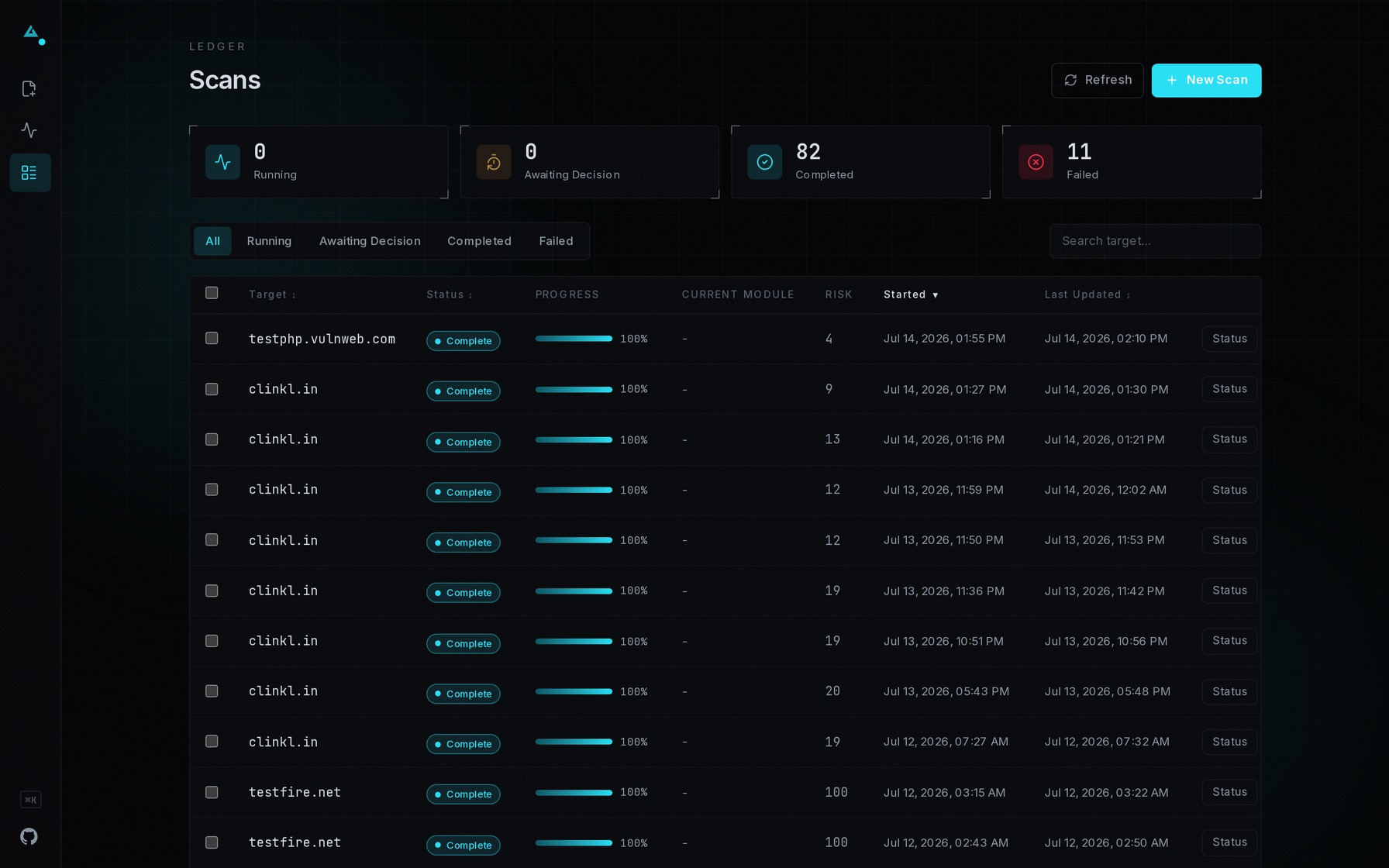
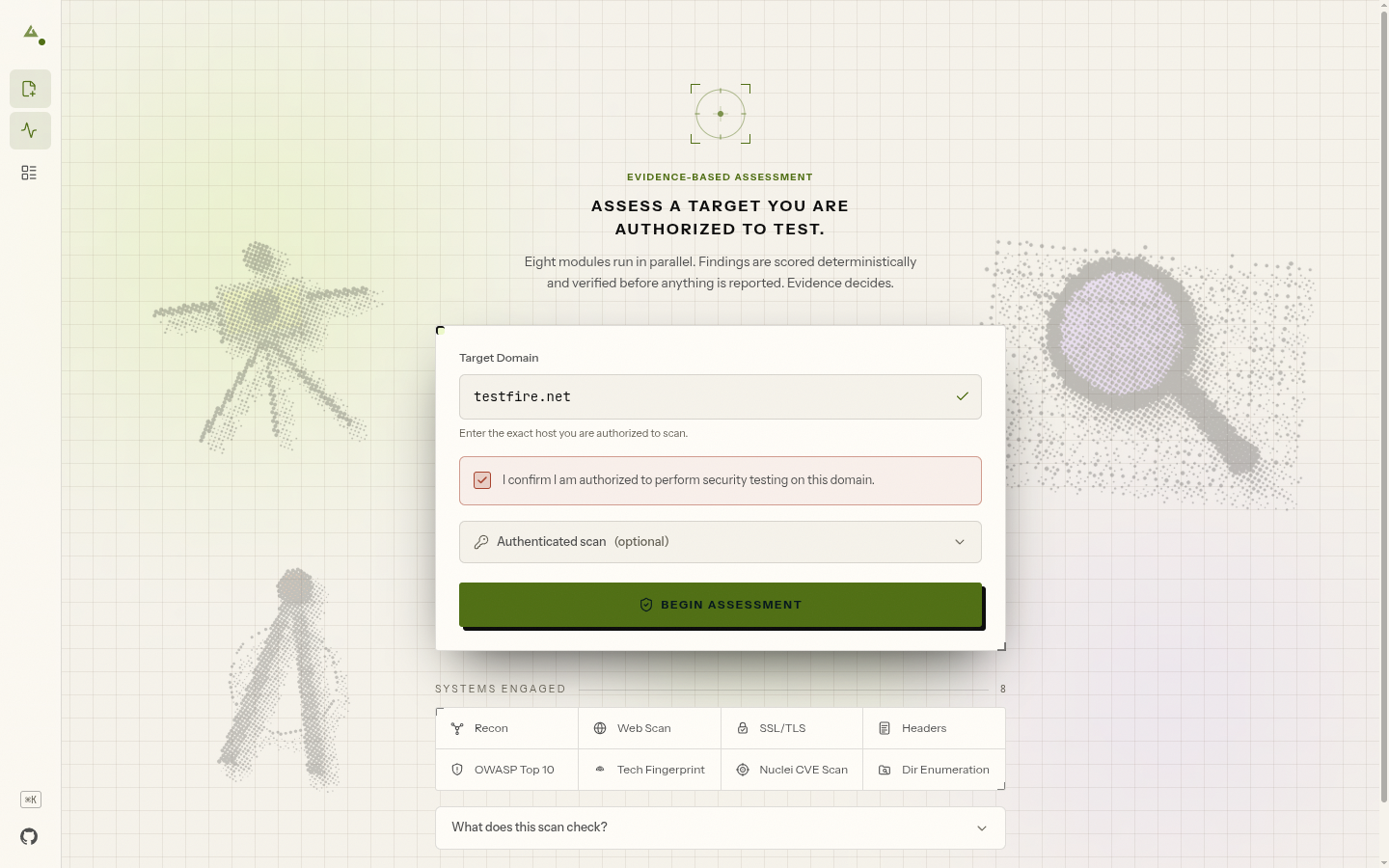
New ScanLive Scan Status
New Scan formScan Status page
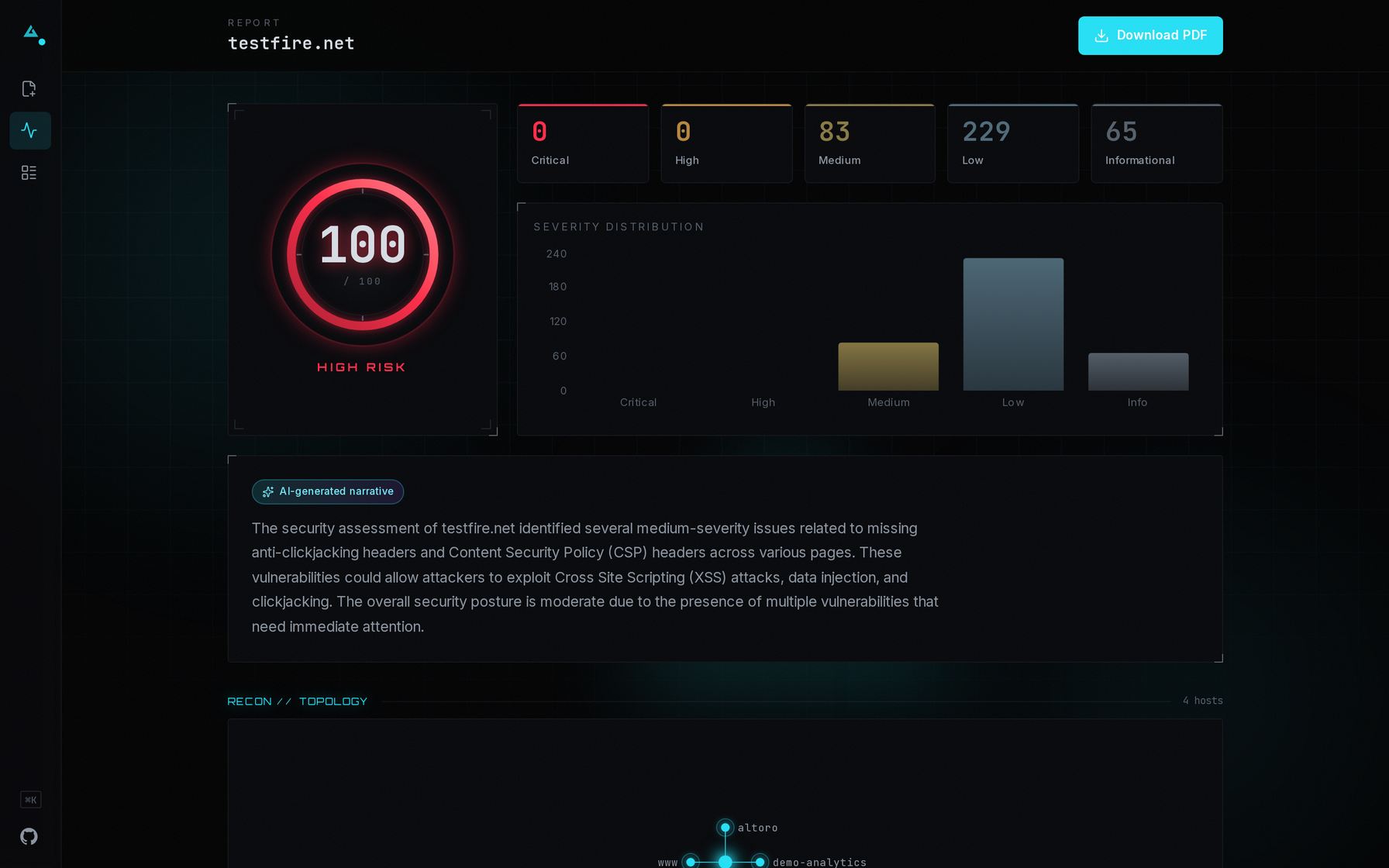
Report DashboardScans Discovery
Report dashboardScans discovery dashboard

Architecture

root@kitploit:~
domain → [recon | webscan | ssl_tls | headers | owasp | tech_fingerprint | nuclei | enumeration] (parallel, Celery)
       → any module failed/timed out? → pause for operator retry/continue/cancel
       → aggregator (dedup + OWASP-map + sort)
       → confidence verification (passive re-observation)
       → deterministic CVSS scoring
       → Ollama (Qwen 2.5 7B) AI analysis
       → WeasyPrint PDF + PostgreSQL
       → dashboard / PDF download
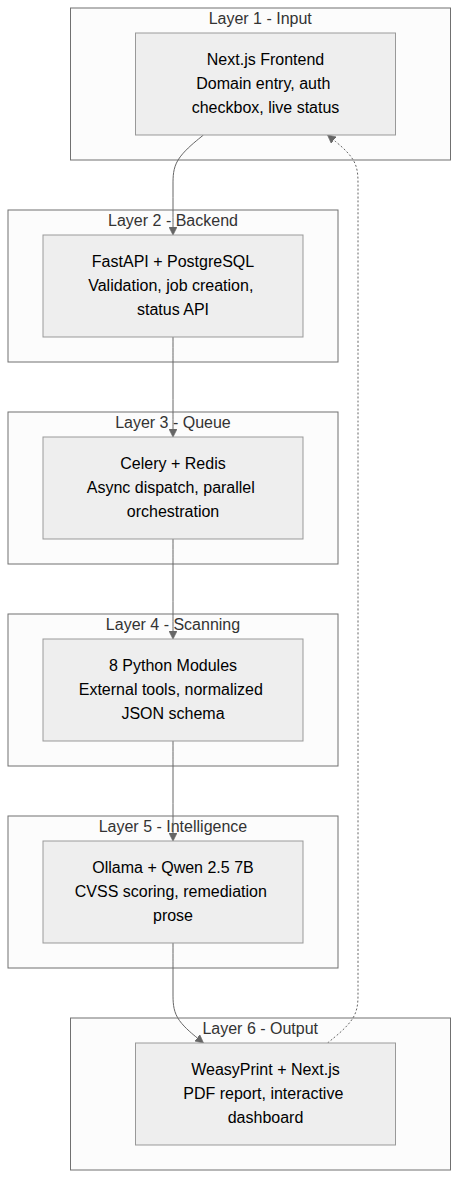
Six-layer architecture diagram

Six layers: Next.js frontend → FastAPI → Celery/Redis → 8 parallel scanning modules → Ollama (Qwen 2.5 7B) → WeasyPrint PDF + dashboard. Full details in ARCHITECTURE.md (schemas, contracts, guardrails) and docs/QUICK_REF.md (quick lookup for common changes).

Prerequisites

  • Docker + Docker Compose v2
  • ~8GB free disk. The built images total ~6.8GB (backend and worker are ~3.25GB each - they bundle Nuclei templates and a headless Chromium via Playwright - plus a ~270MB frontend), and the build itself needs headroom on top.
  • ~6GB free RAM. The ZAP sidecar alone is capped at 4GB (mem_limit: 4g), and Postgres, Redis, the API, the worker and the frontend run alongside it.
  • First build takes roughly 10-15 minutes on a decent connection.

Quick start

See Prerequisites above: ~8GB disk and ~6GB RAM, and expect a 10-15 minute first build.

root@kitploit:~
cp .env.example .env
cp backend/subfinder-config/provider-config.yaml.example backend/subfinder-config/provider-config.yaml
docker compose up -d
docker compose ps        # wait for zap to report healthy (~2 min)

Open http://localhost:3000, enter a domain, tick the authorization box, and start the scan.

No sign-in, sign-up, or email verification. Self-hosted ONUS is single-operator by default - there's no account step between opening the dashboard and scanning.

This works with no Ollama install. CVSS/severity/priority scoring is always deterministic (analysis/cvss_scorer.py) - without Ollama running, findings just get a rule-based description template instead of AI-generated prose. See "Optional: enable AI-generated descriptions" below to turn that on.

Zero API keys are required to run this tool. Every scanning tool it wraps (nmap, ZAP, Nikto, testssl.sh, Nuclei, Amass, Naabu, httpx, WhatWeb, WAFW00F, FFUF) and Ollama itself work with no key at all. The subfinder config copy step above is the one optional exception - leaving it as the empty template is fine, subfinder just runs with free/public sources only. To deepen subdomain enumeration, you can add up to two free-tier keys to that file before starting: a GitHub personal access token and a ProjectDiscovery Chaos API key - see the comments inside provider-config.yaml.example.

Optional: enable AI-generated descriptions

Ollama runs natively on the host (not in Docker) so it can use the host's GPU directly; containers reach it via host.docker.internal.

  1. Install Ollama on the host: https://ollama.com/install.sh
  2. Pull the model: ollama pull qwen2.5:7b
  3. Make Ollama reachable from Docker containers (Ollama defaults to 127.0.0.1-only, which Docker's bridge network cannot reach):
    root@kitploit:~
    sudo systemctl edit ollama
    
    Add under [Service]:
    root@kitploit:~
    [Service]
    Environment="OLLAMA_HOST=0.0.0.0:11434"
    
    Save, then:
    root@kitploit:~
    sudo systemctl daemon-reload && sudo systemctl restart ollama
    
    Note: this makes Ollama reachable from your local network, not just Docker - fine on a personal machine, worth a firewall rule on a shared one.
  4. Verify: curl http://localhost:11434/api/tags
  5. Restart the backend/worker so they pick it up: docker compose restart backend worker

Optional: practice targets

The compose file also defines 12 intentionally-vulnerable practice apps (Juice Shop, DVWA, bWAPP, Mutillidae, NodeGoat, DVWP/WordPress behind a ModSecurity WAF, Metasploitable2, WebGoat) for trying the scanner against something without needing your own authorized target. They're gated behind a Compose profile so they never build/start by default:

root@kitploit:~
docker compose --profile targets up -d

Warning: these are intentionally-vulnerable, some genuinely backdoored, services (Metasploitable2 ships a live vsftpd backdoor). Only run the targets profile on a machine that isn't reachable from the internet or a shared network - never on a public cloud instance or an exposed host.

Most of these run from prebuilt images and need nothing extra. Two - nodegoat and dvwp-wordpress - build from source that isn't vendored into this repo and must be cloned first:

root@kitploit:~
git clone https://github.com/OWASP/NodeGoat nodegoat-src
git clone https://github.com/vavkamil/dvwp dvwp-src

Published ports once running: Juice Shop :3001, DVWA :8081, bWAPP :8083, Mutillidae :8084, NodeGoat :8085, DVWP (via WAF, TLS) :8444, WebGoat :8082. Metasploitable2 publishes no host port (reachable only from backend/worker over Docker's internal network) since it exposes real backdoored/unauthenticated network services.

Configuration

Env vars, set via .env (copied from .env.example):

The POSTGRES_PASSWORD/SECRET_KEY defaults above are demo-only - they're fine for a local/personal instance but change both before deploying anywhere reachable by anyone else. This is now enforced, not just advised: set ONUS_ENV=production (or turn on hosted auth) and the backend refuses to start while either is still a default/placeholder. Generate a strong key with python -c "import secrets; print(secrets.token_urlsafe(48))".

Hosted-only features are off by default. REQUIRE_AUTH (accounts / OAuth sign-in) and HOSTED_QUEUE_ENABLED (scan queue) both default to false and aren't set in docker-compose.yml, so self-hosted ONUS never gates you behind a login or a queue. Leave them off unless you're intentionally building a multi-user hosted deployment - the managed tryonus.tech instance is the one that turns them on.

Analytics (optional)

ONUS has no analytics by default - nothing loads and no data leaves the browser. To collect anonymous product-usage metrics on your own deployment, set a single Google Analytics 4 Measurement ID:

root@kitploit:~
NEXT_PUBLIC_GA_ID=G-XXXXXXXXXX

It's a frontend build-time variable, so set it in the frontend build environment (a Vercel/host env var, or frontend/.env.local for a local npm run build). When set, GA loads only in production builds and tracks page views plus a few product events (e.g. scan_started, scan_completed, report_downloaded). Custom events go through the typed helper in frontend/lib/analytics.ts - trackEvent('scan_started').

Privacy: only anonymous, low-cardinality usage events are sent - never scanned domains, scan results, findings, report contents, the authorization state, or any personal data. Leave NEXT_PUBLIC_GA_ID unset and ONUS behaves exactly as before; analytics is entirely opt-in.

API docs

FastAPI generates interactive Swagger docs for free - once the backend is running, open http://localhost:8000/docs.

Stop

root@kitploit:~
docker compose down

Logs

root@kitploit:~
docker compose logs -f backend worker

Testing & Validation

root@kitploit:~
pip install -r backend/requirements-dev.txt
pytest backend/tests

655 automated backend tests as of this writing. Beyond the unit/integration suite, the tool has been exercised end-to-end during development: 79 real scans executed and 124 PDF reports generated against nine deliberately- vulnerable practice applications (DVWA, Juice Shop, Mutillidae, NodeGoat, bWAPP, WebGoat, Metasploitable2, DVWP/WordPress behind a WAF) plus one authorized public target (testphp.vulnweb.com) - not hypothetical numbers. Only ever scan targets you are explicitly authorized to test - see docs/test_findings.md for the practice targets used during development.

Documentation

  • ARCHITECTURE.md - full architecture, schemas, and the contracts a change should never break. Read this before making a non-trivial change.
  • docs/QUICK_REF.md - run commands, folder responsibilities, "where do I make this change."
  • docs/scanners.md - reasoning behind each scanning module's timing/flag design.
  • docs/ai.md - Ollama timeout/context tuning, why scoring moved off the LLM entirely.
  • docs/docker.md - Docker deviation notes and build gotchas.
  • docs/troubleshooting.md - how to manually test any module/stage in isolation.
  • docs/roadmap.md - historical build sequence (build is complete).
  • CONTRIBUTING.md - dev setup, tests, PR expectations.

License

MIT - see LICENSE.

Authorized use only

Scanning targets without explicit written authorization is illegal under the IT Act 2000 (India) and equivalent international statutes. This tool requires authorization confirmation on every scan and logs the operator + timestamp for accountability.

Download Tool
Self-hosted (this repo)Hosted (tryonus.tech)
Setupdocker compose upnone - just open the site
Sign-innone - single operatoraccount / Google / GitHub OAuth
Scan flowdomain → authorization box → scansame, after signing in
Extras-scan queue, per-user history, hosted email
Runs onyour own network, air-gappedmanaged cloud
VariableDefaultPurpose
POSTGRES_PASSWORDvapt_secure_2025Database password
SECRET_KEYchange_me_to_a_long_random_stringBackend secret key
ALLOWED_HOSTSlocalhost,127.0.0.1FastAPI allowed hosts
OLLAMA_URLhttp://host.docker.internal:11434Where the backend/worker reach Ollama
SCAN_TIMEOUT_MULTIPLIER1.5Scales every module's tool/Celery timeout - real-world targets are slower than lab targets; drop to 1.0 for lab-tuned timings
MAX_CONCURRENT_SCANS3Concurrent-scan cap (resource-exhaustion / target-politeness guard, also sizes the DB connection pool)
ONUS_ENVdevelopmentdevelopment (self-hosted localhost — weak secrets only warn) or production (weak SECRET_KEY/Postgres password become a hard boot failure)