Scanner and Patcher 



Overview:
The Scanner and Patcher project is built as part of the AlphaSecure framework, which has been presented and published at ACM IC3 2024 under the title AlphaSecure: A State-of-the-Art Framework for Web Application Vulnerabilities Detection and Patch Recommendation Using Automated Techniques. You can find the publication here AlphaSecure: A State-of-the-Art Framework for Web Application Vulnerabilities Detection and Patch Recommendation Using Automated Techniques.
- A web application scanner explores a web application by crawling through its web pages and examines it for security vulnerabilities, which involves generation of malicious inputs and evaluation of application's responses.
- These scanners are automated tools that scan web applications to look for security vulnerabilities. They test web applications for common security problems such as cross-site scripting (XSS), SQL injection, and cross-site request forgery (CSRF).
- This scanner uses different tools like nmap, dnswalk, dnsrecon, dnsenum, dnsmap etc in order to scan ports, sites, hosts and network to find vulnerabilites like OpenSSL CCS Injection, Slowloris, Denial of Service, etc.
| Serial No. | Tool Name | | Serial No. | Tool Name |
|---|
| 1 | whatweb | | 2 | nmap |
| 3 | golismero | | 4 | host |
| 5 | wget | | 6 | uniscan |
| 7 | wafw00f | | 8 | dirb |
| 9 | davtest | | 10 | theharvester |
| 11 | xsser | | 12 | fierce |
| 13 | dnswalk | | 14 | dnsrecon |
| 15 | dnsenum | | 16 | dnsmap |
| 17 | dmitry | | 18 | nikto |
| 19 | whois | | 20 | lbd |
| 21 | wapiti | | 22 | devtest |
| 23 | sslyze | | | |
Working
Phase 1
- User has to write:- "python3 web_scan.py (https or http) ://example.com"
- At first program will note initial time of running, then it will make url with "www.example.com".
- After this step system will check the internet connection using ping.
- Functionalities:-
-
- To navigate to helper menu write this command:- --help for update --update
-
- If user want to skip current scan/test:- CTRL+C
-
- To quit the scanner use:- CTRL+Z
-
- The program will tell scanning time taken by the tool for a specific test.
Phase 2
- From here the main function of scanner will start:
- The scanner will automatically select any tool to start scanning.
- Scanners that will be used and filename rotation (default: enabled (1)
- Command that is used to initiate the tool (with parameters and extra params) already given in code
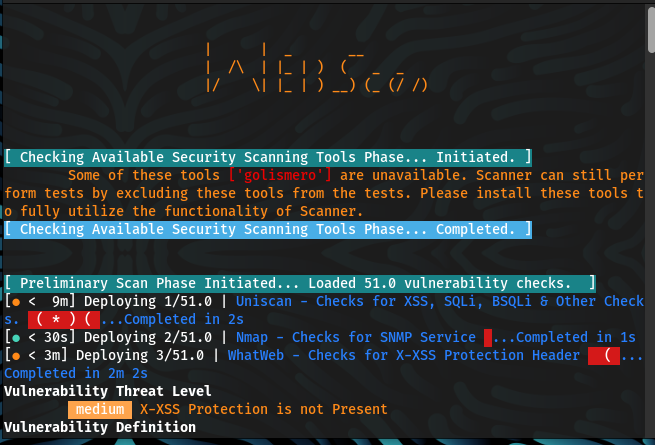
- After founding vulnerability in web application scanner will classify vulnerability in specific format:-
-
- [Responses + Severity (c - critical | h - high | m - medium | l - low | i - informational) + Reference for Vulnerability Definition and Remediation]
-
- Here c or critical defines most vulnerability wheres l or low is for least vulnerable system
Definitions:-
-
Critical:- Vulnerabilities that score in the critical range usually have most of the following characteristics:
Exploitation of the vulnerability likely results in root-level compromise of servers or infrastructure devices.Exploitation is usually straightforward, in the sense that the attacker does not need any special authentication credentials or knowledge about individual victims, and does not need to persuade a target user, for example via social engineering, into performing any special functions.
-
High:- An attacker can fully compromise the confidentiality, integrity or availability, of a target system without specialized access, user interaction or circumstances that are beyond the attacker’s control. Very likely to allow lateral movement and escalation of attack to other systems on the internal network of the vulnerable application. The vulnerability is difficult to exploit. Exploitation could result in elevated privileges. Exploitation could result in a significant data loss or downtime.
-
Medium:- An attacker can partially compromise the confidentiality, integrity, or availability of a target system. Specialized access, user interaction, or circumstances that are beyond the attacker’s control may be required for an attack to succeed. Very likely to be used in conjunction with other vulnerabilities to escalate an attack.Vulnerabilities that require the attacker to manipulate individual victims via social engineering tactics. Denial of service vulnerabilities that are difficult to set up. Exploits that require an attacker to reside on the same local network as the victim. Vulnerabilities where exploitation provides only very limited access. Vulnerabilities that require user privileges for successful exploitation.
-
Low:- An attacker has limited scope to compromise the confidentiality, integrity, or availability of a target system. Specialized access, user interaction, or circumstances that are beyond the attacker’s control is required for an attack to succeed. Needs to be used in conjunction with other vulnerabilities to escalate an attack.
-
Info:- An attacker can obtain information about the web site. This is not necessarily a vulnerability, but any information which an attacker obtains might be used to more accurately craft an attack at a later date. Recommended to restrict as far as possible any information disclosure.
-
| CVSS V3 SCORE RANGE | SEVERITY IN ADVISORY |
|---|
| 0.1 - 3.9 | Low |
| 4.0 - 6.9 | Medium |
| 7.0 - 8.9 | High |
| 9.0 - 10.0 | Critical |
Vulnerabilities
- After this scanner will show results which inclues:
-
-
-
- Now, Scanner will tell about harmful effects of that specific type vulnerabilility.
- Scanner tell about sources to know more about the vulnerabilities. (websites).
- After this step, scanner suggests some remdies to overcome the vulnerabilites.
Phase 3
- Scanner will Generate a proper report including
-
- Total number of vulnerabilities scanned
-
- Total number of vulnerabilities skipped
-
- Total number of vulnerabilities detected
-
- Time taken for total scan
-
- Details about each and every vulnerabilites.
- Writing all scan files output into SA-Debug-ScanLog for debugging purposes under the same directory
- For Debugging Purposes, You can view the complete output generated by all the tools named SA-Debug-ScanLog.
Use
Use Program as python3 web_scan.py (https or http) ://example.com
--help
--update

 malwareman007/scanner-and-patcher