 loseys/awesome-c2-frameworks
Curated catalog of 2026 command-and-control frameworks for red team operations, with per-tool breakdowns of implants, listeners, payloads, and evasion features.


The best C2 tools of 2026 for red team operations. Disclaimer: this project is for security professionals doing authorized work and study.
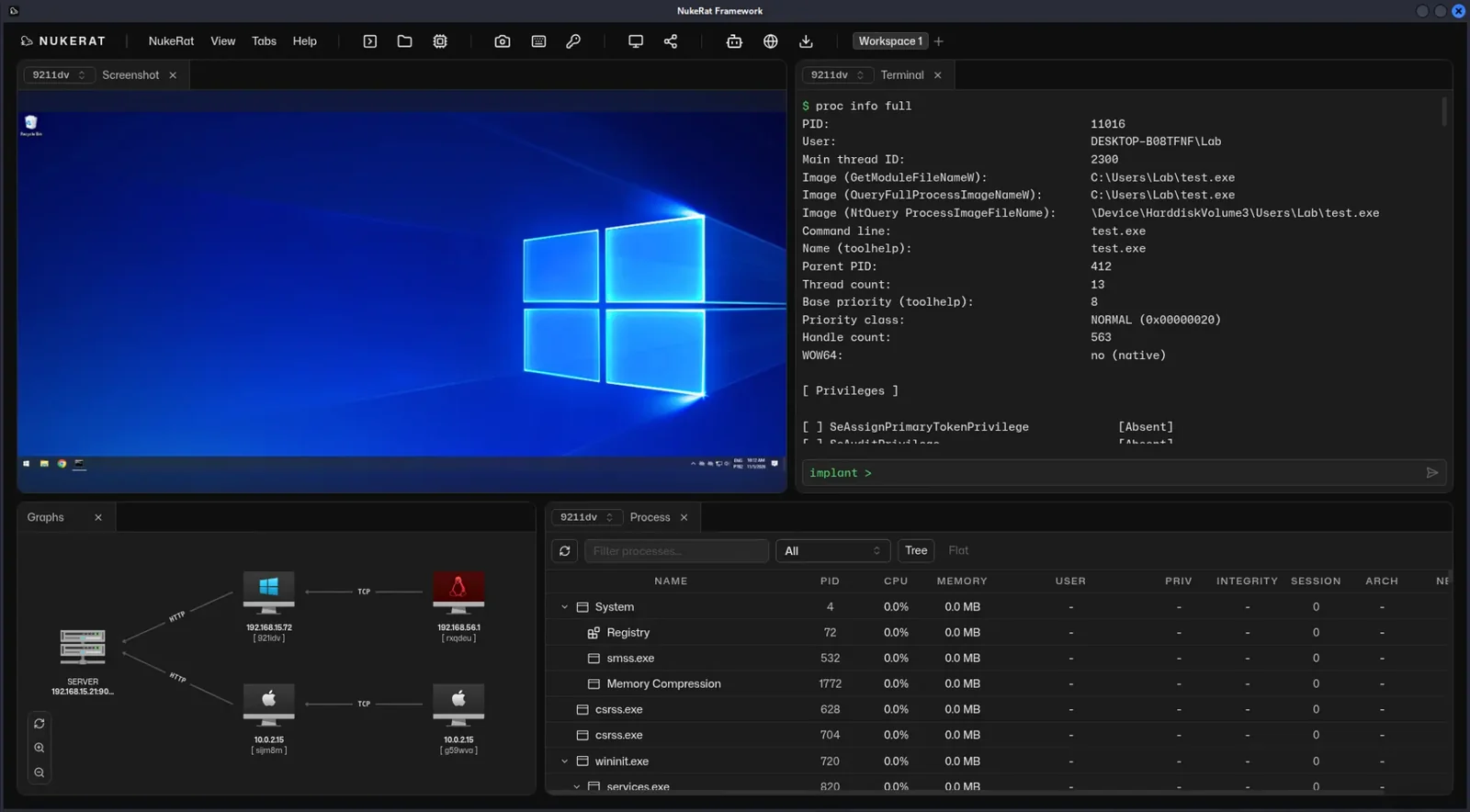
NukeRat is a post-exploitation framework and C2 for advanced red team operations. The README centers on an armory of BOF and .NET utilities, implants for Windows, Linux, and macOS, and reports of commands, IOCs, and compromised hosts.
It comes with runtime evasion containing indirect syscalls, stack spoofing, and a sleep mask.
Repository: https://github.com/nukeratframework/nukerat
[!NOTE] Click below to see more details.
| Repository | nukeratframework/nukerat |
| Primary language | TypeScript, as reported by GitHub. The tree also contains a Python entrypoint, a server, a client, and implants. |
| License | GPL-3.0. The README also names MIT pieces (SGN, Nim crypt utils) and a GPLv3 LOLBAS reference copy. |
| Created | 6 November 2026 |
| Last push | 14 November 2026 |
| Stars / forks | 263 / 65 |
| Docs languages | English, Spanish, Korean, Simplified Chinese, Russian, Persian, Japanese |
Docs · Armory · Disclaimer. The docs home describes BOFs and .NET tools from the official repository, run from the client, plus stageless and loader builds. Repository topics also include active-directory, edr-bypass, and lateral-movement. Those three stay topics. The feature table gives them no row, so they are not categories.
| Category | In the project's words | Source |
|---|---|---|
| Armory | More than 550 adapted BOF and .NET utilities. | README |
| External-platform C2 | Custom C2 with external platforms. The examples named are Telegram and Discord. | README |
| Runtime evasion | A feature row under that name. | README |
| Injections | A feature row for allocation modes. | README |
| Living off the land | Integration with more than 240 native Windows binaries, cited as LOLBAS. | README |
| Static evasion | A feature row for PE customization. | README |
| Implants | Cross-platform: Windows, Linux, and macOS, with ARM support. | README |
| Linux BOF | Linux implants described as compatible with Linux BOFs. | README |
| AI | Integration with agents. The examples named are DeepSeek and local agents. | README |
| Reports | Executed commands, IOCs, and compromised hosts. | README |
| Client | The docs say the armory tools are ready to run from the client. The README includes a gallery. | Docs |
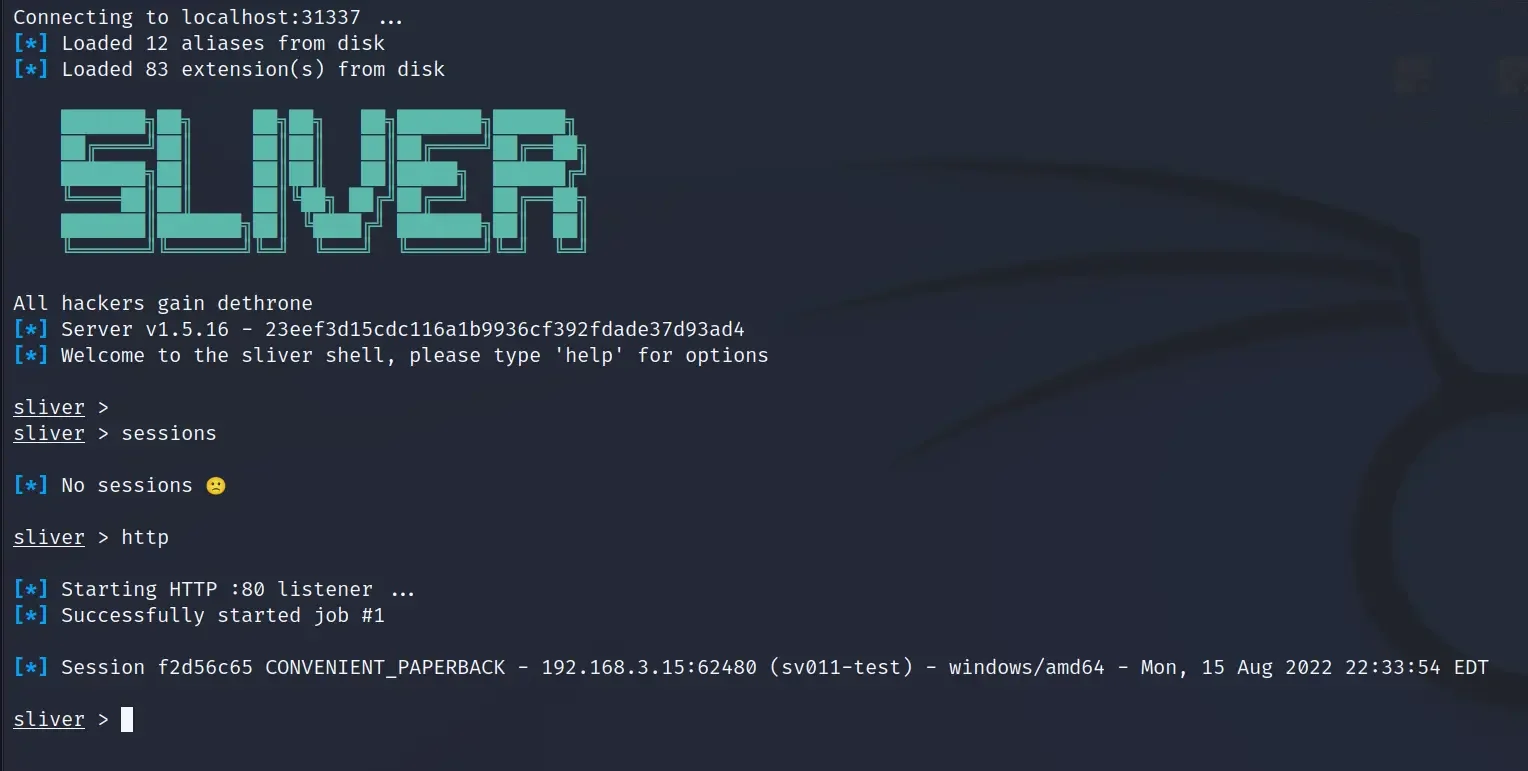
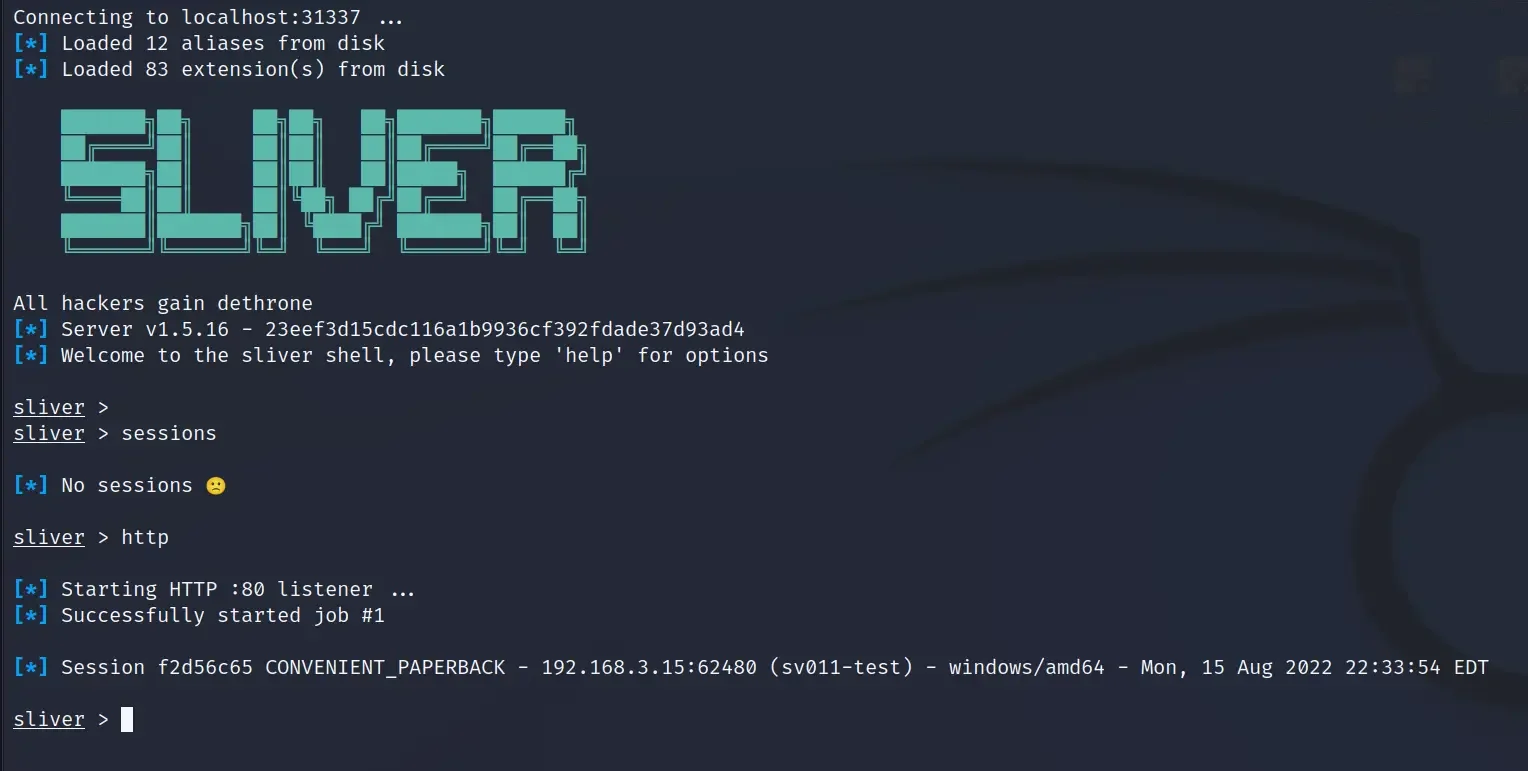
Sliver is Bishop Fox's framework for adversary emulation and authorized red team work. The server and client run on Windows, Linux, and macOS, and the implants officially support those same three, with C2 over mutual TLS, WireGuard, HTTP(S), and DNS.
[!NOTE] Click below to see more details.
| Primary language | Go |
| License | GPL-3.0 |
| Last push | 14 November 2026 |
| Stars / forks | 12,337 / 1,674 |
The README says implants are dynamically compiled with unique per-binary asymmetric encryption keys, and that they support native and shellcode payloads, userspace reflective loading, built-in shellcode encoding, and BOF/COFF execution on amd64 and arm64.
| Category | In the project's words | Source |
|---|---|---|
| Transports | Mutual TLS, WireGuard, HTTP(S), and DNS. | README |
| Implants | Windows, Linux, and macOS. BOF/COFF on amd64 and arm64 for those three. | README |
| Per-build keys | Unique per-binary asymmetric encryption keys. | README |
| Payload forms | Native and shellcode payloads, userspace reflective loading, built-in shellcode encoding. | README |
| Armory | The Armory page describes a package manager for aliases and extensions, including BOFs and .NET tooling. The armory index lists 22 aliases and 157 extensions. Aliases wrap .NET assemblies or shared libraries. Extensions are BOFs or native libraries. Packages install on the client and are not shared across operators in multiplayer. Signed packages come from the Sliver Armory GitHub organization. | Docs |
| AI store | The same Armory page describes a separate server-side store for an AI agent, distinct from the client Armory. | Docs |
| Adversary emulation | The README's own name for the project. | README |
Havoc is a malleable post-exploitation command-and-control framework by @C5pider. The client is a cross-platform Qt UI, the teamserver is Go, and the flagship agent is Demon, written in C and assembly. GitHub marks the repository archived.
[!NOTE] Click below to see more details.
Site: havocframework.com. Wiki: Havoc wiki.
| Primary language | Go |
| License | GPL-3.0 |
| Last push | 18 December 2025 |
| Stars / forks | 8,501 / 1,272 |
| Repository state | Archived, in the GitHub API. |
The teamserver is described as multiplayer, with payload generation, HTTP/HTTPS listeners, customizable C2 profiles, and External C2. Demon's README section lists SMB support, a token vault, and built-in post-exploitation commands, and it also lists sleep obfuscation, x64 return-address spoofing, indirect syscalls, and AMSI/ETW patching via hardware breakpoints.
The same README states that Havoc was not developed to be evasive. It was designed to be malleable and modular, so an operator can add custom features or modules. That sentence decides the category. Evasion is not one of them.
