
Skip to content
KitploitKITPLOIT
ToolsExploitsBlog
Log in
Submit
ToolsExploitsBlog
Submit

Hacking, PenTest, and Cybersecurity Tools for Your Security Arsenal!

Kitploit is a directory of hacking, cybersecurity, and pentesting tools. Discover the latest project updates to find vulnerabilities, analyze systems, automate testing, and strengthen your security.

··Feeds·Contact·Privacy·© 2026 Kitploit

Tool Directory

Categories

View all categories
Loading categories
CVE-2025-24071-PoC — CVE-2025-24071 Proof Of Concept | Kitploit
Tools/GitHubGitHub/looky243/cve-2025-24071-poc
Password CrackingReconnaissanceVulnerability AnalysisExploitationData ExfiltrationInformation Gathering
GitHublooky243/cve-2025-24071-poc

CVE-2025-24071-PoC

CVE-2025-24071 Proof Of Concept

View Repository
3141 year agoNot yet reviewed

Most Popular

View all →

Discover the most used tools by our community.

Explore all tools

Browse our collection of tools

View all tools →
Share

CVE-2025-24071 - Windows File Explorer Spoofing Vulnerability Proof of Concept

Overview

CVE-2025-24071 is a spoofing vulnerability in Windows File Explorer that allows an unauthenticated attacker to expose sensitive information over a network. The vulnerability arises due to the implicit trust and automatic parsing behavior of .library-ms files in Windows Explorer. By crafting malicious archive files (e.g., RAR/ZIP) containing .library-ms files with embedded SMB paths, an attacker can trigger an SMB authentication request upon extraction, potentially exposing the user's NTLM hash.

  • CVE ID: CVE-2025-24071
  • Severity: Medium (CVSS v3.1 Base Score: 6.5)
  • Vector: AV:N/AC:L/PR:N/UI:R/S:U/C:H/I:N/A:N
  • CWE: CWE-200 - Exposure of Sensitive Information to an Unauthorized Actor
  • Published: March 11, 2025
  • Last Updated: April 16, 2025

Affected Systems

The vulnerability affects the following Windows versions:

  • Windows 10 (versions 1607, 1809, 21H2, 22H2)
  • Windows 11 (versions 22H2, 23H2, 24H2)
  • Windows Server 2012 R2
  • Windows Server 2016
  • Windows Server 2019
  • Windows Server 2022
  • Windows Server 2025

For a comprehensive list of affected systems, refer to the Microsoft Security Update Guide.

Exploitation Details

An attacker can exploit this vulnerability by:

  1. Crafting a .library-ms file with a malicious SMB path.
  2. Embedding the .library-ms file within a RAR or ZIP archive.
  3. Distributing the archive to the target user.
  4. Upon extraction, Windows Explorer automatically processes the .library-ms file, initiating an SMB authentication request to the attacker's server.
  5. This process can lead to the exposure of the user's NTLM hash.

This method leverages the behavior of Windows Explorer in handling .library-ms files and the SMB protocol's authentication mechanism.

Proof of Concept

This repository contains a PoC demonstrating the vulnerability, in this case uplaoding the file via smb:

  • exploit.py: Script to generate a malicious .library-ms file and package it into a ZIP archive.

Usage:

python exploit.py --ip $IP --filename payload --share share-name
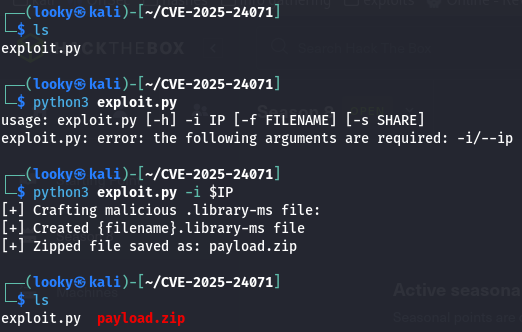
First, we craft the payload using our exploit.py

image

On another tab we setup our listener which will receive the hash

image

We then Upload the file an wait for someone to open it

poc

Finally, after being opened we receive the user's hash

poc

Download Tool