 loerting/threadtear
Multifunctional java deobfuscation tool suite



Threadtear is a multifunctional deobfuscation tool for java. Android application support is coming soon (Currently working on a dalvik to java converter).
Suitable for easier code analysis without worrying too much about obfuscation.
Even the most expensive obfuscators like ZKM or Stringer are included. For easier debugging there are other tools included.
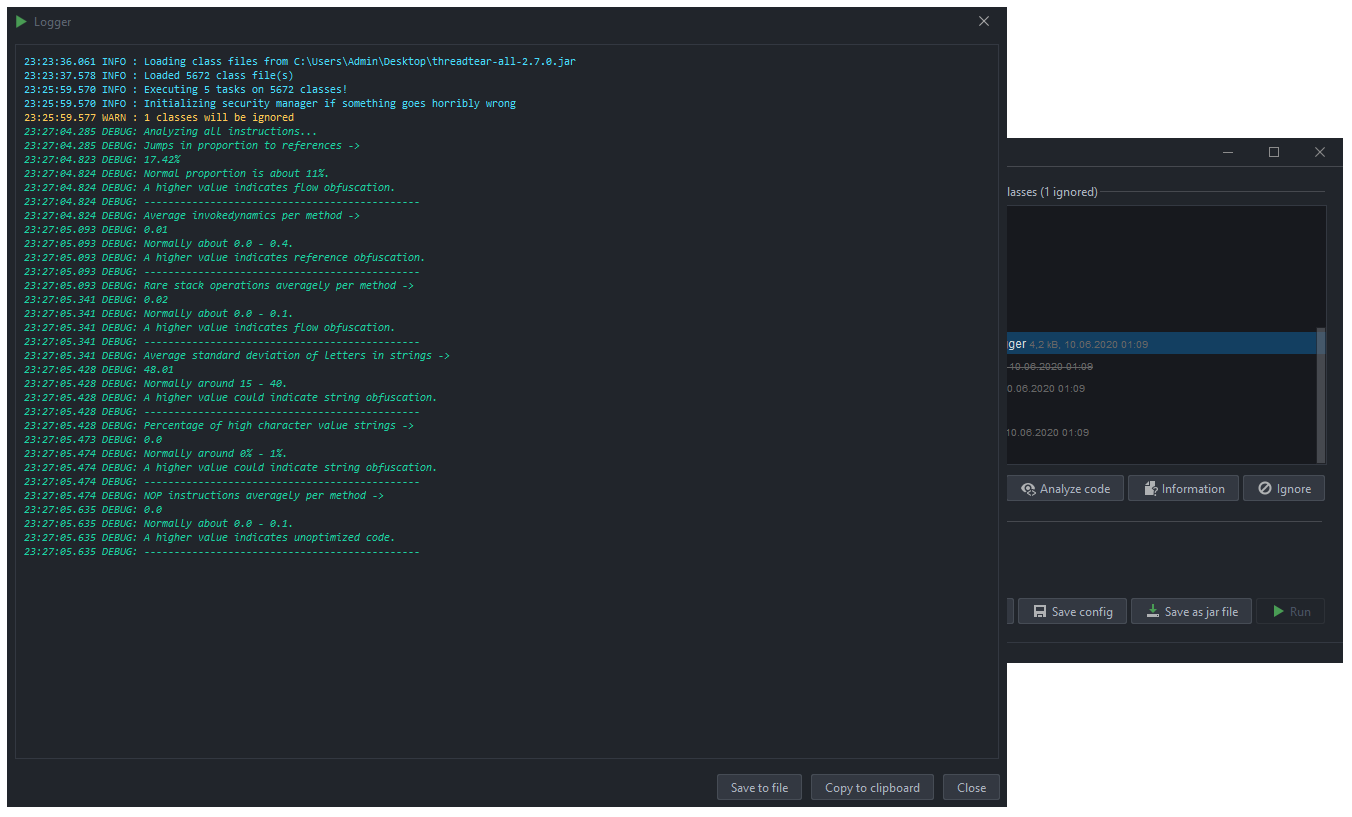
Insert debug line numbers to better understand where exceptions originate, or add .printStackTrace() to try catch blocks without re-compiling your code.
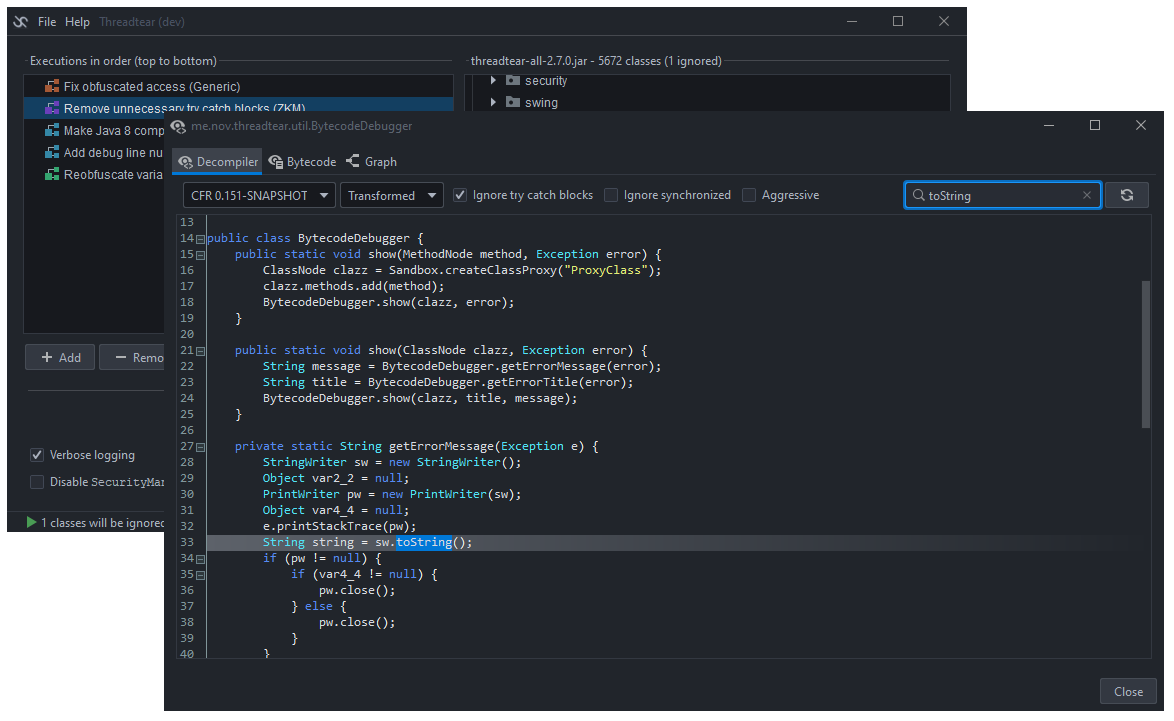
Reverse compatibility is not a problem anymore, if no version specific methods are used. Analyze code flow in a graph, to better understand algorithms.
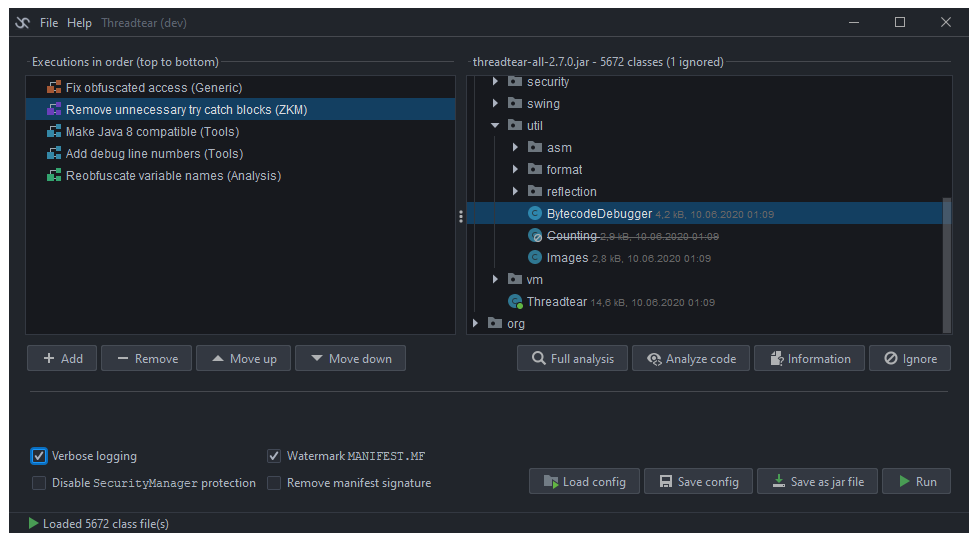
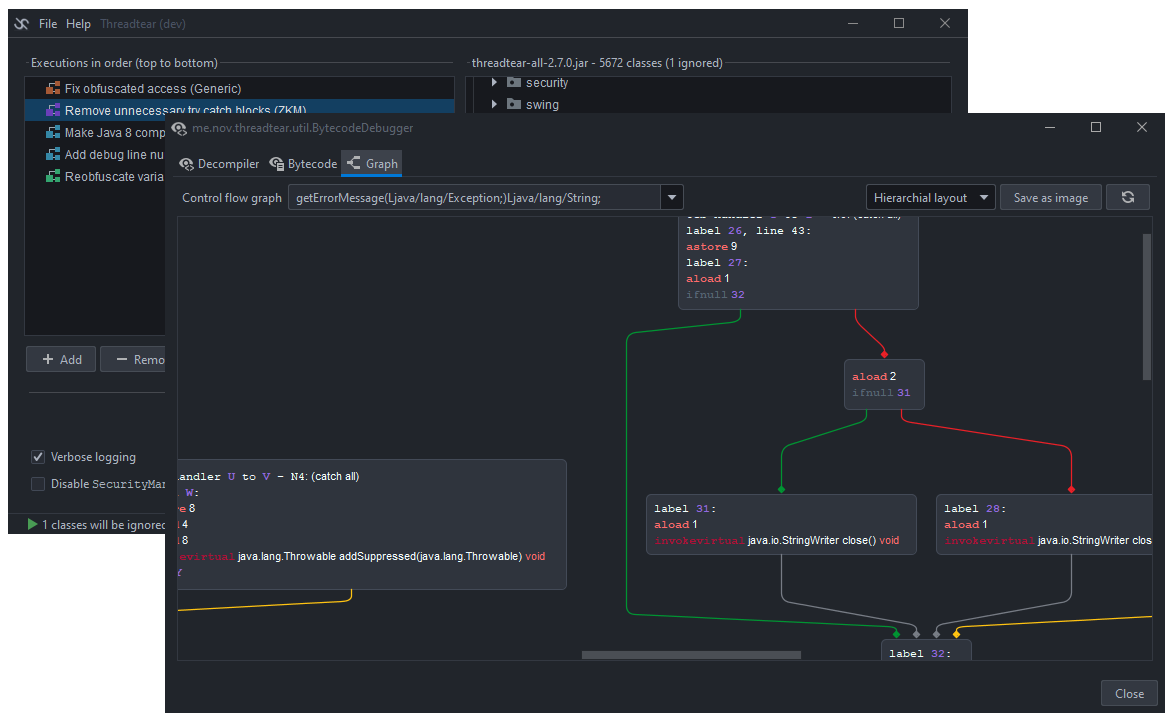
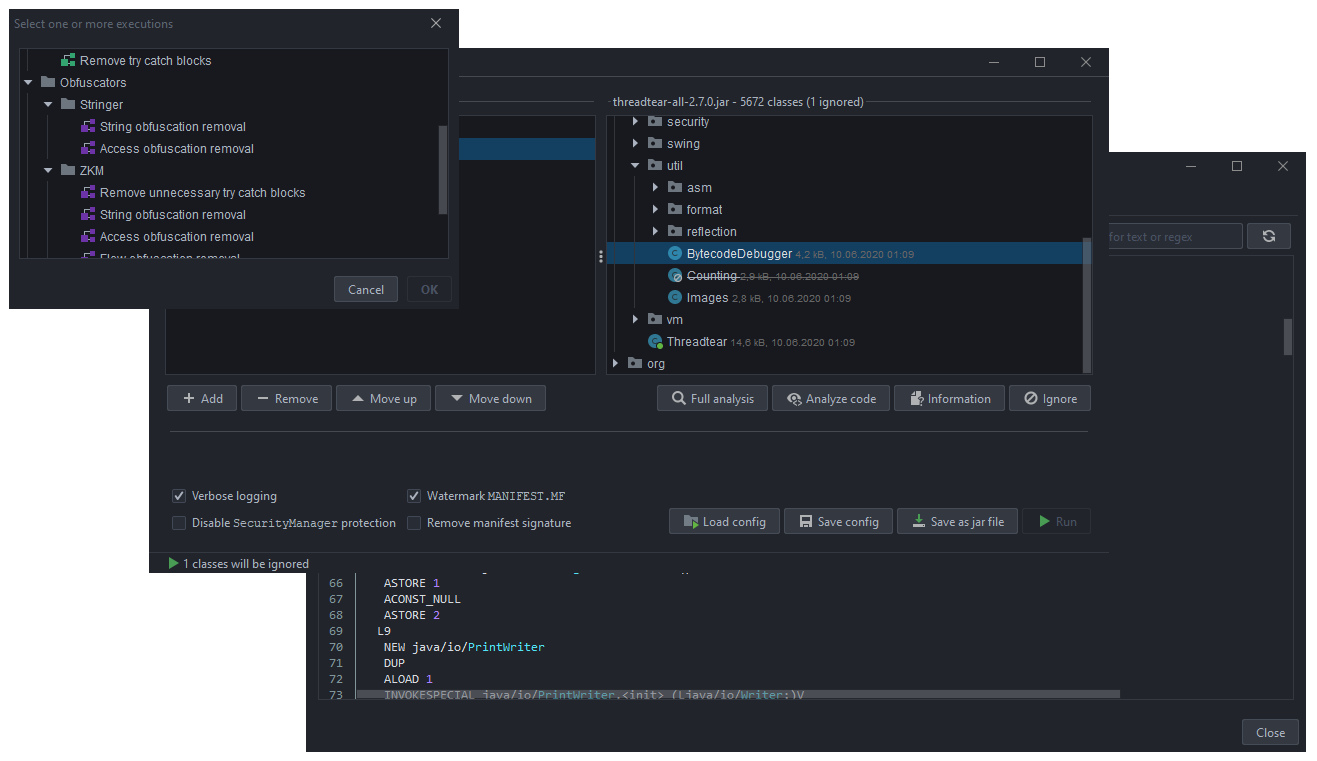
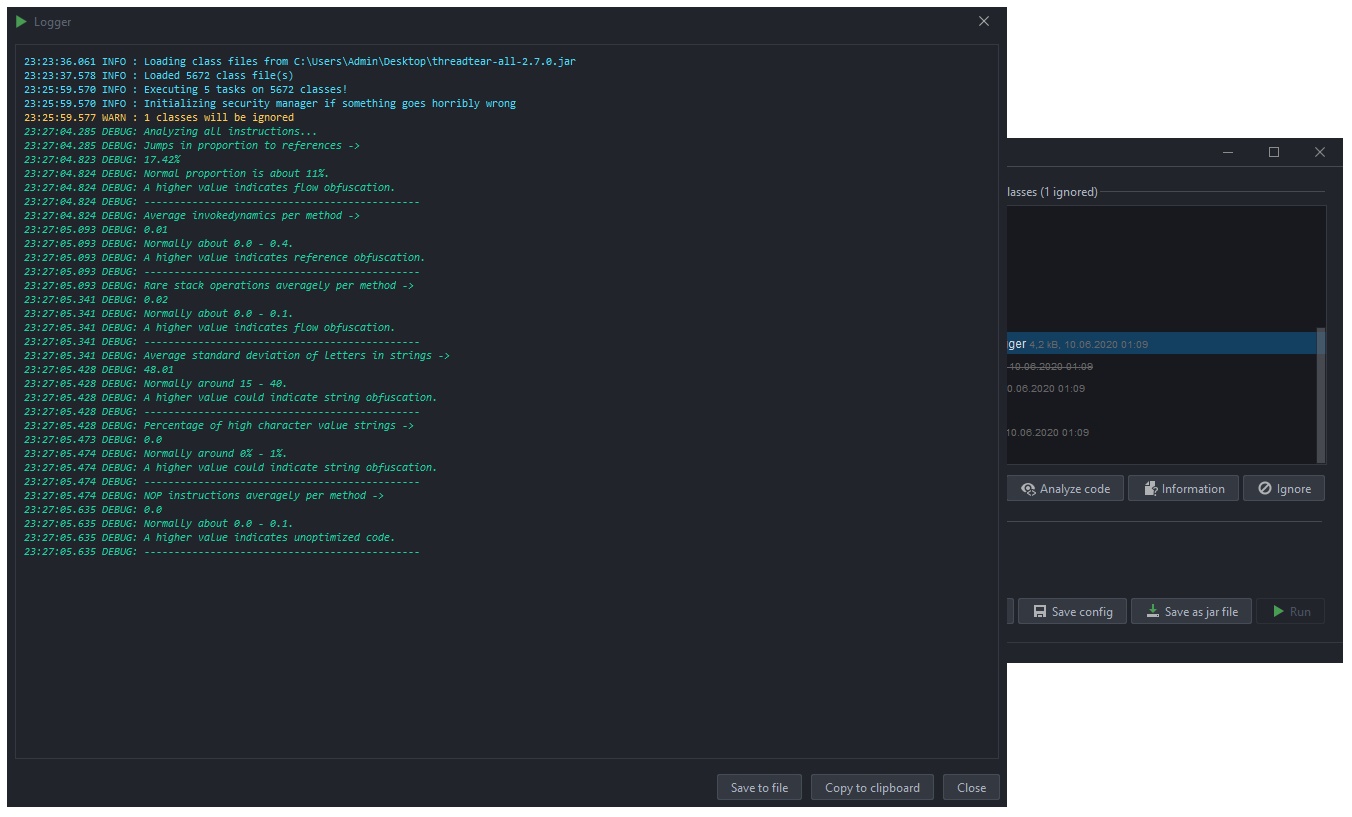
An "execution" is a task that is executed and modifies all loaded class files. There are multiple types of executions, varying from bytecode cleanup to string deobfuscation. Make sure to have them in the right order. Cleanup executions for example should be executed at last, but also can help other executions if executed first. If you are ready, click on the "Run" button, and they will be executed in order.
Use this tool at your own risk. Some executions use implemented ClassLoaders to run code from the jar file. An attacker could tweak the bytecode so that malicious code could be executed.
Affected executions use the class me.nov.threadtear.asm.vm.VM.
These are mostly used for decrypting string or resource / access obfuscation, as it is much easier to execute the decryption methods remotely.
Threadtear tries its best to protect you from malicious calls (arbitrary code executions) using its own SecurityManager, but there is no guarantee.
Especially with deobfuscators like for ZKM or Stringer you have to be very careful, as reflection has to be allowed, otherwise they would not function.
If you discover an ACE, please open an issue. I will try to fix them as soon as possible.
First, run gradle build, then gradle fatJar. In builds/libs a runnable jar file should then have been created. If you don't want to download the repo, you can use the latest release.
You can easily create your own execution task. Just extend me.nov.threadtear.execution.Execution:
public class MyExecution extends Execution {
	public MyExecution() {
		super(ExecutionCategory.CLEANING /* category */, "My execution" /* name */,
				"Executes something" /* description, can use html */);
	}
	/**
	* This method is invoked when the user clicks on the Run button
	* @return true if success, false if failure
	*/
	@Override
	public boolean execute(Map<String, Clazz> classes, boolean verbose) {
		classes.values().stream().map(c -> c.node).forEach(c -> {
			//transform the classes here using the tree-API of ASM
		});
		return false;
	}
}
To load ClassNodes at runtime, use the me.nov.threadtear.asm.vm.VM class and implement me.nov.threadtear.asm.vm.IVMReferenceHandler:
public class MyExecution extends Execution implements IVMReferenceHandler {
	public MyExecution() {
		super(ExecutionCategory.GENERIC, "My execution", "Loads ClassNodes at runtime");
	}
	@Override
	public boolean execute(Map<String, Clazz> classes, boolean verbose) {
		classes.values().stream().map(c -> c.node).forEach(c -> {
			VM vm = VM.constructVM(this);
			//transform bytecode to java.lang.Class
			Class<?> loadedClass = vm.loadClass(c.name.replace('/', '.'), true);
			//do stuff with your class here
			loadedClass.getMethods()[0].invoke(...);
			return true;
		});
	}
	/**
	* Will get invoked by VM, when VM.loadClass is called
	*/
	@Override
	public ClassNode tryClassLoad(String name) {
		//try to find the class to be loaded in open jar archive
		return classes.containsKey(name) ? classes.get(name).node : null;
	}
}
Using the ConstantTracker (me.nov.threadtear.analysis.stack.ConstantTracker) you can analyze methods and keep track of non-variable stack values.
If for example iconst_0 is pushed to the stack, the value itself isn't lost like in the basic ASM analyzer, and you can use it to predict things later on in the code.
public class MyExecution extends Execution implements IConstantReferenceHandler {
	public MyExecution() {
		super(ExecutionCategory.GENERIC, "My execution", "Performs stack analysis and replaces code.");
	}
	@Override
	public boolean execute(Map<String, Clazz> classes, boolean verbose) {
		classes.values().stream().map(c -> c.node).forEach(this::analyzeAndRewrite);
		return true;
	}
	public void analyzeAndRewrite(ClassNode cn) {
		cn.methods.forEach(m -> {
			// this analyzer keeps known stack values, e.g. can be useful for jump prediction
			Analyzer<ConstantValue> a = new Analyzer<ConstantValue>(new ConstantTracker(this, Access.isStatic(m.access), m.maxLocals, m.desc, new Object[0]));
			try {
				a.analyze(cn.name, m);
			} catch (AnalyzerException e) {
				logger.severe("Failed stack analysis in " + cn.name + "." + m.name + ":" + e.getMessage());
				return;
			}
			Frame<ConstantValue>[] frames = a.getFrames();
			InsnList rewrittenCode = new InsnList();
			Map<LabelNode, LabelNode> labels = Instructions.cloneLabels(m.instructions);
