
Skip to content
KitploitKITPLOIT
ToolsBlog
Submit
ToolsBlog
Submit

Hacking, PenTest, and Cybersecurity Tools for Your Security Arsenal!

Kitploit is a directory of hacking, cybersecurity, and pentesting tools. Discover the latest project updates to find vulnerabilities, analyze systems, automate testing, and strengthen your security.

··Feeds·Contact·Privacy·© 2026 Kitploit

Tool Directory

Categories

View all categories
Loading categories
ldapnomnom — Quietly and anonymously bruteforce Active Directory usernames at insane speeds from Domain Controllers by (ab)using LDAP Ping requests (cLDAP) | Kitploit
Tools/GitHubGitHub/lkarlslund/ldapnomnom
ReconnaissancePassword AttacksInformation GatheringAuthentication
GitHublkarlslund/ldapnomnom

ldapnomnom

Quietly and anonymously bruteforce Active Directory usernames at insane speeds from Domain Controllers by (ab)using LDAP Ping requests (cLDAP)

View Repository
1.1k931 year agoReviewed by Kitploit

Most Popular

View all →

Discover the most used tools by our community.

Explore all tools

Browse our collection of tools

View all tools →
Share

LDAP Nom Nom

Quietly and anonymously bruteforce Active Directory usernames at insane speeds from Domain Controllers by (ab)using LDAP Ping requests (cLDAP)

Looks for enabled normal user accounts. No Windows audit logs generated. High speed ~ up to 50K/sec per server - go way beyond that with multiple servers in parallel!

GitHub all releases GitHub Workflow Status

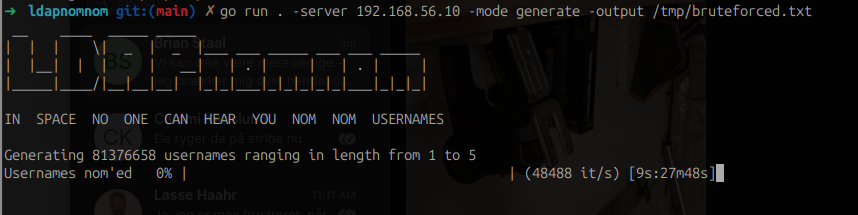
Highspeed bruteforcing using generated usernames

  • Tries to autodetect DC from environment variables on domain joined machines or falls back to machine hostname FQDN DNS suffix
  • Reads usernames to test from stdin (default) or file
  • Outputs to stdout (default) or file
  • Parallelized, multiple connections to multiple servers (defaults to 8 servers, 8 connections per server)
  • Shows progressbar if you're using both input and output files
  • Evasive maneuvers: Use --throttle 20 for a 20ms delay between each request (slows everything down to a crawl)
  • Evasive maneuvers: Use --maxrequests 1000 to close connection and reconnect after 1000 requests in each connection (try to avoid detection based on traffic volume)

Download auto built binaries from releases or build and install with this Go command

root@kitploit:~
go install github.com/lkarlslund/ldapnomnom@latest

Usage

root@kitploit:~
ldapnomnom [--server dc1.domain.suffix[,dc2.domain.suffix] | --dnsdomain domain.suffix] [--port number] [--tlsmode notls|tls|starttls] [--input filename] [--output filename] [--parallel number-of-connections] [--maxservers number-of-servers] [--maxstrategy fastest|random] [--throttle n] [--maxrequests n]

Show version

root@kitploit:~
ldapnomnom version

Bruteforcing examples

Connect to up to 32 servers from contoso.local with 16 connections to each - FAAAAAAAST

root@kitploit:~
ldapnomnom --input 10m_usernames.txt --output multiservers.txt --dnsdomain contoso.local --maxservers 32 --parallel 16

Connect to one named server with 4 connections

root@kitploit:~
ldapnomnom --input 10m_usernames.txt --output results.txt --server 192.168.0.11 --parallel 4

Look for username lists to feed into this elsewhere - for instance the 10M list from here

Extract rootDSE attributes

You can also use LDAP Nom Nom to dump attributes from the rootDSE object, by adding the "--dump" option.

Connect to all servers you can find, and output all readable attributes to JSON:

root@kitploit:~
ldapnomnom --output rootDSEs.json --dump

Detection

  • Nothing native in the Windows event logs are generated (tested on Windows 2016 / 2019)
  • Microsoft Defender for Identity 2.228 (February 2024) adds event ID 2437 and is triggered if the number of failed requests (i.e. wrong guesses at usernames) crosses an unknown threshold
  • Custom network level monitoring (unencrypted LDAP analysis or traffic volume for LDAPS) can also be used, though it's not reliable

Mitigation

  • None, this is part of the dcLocator stuff
  • Rename your administrator account
  • Audit accounts for having same password as the username
  • Prevent kerberoasting by removing SPNs on as many accounts as possible
  • Use long and complex passwords on accounts with SPNs

History

During a discussion on Twitter about locating Kerberos services, someone hinted the existance of LDAP Ping requests. They're documented on Microsofts Open Specifications Pages, and it contains pseudo code for how you initiate a LDAP Ping, what parameters it takes and the data returned. It immediately seemed obvious that there is an information leak here that can be abused.

After having released the tool, I can see I'm not the only one to spot this "mistake" which is clearly still around for historic backwards compatibility reasons.

If you want to avoid network level detection as an attacker you should use TLS on port 636 (tool defaults to unencrypted LDAP on port 389).

If you like Active Directory you might also like my attack graph tool Adalanche

Download Tool