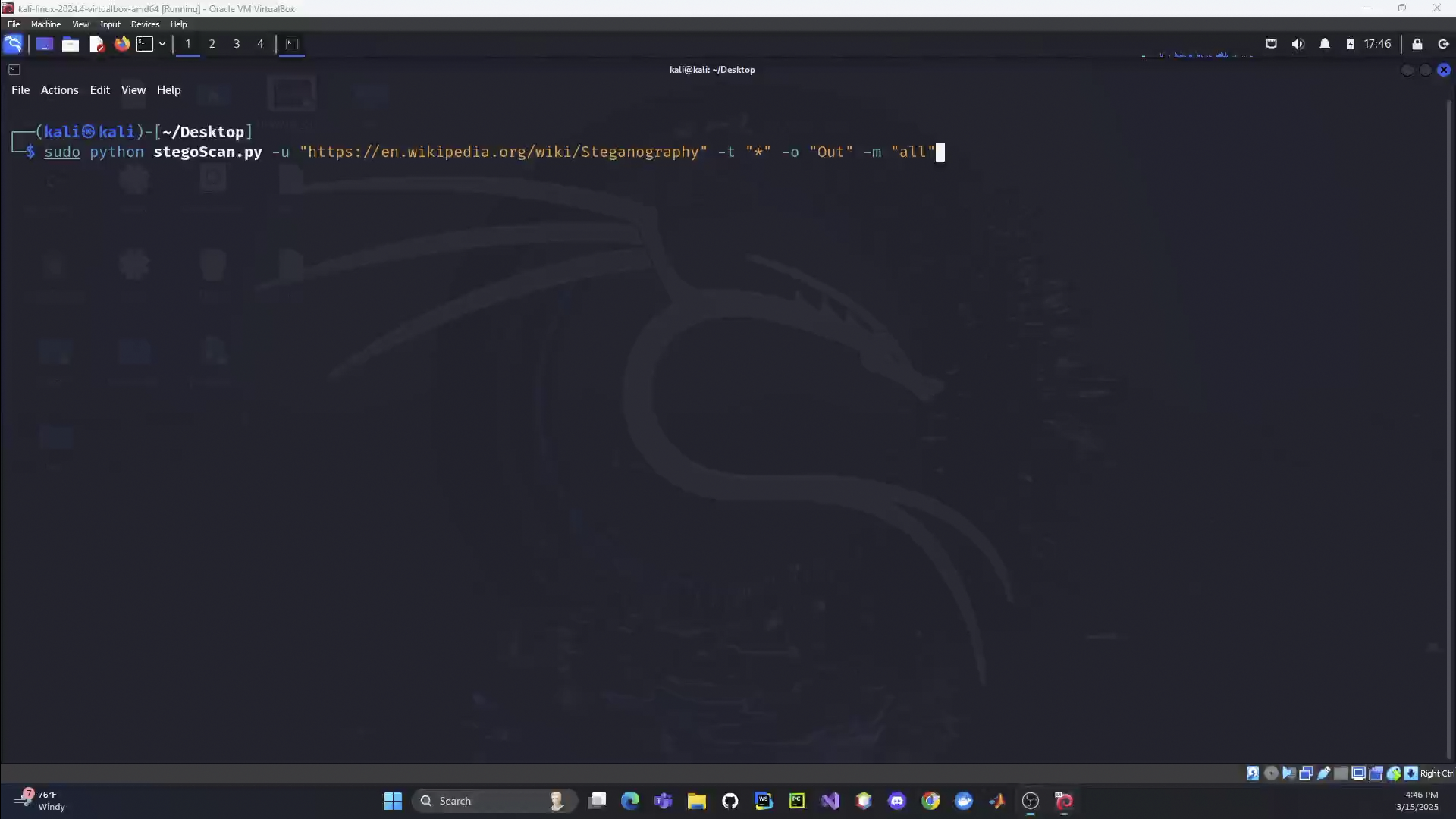

Automated steganography detection tool that scans websites, web servers, and local directories using AI-driven object/text recognition and deep file analysis across images, audio, PDFs, and binaries.
StegoScan.py is a powerful, next-generation tool for automated steganography detection in websites, web servers, and local directories, integrating AI-driven object and text recognition with deep file analysis. Unlike traditional steganography detection tools that focus on a limited set of file types or require manual processing, StegoScan.py is designed for comprehensive, automated scanning—scraping websites, dissecting embedded files, and detecting hidden messages across a broad range of formats, including PNG, JPG, BIN, PDF, DOCX, WAV, and MP3.
The tool boasts website and web server scanning capabilities, making it invaluable for security researchers monitoring illicit data exchanges or law enforcement tracking cybercriminals. A single command can analyze entire domains or IP ranges, retrieving and inspecting suspicious media and documents for hidden communications. Whether it’s detecting covert exchanges in dark web marketplaces, identifying embedded propaganda in misinformation campaigns, or revealing concealed instructions within terrorist networks, StegoScan.py offers unparalleled visibility into steganographic threats.
One of its steganography detection improvements is the integration of AI models such as YOLO and TrOCR for object and text detection within images and audio files that previously had to be manually verified. Traditional OCR (Optical Character Recognition) tools are notoriously unreliable, often failing to recognize even basic text hidden in images due to noise, distortions, or non-standard fonts. StegoScan.py overcomes this by offering optional AI-enhanced text detection, dramatically improving the ability to extract hidden messages from images, scanned documents, and even spectrograms of audio files. This is a game-changer for forensic analysts, cybersecurity professionals, and law enforcement agencies who need high-confidence text extraction from compromised media.
Another novel feature is deep file extraction—a critical advancement in steganalysis. StegoScan.py doesn't just scan the surface of PDFs and DOCX files; it goes further, extracting and analyzing embedded files within them. This means steganographic content hidden inside attachments or deeply nested documents can be uncovered, addressing a major blind spot in traditional scanning tools.
By combining multiple steganalysis techniques into a unified test, StegoScan.py provides a detailed and multi-layered analysis of files, offering security teams, digital forensics experts, and cybersecurity researchers a cutting-edge solution to an evolving digital threat. As steganography techniques become more sophisticated, traditional tools fall short—StegoScan.py ensures organizations stay ahead of bad actors by detecting what others miss. For a more detailed description of steganography and how it's used review the section titled "Background and Rationale of StegoScan".
StegoScan kicks off by setting up its own dedicated Python environment, creating a local workspace, and installing all the necessary tools and packages to power its suite of analysis features. Once everything is in place, it verifies any provided IP addresses (if selected) to ensure they belong to active web servers.
With the targets confirmed, StegoScan gets to work—scraping all available files of the specified types from the given IP addresses and URLs. If a local directory is selected, it gathers files from there as well. Every collected file is neatly organized by type and stored in the chosen directory.
Next, StegoScan prepares a results directory and launches its suite of steganography detection tests. For greater detail into what tests are available review the section titled "Steganography Test". As hidden data is uncovered, files are categorized and stored in subfolders corresponding to the specific test that identified them. Once all tests have run their course, StegoScan finalizes the process and concludes execution.
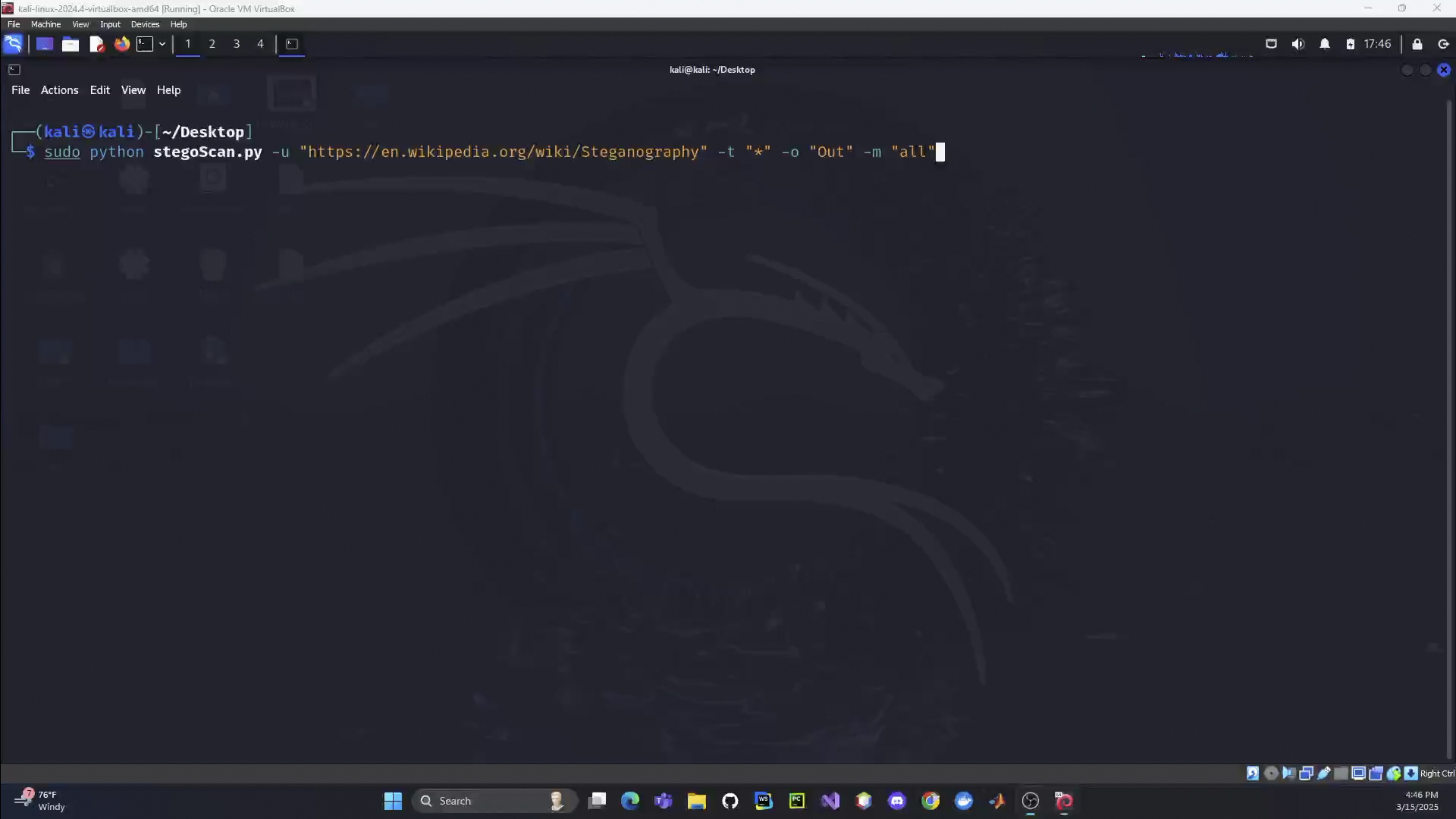
Website and Web Server Scanning Abilities – Unlike conventional steganalysis tools that focus only on static files, StegoScan.py actively scans entire websites, IP ranges, and web servers for hidden messages. Whether investigating dark web marketplaces, cybercriminal forums, or compromised corporate sites, it automates the entire process, of retrieving and analyzing files for embedded steganographic content. No more manual downloading and sorting—StegoScan does it all for you!
AI Object and Text Detection on Images and Audio Files – Traditional OCR (Optical Character Recognition) is unreliable, often failing on distorted text, non-standard fonts, or noisy images. StegoScan.py integrates advanced AI models like YOLO and TrOCR to enhance text extraction and object detection, revealing hidden messages that standard OCR completely misses. Even audio spectrograms can be scanned for steganographic content, offering insight into hidden data exchanges.
Deep File Extraction in PDFs and DOCX Files – Most tools barely scratch the surface when analyzing document files, but StegoScan.py digs deeper! It automatically extracts embedded files hidden within PDFs, DOCX documents, and other complex formats, analyzing them for steganographic data. This eliminates a major blind spot—hidden payloads concealed inside innocent-looking documents are no longer safe from detection. No more overlooked hidden files—if it's there, StegoScan will find it.
Combined Tool Test for Detailed File Analysis – StegoScan.py isn't just a one-trick pony. It combines multiple steganography detection methods into a single, powerful test, ensuring layered, thorough analysis of every scanned file. Rather than relying on a single detection technique (which can be easily evaded), StegoScan cross-checks files using multiple methods to maximize detection accuracy.
Automated and Optimized for Linux – Tired of wrestling with dependencies? StegoScan.py is plug-and-play. It automatically installs what it needs, ensuring a smooth, efficient scanning process without manual setup. Built for speed and efficiency, it runs seamlessly on Linux, making it the perfect tool for cybersecurity professionals, penetration testers, and forensic analysts.
Web Scraping & File Downloading – Automates the extraction and downloading of specific file types from URLs, IP addresses, and IP ranges, enabling large-scale web content analysis.
Local Directory Extraction & Testing – Scans local directories for steganographic content, identifying hidden messages within stored files.
Image Processing & Steganography Analysis – Performs in-depth steganographic testing on images, using multiple detection techniques to uncover hidden data.
Embedded File Extraction from PDFs & DOCX – Extracts and analyzes images and embedded files from PDF and DOCX documents, a critical step in identifying deeply hidden steganographic content.
Steganographic Detection Tools – Integrates stegano, stegdetect, and zsteg for multi-layered detection of concealed messages within image files.
AI-Powered Object & Text Detection – Enhances traditional detection methods with AI-driven analysis:
YOLOv8 for high-accuracy object detection, identifying embedded images, and symbols.
TrOCR for advanced text recognition, extracting text from handwritten, stylized, or distorted fonts with improved accuracy over standard OCR tools.
Basic Malware & ELF File Analysis – Performs preliminary security analysis on ELF binaries and other executables, helping to identify potential malware threats.
Audio & Binary File Analysis – Analyzes WAV and MP3 files for hidden steganographic data, including messages embedded in spectrograms or inaudible frequency ranges.

